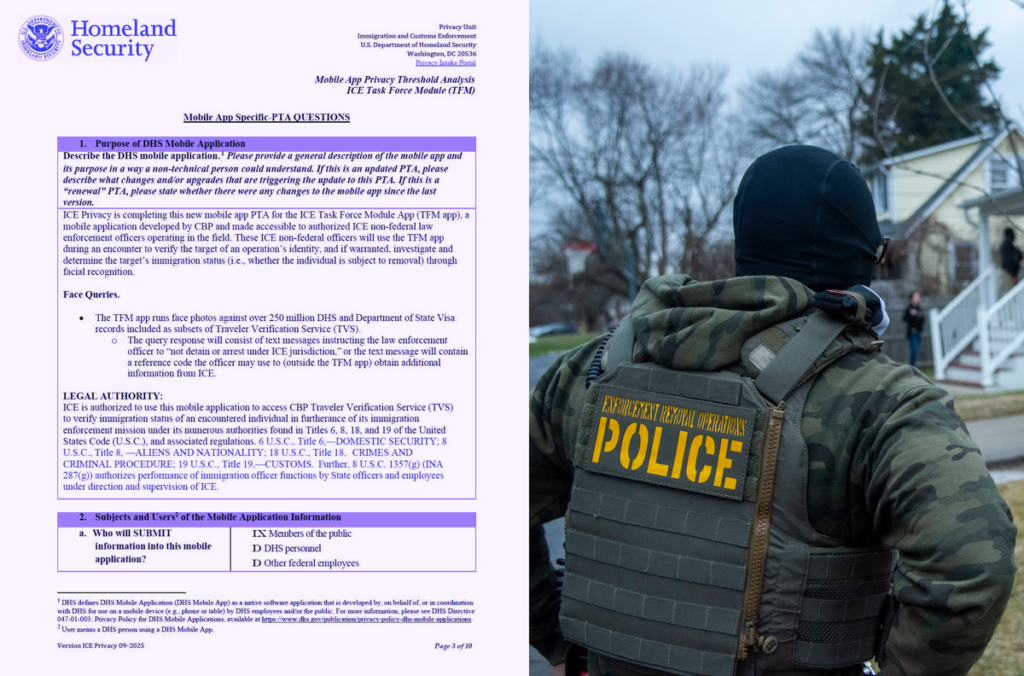
For creators, artists, and anyone else who values their privacy, the landscape is darkening. Immigration and Customs Enforcement (ICE) is preparing to hand over a powerful facial recognition tool to local police across the nation. According to an internal Department of Homeland Security (DHS) document obtained by 404 Media, this app will query a massive repository of hundreds of millions of images to instantly verify a person’s immigration status.
A dangerous escalation in surveillance
This move represents a significant step up in the technology deployed to execute the Trump administration’s mass deportation agenda. ICE and Customs and Border Protection (CBP) are already using Mobile Fortify on U.S. streets. Officers point their phone cameras at individuals, and the system returns biographical data and flags whether an order of removal exists. That tool has already been shown to make errors and has been used against American citizens.
With this new application, that capability shifts from federal agents to local officers who are effectively acting as extensions of ICE.
“This embarrassingly cursory document utterly fails to acknowledge the harms that will flow from putting a flawed face recognition app in the hands of many thousands of local police.”
Nate Wessler, deputy director with the American Civil Liberties Union (ACLU) Speech, Privacy, and Technology Project, told 404 Media that sending untrained police out to indiscriminately scan faces with a system known for false matches is a recipe for disaster. He added that saving this data for 15 years and forcing officers to make immigration decisions undermines community safety efforts.
The document outlines the specific workflow. The app, named the “ICE Task Force Module App (TFM App),” is designed for members of the 287(g) program. When an officer scans a face, the system runs it against a database of over 250 million DHS and State Department records. It then instructs the officer either not to detain the individual or provides a reference code to investigate further.
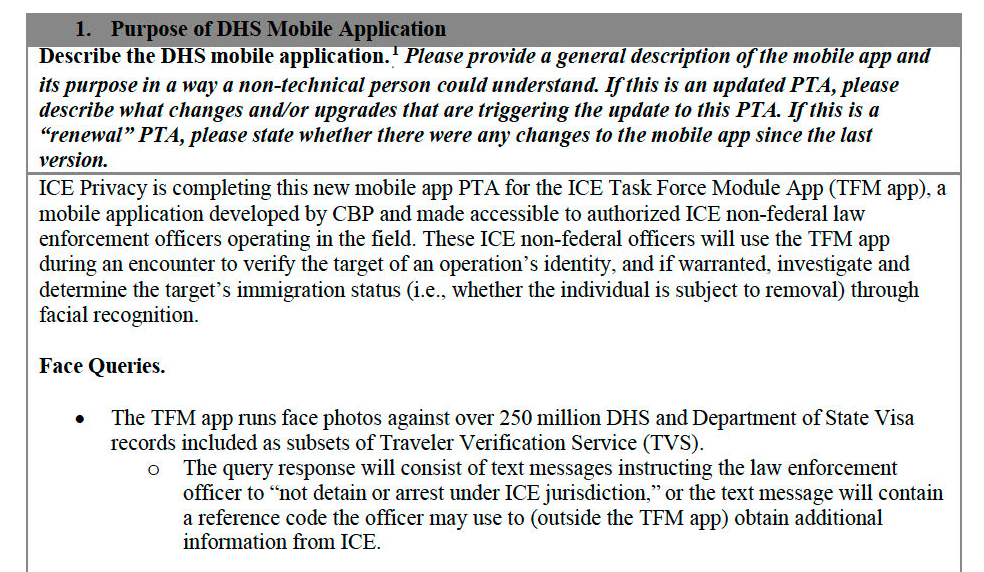
404 Media previously reported on Mobile Identify, which appears to be the same software under a different name. It was removed from the Google Play Store and has not returned, though the new document suggests availability via the Apple App Store.
While the launch date listed in the document is September 24, 2025, it is unclear if or when this rollout will actually happen. DHS did not respond to requests for comment.
Turning police into immigration agents
The app is explicitly designed for the 287(g) initiative, which grants local and state police certain immigration enforcement powers. Cooper Quintin, a security researcher with the Electronic Frontier Foundation (EFF), argued that this essentially turns police officers into ICE agents, subjecting even more Americans to omnipresent surveillance and unjust detainment.
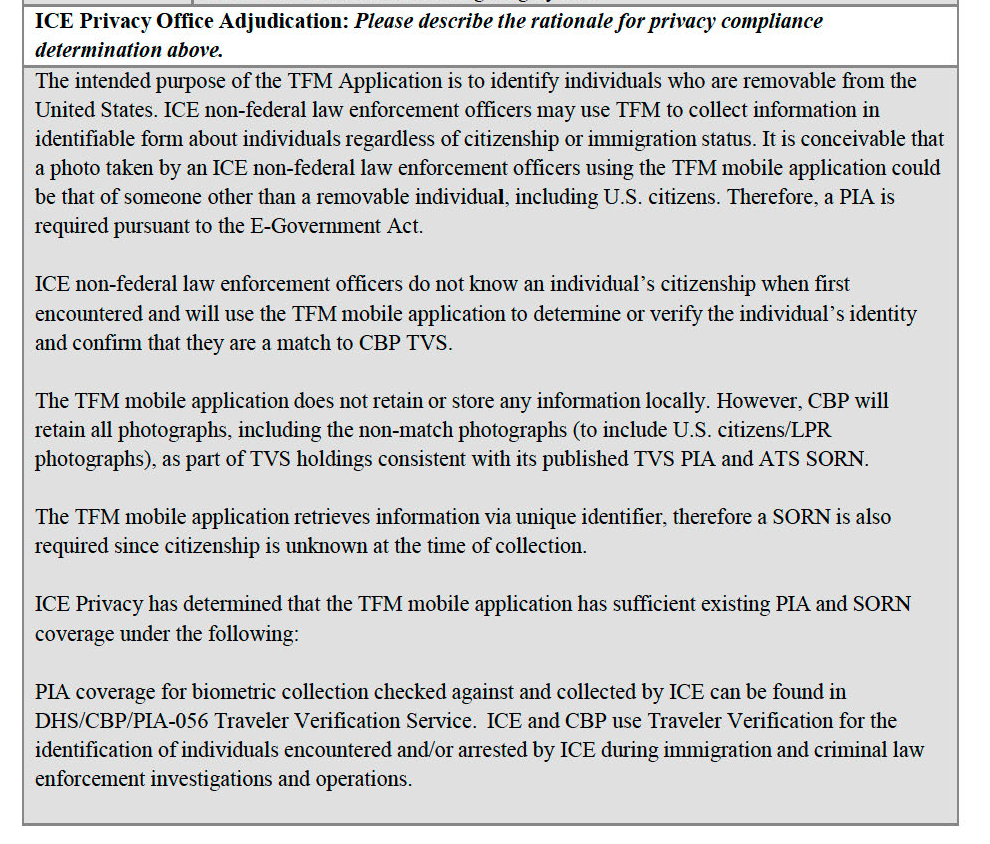
The document acknowledges that the app may be used on U.S. citizens. It notes that officers do not know an individual’s citizenship upon first encounter and must use the TFM mobile application to verify identity and confirm a match with the Traveler Verification Service (TVS). TVS is a CBP system usually reserved for verifying people entering at ports of entry, but ICE is now turning it inward onto American streets.
At the time of writing, 1,220 agencies in 32 states and two U.S. territories participate in the 287(g) program. These are the agencies potentially receiving access to the app. Matthew Elliston, an assistant director at ICE, noted that Mobile Fortify has been used over 200,000 times. Reports also suggest ICE plans to develop its own smart glasses to supplement the facial recognition technology.
Key takeaways
- ICE plans to distribute a facial recognition app, the TFM App, to over a thousand local law enforcement agencies to verify immigration status.
- The app queries a database of more than 250 million records and is intended for officers participating in the 287(g) program, effectively deputising them for immigration enforcement.
- Activists and civil liberties groups warn that the technology is flawed, prone to error, and poses a severe threat to community trust and civil liberties.