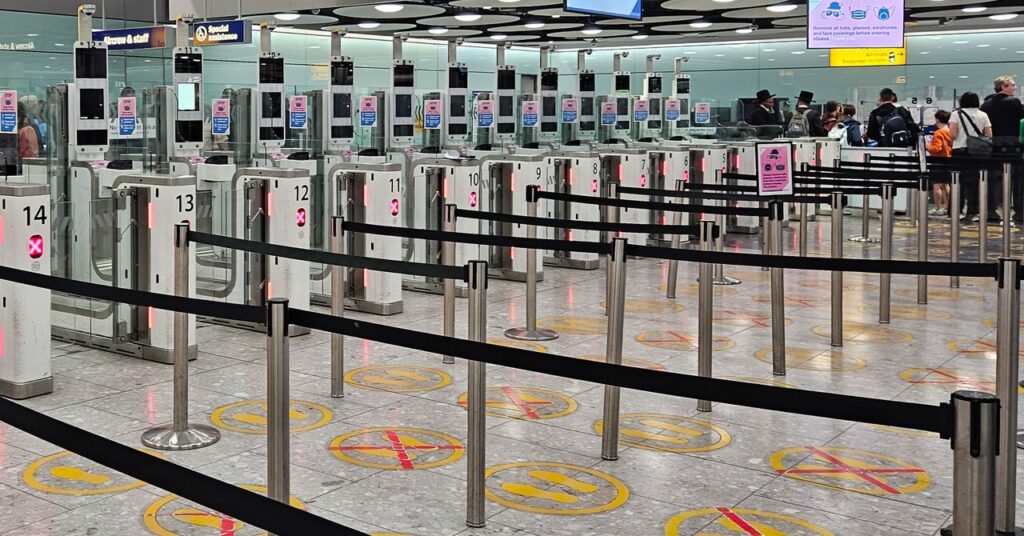
The rush to digitise age verification is moving from online platforms into the physical world, where the stakes are far higher. While social media bans and adult-content restrictions in the US and Australia drive the demand for digital proof of age, a new wave of AI is set to determine the age of asylum seekers at the UK border. This shift carries profound implications for vulnerable people whose futures could hinge on an algorithm’s guesswork.
From next year, the British government intends to deploy facial age estimation (FAE) to assess the age of migrants arriving at its borders. This is expected to be the first instance of such a system being used for asylum determinations. Many claimants lack documentation proving their age, and misclassification carries severe penalties: a child wrongly deemed an adult risks losing legal protections and facing detention in facilities reserved for adults.
An investigation by WIRED, Lighthouse Reports, and The Independent has secured an internal Home Office report detailing tests of these technologies. The data reveals that the systems frequently misidentify children as adults and suffer from significant bias. This directly impacts the largest group of migrants subject to age assessments in 2025, according to Home Office figures. The findings cast serious doubt on the efficacy of the technology in high-stakes humanitarian scenarios.
These revelations arrive as global governments, including the second Trump administration, increasingly adopt anti-migrant policies while investing billions in surveillance tools often deployed against populations with little understanding of how they function or how to contest them.
The leaked document, obtained by Lighthouse Reports, outlines the performance of seven tested algorithms without naming the vendors. Crucially, the report indicates the systems performed significantly worse on Sub-Saharan Africans, who constitute the largest group of migrants crossing the English Channel in small boats. In 2025, this demographic faced more age assessments than any other cohort. For female Sub-Saharan Africans, the average error margin was 4.6 years; a 13.5-year-old girl could be classified as an 18-year-old adult.
Furthermore, the Home Office disbanded a scientific committee tasked with advising on age estimation methods while exploring AI integration. Tim Cole, an emeritus professor of medical statistics at University College London’s Institute of Child Health and a former committee member, described the face scans as “hideously inaccurate.” He noted that the committee was eager to highlight these inadequacies but was shut down before they could present their findings.
These concerns are echoed by years of testing from the US National Institute of Standards and Technology (NIST), which has demonstrated that FAE accuracy fluctuates wildly based on race and photo quality. A Home Office spokesperson responded by stating that rigorous verification processes are being modernised through the testing of fast and effective technology. They claimed the committee was disbanded due to a need for “different fields of expertise,” though they did not clarify how the technology would function in real-world border environments.
While officials insist the tool is “additional” and will not “replace or overrule human judgment,” the government offered no details on its practical application. The spokesperson confirmed that in cases of uncertainty, individuals would be treated as children pending further assessment.
Expanding Estimates
The UK government first announced plans to combine face age estimation with border staff judgments in July 2025. Following this, the rollout was delayed until 2027, with officials claiming the “cutting-edge AI tech” would help crack down on fake claims by adults attempting to game the system.
Over the last five years, AI face scans have become central to controversial online age verification mandates for social media, pornography, and retail. Trials have also occurred in UK bars and shops. The technology analyses facial features against millions of age-labeled faces to produce an estimate. In ideal laboratory conditions, the best algorithms can predict age within roughly 2.5 years.
However, real-world performance varies drastically based on the algorithm, gender, demographics, and image quality. Poor lighting or low-resolution photos can degrade system performance significantly. The Home Office appears to have been aware of these potential pitfalls yet proceeded with the programme regardless.
The leaked report, produced in April 2025 before the technology was purchased, tested seven algorithms against over 2.5 million images. The unnamed “best performing algorithm” showed substantial deviations when tested on images of Sub-Saharan Africans. On average, it tended to predict that a 17-year-old was over 18, performing even worse on females.
Tens of thousands of asylum claims are made in the UK annually, many involving perilous journeys across the English Channel. Currently, if border staff doubt a claimant’s age, they assess physical appearance, interview responses, and general demeanor during the “first encounter.” Since 2010, official statistics show that 40 percent of those facing age assessments have been classified as adults.
The leaked report suggests its findings rely on high-quality images of documented people, implying accuracy rates could be even lower in practice. The Home Office indicates the technology will assist officers during initial encounters. However, the report notes that photos taken at these initial encounters were “routinely worse” than follow-up images, making it impossible to determine if photo quality or the physical condition of asylum seekers drove the errors. NIST testing confirms that lower-quality photos typically lead to larger errors.
“Children seeking asylum have often suffered unimaginable trauma,” says Martha Dark, co-executive director of rights group Foxglove. “They should not be the test subjects for experimental tech that has baked-in inaccuracy and racist bias.” Foxglove and 61 other organisations sent an open letter to the UK government urging the Home Office to scrap the plans.
While it is unclear if the flawed system in the report was the one purchased, in May the government spent over $400,000 on face-scanning technology from German firm Cognitec. Public data analysis of Cognitec’s systems showed that when tested on lower-quality photos from border crossings, the system misclassified twice as many 16-year-olds as being 18 or older compared to higher-quality visa photos. The data also highlighted demographic disparities, with 16-year-olds from West Africa more likely to be classified as adults than their Eastern European counterparts.
A Cognitec spokesperson stated they could not comment on their work with the Home Office but argued that “demographic differences” apply to all face scanning algorithms. They attributed bias to complex factors, primarily image quality issues, and claimed their bias levels are low compared to similar accuracy algorithms.
Stress Test
Even with improved accuracy, technology is rarely operated as intended. Bugs, flaws, and user error frequently cause system failures. When applied to sensitive decisions that alter lives, these risks are magnified.
Previous reports from the UK’s Independent Chief Inspector of Borders and Immigration have highlighted issues with human-led age assessments, including poor record-keeping, perfunctory visual checks, and a lack of staff explanation regarding processes. Staff were not provided with specific training for these assessments until 2023.
“Making initial age decisions is a difficult and complex job, with immigration officers working in challenging circumstances, often under pressure to quickly process lots of new arrivals,” the Home Office states in recent guidance regarding the potential use of AI. It suggests the technology allows officers to test their judgment against the algorithm’s estimate.
Yet, the leaked report from last year noted that the operational context for face scanning was still being explored. The document also highlighted that “temporary aging” related to trauma and the “stress of travel” appears to impact accuracy, raising further questions about deploying such tools in the asylum process.
Key takeaways
- Despite internal evidence of significant bias and inaccuracy, particularly against Sub-Saharan African migrants, the UK government plans to deploy facial age estimation technology at borders by 2027.
- Current testing shows the system can misclassify children as adults by an average of 4.6 years for female Sub-Saharan Africans, risking the removal of legal protections for minors.
- Experts and rights groups argue that traumatised asylum seekers should not be subjected to experimental technology with known flaws, noting that poor photo quality and travel stress further degrade performance.