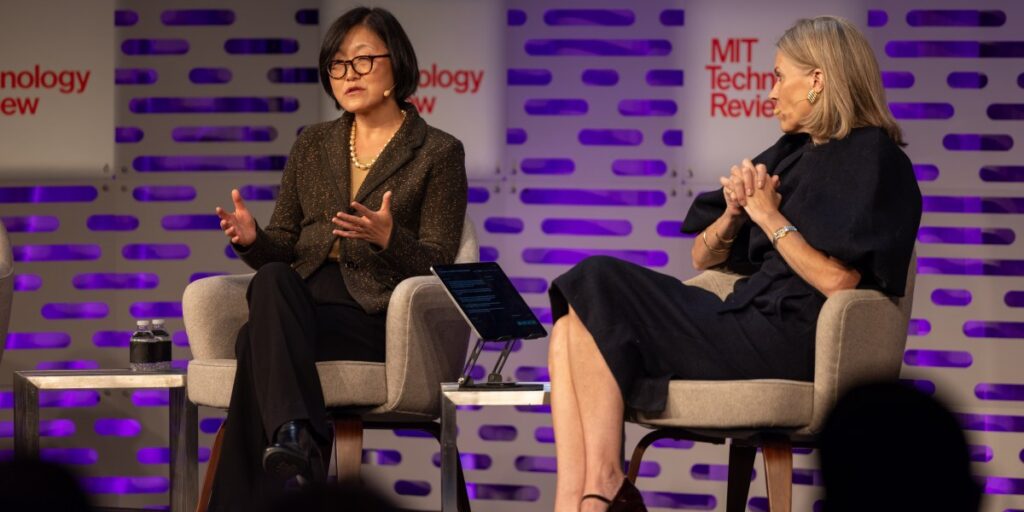
Jing Wang presented a session at MIT Technology Review’s EmTech Future conference arguing that scalable artificial intelligence depends on converging data, engineering, platforms, operating models, and governance into a single operational unit. The discussion focused on constructing this foundation within highly regulated environments while ensuring responsible implementation of agentic systems. Wang, a principal at Vanguard’s Center for AI and Insights, emphasised that trustworthy execution is required to transform emerging capabilities into lasting value for investors. Her background includes leading enterprise-wide innovation across Vanguard’s financial and corporate divisions since 2009, following a tenure at the Boston Consulting Group. She holds degrees from the University of Science and Technology of China, the University of Pennsylvania, and the Wharton School of Business.
The core argument is that technical novelty alone cannot sustain deployment without structural alignment. Financial services regulations demand rigorous controls over how algorithms make decisions, making the integration of governance with platform engineering a practical necessity rather than a theoretical ideal. This approach prevents fragmentation where data quality or compliance failures halt progress. The session highlighted that measurable business value arises only when these distinct elements function as one cohesive system.
- Regulatory compliance must be embedded within the engineering platform.
- Agentic systems require trusted implementation to retain investor confidence.
- Vanguard’s internal teams drive research and delivery for client outcomes.