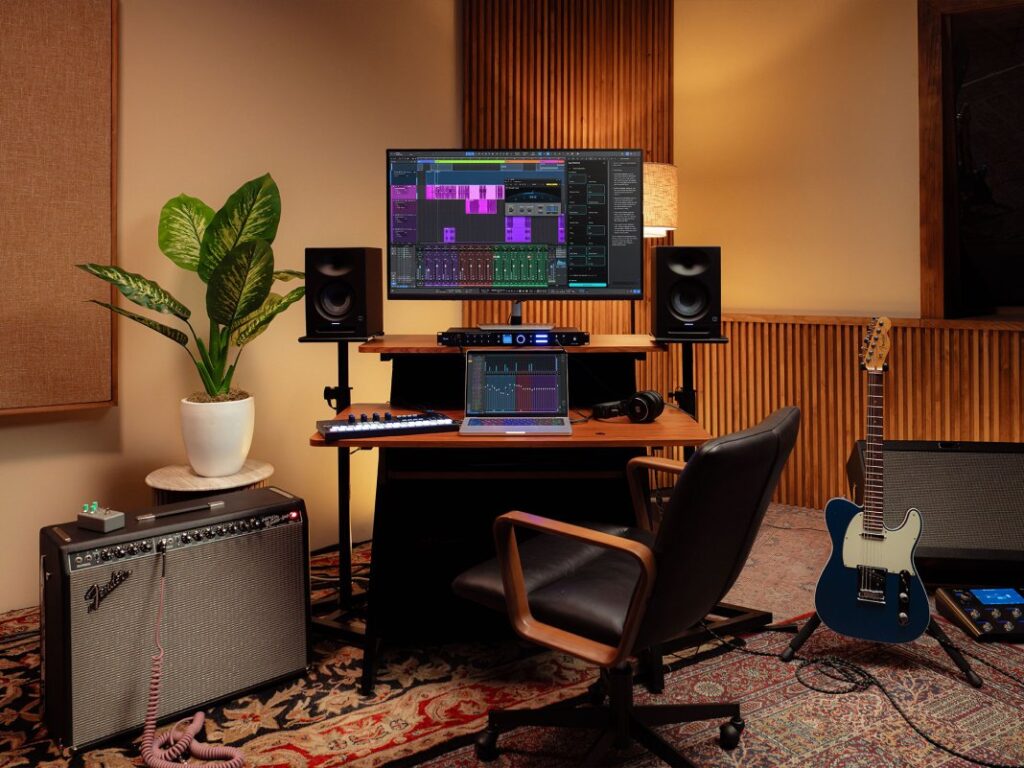
For makers and artists, the latest update to Fender Studio Pro signals a decisive pivot: the software is no longer just a rebranded DAW but a serious creative instrument where AI serves the musician rather than replacing them. The new 8.1 update introduces deep integrations with Moises, a suite of composer-centric tools, and workflow refinements that suggest Fender has listened to its core user base while embracing the future of audio production.
The artist is always first
When Fender rebranded PreSonus Studio One, the industry wondered if the mature DAW would drift toward a simplified, beginner-focused ecosystem. Now, after the dust has settled, the answer appears clear. At a recent event in Covent Garden, held in a historic Grade II-listed former stained glass factory, Fender’s General Manager of Software, Arnd Kaiser, and educational lead Gregor Beyerle demonstrated that the update prioritises professional utility over gimmickry.
The central philosophy guiding the new features is straightforward. As Arnd Kaiser stated during the demo:
“We have a very strict rule. We embrace modern AI technologies, you’ve seen a few of them today, as long as the artist stays in control. We want to have tools available to us, as artists, that make our lives easier, our workflows easier, that allow us to create, to be creative, but we would never do anything that replaces creativity or replaces the artist. The artist is always first.”
Deep Moises integration
The headline feature of Fender Studio Pro 8.1 is a direct browser integration with Moises, bringing stem separation, stem generation, and voice replacement directly into the DAW. Previously, combining these tools required a cumbersome cycle of exporting, uploading, processing, and reimporting. Now, the workflow is seamless.
While stem separation is now common across major platforms, Fender’s implementation stands out. The algorithm is more detailed than peers like FL Studio, Logic Pro, or Ableton Live, capable of isolating orchestral elements such as strings and woodwinds into their own tracks. During the demonstration, the quality was so high that the separated stems were nearly indistinguishable from the master mix when summed back together.
The stem generation capabilities are equally impressive. Users can feed the DAW session audio alongside a text prompt, and Moises will generate new, context-aware parts in seconds. It functions as a rapid prototyping tool, allowing producers to iterate on ideas without leaving the interface.
Vocal replacement is also available for those seeking reference tracks or demos. A user can record a scratch vocal and instantly swap it with a professional track, perfect for demos where the final part will be sung by a different artist later.
An AI-assisted studio assistant
Beyond audio processing, the update introduces a ‘studio assistant’ chat feature designed to help users overcome technical and creative roadblocks. This tool is particularly aimed at production newcomers who might find a professional DAW overwhelming.
Unlike generic search engines, the assistant can ‘see’ the user’s open session, providing it with rich context to offer accurate solutions. In the demo, the assistant successfully troubleshooted a greyed-out track arm button by identifying a missing input selection and configured a signal chain to add grit to an acoustic guitar take.
When questioned about the assistant’s intelligence, specifically whether it could analyse audio frequencies to identify issues like boxiness, Arnd Kaiser clarified the boundaries of the technology:
“It doesn’t listen. I don’t know if it will listen at some point, it could, but that would take it in another direction.”
New native autotune device
Fender Studio Pro already features tight integration with Celemony Melodyne, but version 8.1 adds a new native autotune device. The developers walked through classic use cases, from subtle tuning corrections to the signature ‘Cher effect’.
Uniquely, the device includes a formant shifting control. This allows producers to create contemporary R&B sounds or, more practically, duplicate harmonies to mimic the texture of a small ensemble. As Arnd noted, these kinds of effects used to be locked behind expensive third-party plugins that often cost more than the software itself.
Scoring and composer tools
The update positions Fender Studio Pro as a serious contender for film and game composers, rivaling software like Cubase. This is partly due to the existing integration of Notion, a scoring tool PreSonus acquired in 2013, but 8.1 further dissolves the barrier between the score and the DAW.
Arnd Kaiser explained the seamless workflow:
“We’re at a point now where you could say there’s almost no difference in workflow, whether you start from the score and then move into mixing and playback, or whether you start in the traditional sequencer or DAW workflow, but then build a score from there.”
For those working with orchestral libraries, the improvements are significant. Articulation MIDI keyswitches have been separated from note data in the piano roll for more efficient editing, with changes automatically reflected in the score with appropriate symbols. Users can now set attack compensation, ensuring notes trigger earlier for sustained passages while remaining perfectly locked to the grid.
The editing workflow is also more holistic; repeats entered in the score are now reflected on the linear timeline, creating ghosted arrangement sections and keeping lyrics aligned for recording. Perhaps most impressively, users can now create global instrument racks that live in shared memory, allowing them to swap between project versions without waiting for heavy libraries like Omnisphere or Keyscape to reload.
Workflow and interface refinements
The 8.0 update introduced a major interface refresh, including a timeline overview and native device controls similar to Ableton Live. Version 8.1 continues this refinement with the addition of pitch curves. This feature lets users draw transposition envelopes directly onto audio clips in the timeline without needing to set up automation lanes.
Despite mixed online sentiment regarding the One-to-Pro rebrand, Arnd Kaiser emphasised that user feedback remains the primary driver for development:
“[Pitch curves are] a feature that so many people have requested, and I think this is a testament that we’re still listening to all of the feature requests out there, which really define the future of our versions.”
Cost and the wider ecosystem
Fender Studio Pro is sold via a perpetual licence for £170, which includes the current version of the software and one year of updates. Existing owners of PreSonus Studio One can upgrade at a discounted price.
The update concludes with a look at the broader Fender ecosystem. The collaboration with Moises brings AI creative tools under the same roof as world-renowned guitars, amplifiers, and hardware controllers. David King, a chart-topping producer and Fender evangelist, highlighted a poignant use case for the stem separation tool: recovering files lost when his studio was damaged in the Malibu fires.
Meanwhile, Matt Henninger, VP of Business Development at Moises, stressed the ethical considerations of their technology. He noted that Moises is trained on fully licensed content and often pauses new ideas to ensure they remain responsible. As Henninger put it, their job is to provide tools that musicians can “bend, break, destroy, wire wrong,” trusting the artist to choose how to leverage them.
Key takeaways
- Artist-first AI philosophy: The new features, particularly the Moises integration, are designed to augment creativity rather than replace the human element, adhering to a strict ethical guideline that the artist remains in control.
- Professional-grade audio tools: The update offers detailed stem separation capable of isolating orchestral elements, a new native autotune device with formant shifting, and an AI assistant that understands the context of the open session.
- Enhanced composer workflow: Significant improvements to the scoring interface, including global instrument racks and better articulation handling, position the DAW as a viable option for film and game composers.
- Responsive development: Despite the rebrand, Fender continues to prioritise user-requested features like pitch curves, proving that the core user base remains the primary focus.