Osmose CE 49 €999
Osmose CE 61 €1199
expressivee.com
For the maker and the artist, the Osmose CE represents a shift from simply playing notes to sculpting sound in real time. It strips away the onboard synthesiser engine found in its predecessor to focus entirely on being a master controller for your own software or hardware setup. This approach lowers the entry price while retaining the next-generation MPE (MIDI Polyphonic Expression) capabilities that define the instrument.
When Expressive E launched the original Osmose synthesiser in 2023, it was a bold move. Andrew Huang praised it highly, and Hans Zimmer noted it allowed him to “transform a sound completely” for his work on Dune. While purists initially balked at the cost, the Osmose CE offers that same expressive depth for a more accessible price point.
The evaluation of this device hinges almost entirely on the keybed. Expressive E markets it as ‘a keyboard unlike any other,’ and the claim holds water. Unlike the ROLI Seaboard 2, which demands a completely new physical technique, the Osmose CE takes the familiar black and white key layout and deepens it.
Pressing a key is just the start. You push down, but the travel continues far beyond the traditional stopping point. The aftertouch range is immense, offering seven millimetres of physical travel. This allows for granular control over parameters like filter cutoff or LFO depth. I found great satisfaction in holding a chord and varying the pressure on individual notes to create shifting accents and evolving timbres.
The tactile feel is firm and springy, almost like kneading dough, yet the keys are highly sensitive. You can trigger sound with the lightest tap, and the sensitivity range is easily customisable.

Control is not limited to just up and down; you can also wiggle the keys side to side to produce vibrato, mimicking the technique used on stringed instruments. However, this lateral movement introduces a minor friction: keys can occasionally click against one another when released quickly after a deep press. While not a dealbreaker, it is a consideration for those executing fast, virtuosic passages.
Without its own synth engine, the Osmose CE relies on deep DAW integration. It performed solidly across Cubase 15, Ableton 12, and Bitwig 6.
The interface combines a 4.3-inch colour LCD, six clickable rotary knobs, and push buttons to navigate tracks, manage loops, open plugins, and control macros without touching a computer. The companion software, Ctrl-e, adds guidance for preset selection and navigation.

Unfortunately, the bundled presets in Ctrl-e are the weak link. They are not bad, but they lack inspiration, especially when the hardware itself is so capable. The good news is that setting up the unit with your own favourite instruments is straightforward. You can switch between poly-aftertouch, multichannel, and classic MIDI modes to map pressure gestures to specific CC messages.
Currently, side-to-side gestures are hardcoded to pitch bends and cannot be reassigned to other controls, though one hopes this will change in future updates.

Beyond the basics, the unit features excellent onboard arpeggiation and pitch glide functions. You can assign arpeggio parameters to specific gestures, such as adding octave jumps only when bending a note sideways. For pitch glides, you can set interval ranges and control the portamento time by ‘seesawing’ between notes, effectively turning the keyboard into a ribbon controller for massive sweeps.
The Osmose CE is a professional instrument priced at €999 for the 49-key version and €1199 for the 61-key model. This places it in the same bracket as the ROLI Seaboard 2, far above standard controllers like the Arturia Keystep Pro or the Novation Launchkey MK4 61.

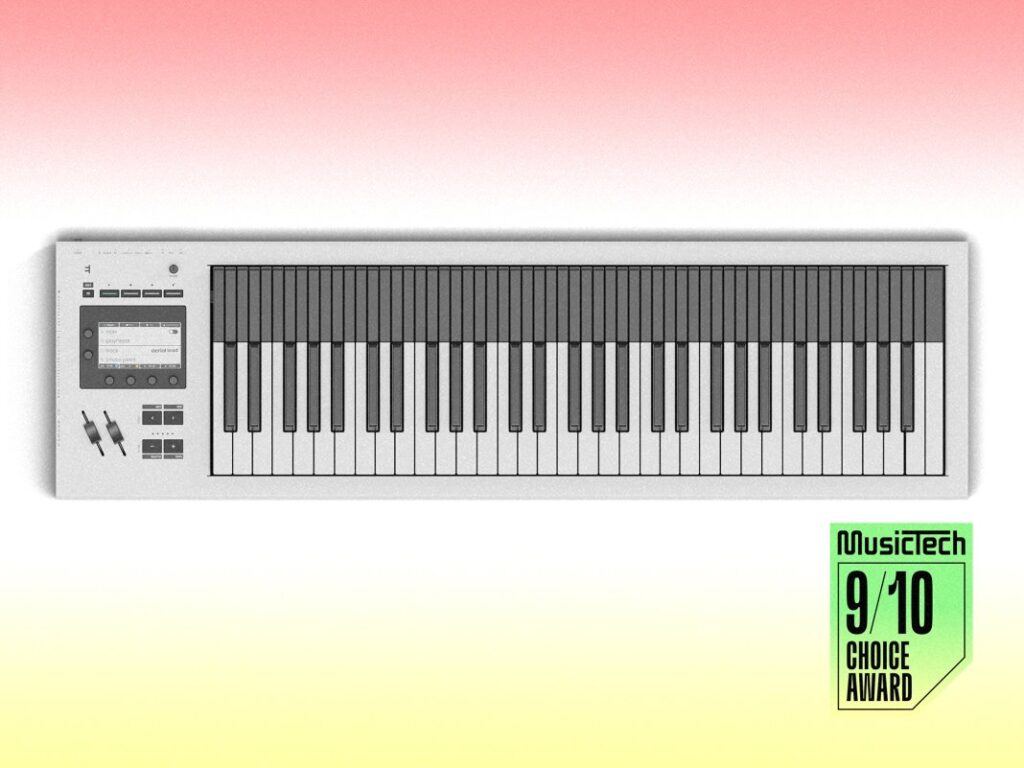
Despite the cost, the build quality is robust. The aluminium casing and metal under-panel are rock solid, and the sliders and knobs feel premium. It is a visually striking piece of kit for any desktop or stage setup.
This instrument is for those who have exhausted the limits of standard MIDI keyboards. It genuinely elevates classic design by allowing nuanced timbre fluctuations that would otherwise require painstaking automation. For the skilled musician with the ambition and budget, the Osmose CE is the definitive MIDI controller right now.

Key features
- MPE-compatible controller keyboard with an innovative keybed
- Available in 49-key and 61-key sizes
- Multiple gesture inputs, including tap, press, pitch bend, vibrato, and shake
- Onboard arpeggiator and pitch glide functionality
- Ctrl-e companion software with 900+ sound presets
- DAW integration with Live, Cubase, Bitwig and Logic Pro
- 4.3-inch colour LCD screen
- 9 buttons and 7 knobs/encoders
- Pitch and modulation sliders
- MIDI in/out/thru
- 2 assignable pedal inputs
- Weight: 10 kg (Osmose CE 49) / 11 kg (Osmose CE 61)
Key takeaways
- The Osmose CE offers a familiar yet deeply expressive keybed that allows for granular control over aftertouch and lateral gestures without requiring a complete change in playing technique.
- While the bundled Ctrl-e presets are uninspiring, the unit excels as a versatile controller for external software instruments and features powerful onboard arpeggiation and pitch glide tools.
- Priced at a premium comparable to the ROLI SeaboardSource Read original →
Stay ahead of AI. Get the most important stories delivered to your inbox — no spam, no noise.