The AI justice gap solution is slowly turning into an existential paperwork nightmare for US federal courts
A new study from MIT and the University of Southern California shows that lawsuits filed without a lawyer at US federal courts have nearly doubled since ChatGPT went mainstream. One in five complaints now contains AI-generated text. Judges are resorting to drastic measures to cope with the flood of filings.
The researchers analyzed 4.5 million civil lawsuits from fiscal years 2005 through 2026 and 46 million entries from the electronic case registry PACER. The key metric is the “pro se” rate, the share of lawsuits where plaintiffs represent themselves without a lawyer. The right to self-representation in the US predates the Bill of Rights, and the rate held steady at about 11 percent of all federal civil cases for two decades. In fiscal year 2025, it jumped to 16.8 percent. That year alone saw 41,490 pro se filings, nearly double the pre-AI average. According to the study, 59 percent of all growth in civil lawsuits came from self-represented plaintiffs.
The finding is striking because US federal courts set the highest bar for unrepresented litigants anywhere in the American system. Filing fees run $405, roughly twice what most state courts charge, and formal requirements for complaints are far stricter. Over 90 percent of all civil cases in the US go through state or local courts anyway. The AI effect there is likely even bigger, the study says.
Simple cases benefit, complex ones don’t
The surge clusters in case types where formulaic document drafting does most of the heavy lifting: civil rights complaints, consumer credit disputes, foreclosures. Areas that demand sustained specialized knowledge, like patent or securities law, show no effect. The researchers read this as evidence that LLMs are cutting costs that were previously too high for laypeople: drafting procedurally viable legal briefs. The increase is almost entirely on the plaintiff side and shows up in 44 of 50 states at once, ruling out local explanations.
Case durations and outcome distributions are largely unchanged, but activity within cases is exploding. The number of docket entries per court from pro se plaintiffs in the first 180 days sits 158 percent above the pre-AI average as of Q2 2025. Every one of those entries, whether a motion, a response, or an order, eats up processing time. Cases with lawyers are generating more entries too (+23 percent per case), suggesting law firms are also using LLMs.
Pangram detector flags 18 percent AI text in 2026 complaints
The most direct evidence comes from a test using the AI text detector Pangram, which Imas and Jabarian validated as fairly reliable. The researchers pulled 1,600 random federal complaints from the CourtListener archive, a public collection of American court documents. Before 2023, Pangram flagged just one document out of 800 as AI-generated. The rate then climbed steadily: 1.0 percent in 2023, 3.5 percent in 2024, 10.5 percent in 2025, 18.0 percent in early 2026.
One especially striking case is the federal district of Vermont, where pro se filings jumped from about 45 per year to over 1,100 in fiscal year 2024. Nearly all of that growth traces back to mandamus petitions against US Citizenship and Immigration Services (USCIS), where applicants seek a court order forcing the agency to process their long-stalled green card or naturalization cases.
Online guides on Reddit recommend using Microsoft Copilot to draft a complaint, paying $150 to have a lawyer on the freelance platform Fiverr review it, and filing specifically in Vermont because the court there is considered fast. One guide cited in the study’s appendix puts it bluntly: “I used AI (Microsoft Copilot, to be exact). It’s free and comes with Windows computers. I asked it to write me a writ of mandamus.”
Judges respond with shredding orders and fines
A New York Times report illustrates the burden through a specific case. Donald Sauve, a 69-year-old from Minnesota, sued his ex-wife, her lawyer, and a state judge after a divorce. A first handwritten complaint seeking $275,000 in damages was dismissed within a month for lack of jurisdiction. Three months later, Sauve filed a new complaint using ChatGPT and Claude. This time it was neatly typed and padded with 50 additional filings, including a “Case Law Synthesis” compiling supposedly supporting precedents.
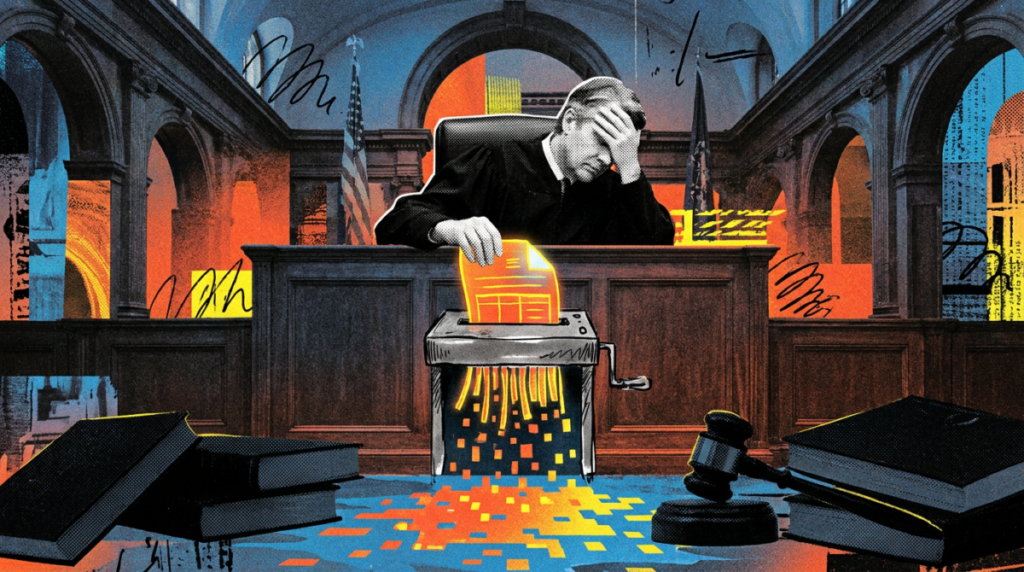
Each of those filings had to be read, cataloged, and entered into the public docket before Judge Patrick J. Schiltz dismissed the case again in a 14-page ruling. Schiltz ordered that any future filings from Sauve would be “shredded without any additional notice,” because a plaintiff cannot “dump hundreds of pages of documents on a court and expect the court to sift through them to find facts or arguments that might support claims against a defendant.”
Schiltz told the NYT he considers the trend “an existential threat to the federal courts.” Sauve, who is currently living out of his car, said he plans to use AI to soon produce filings of “SCOTUS-grade” quality.
Access to justice cuts both ways
For all the strain on courts, the trend has a democratizing side too. The researchers explicitly frame their findings within the literature on the “justice gap,” the gulf between legal need and actual access to legal representation for low-income Americans.
Judge Michael Y. Scudder of the Seventh Circuit Court of Appeals wrote in a recent decision that AI offers “great promise for enhancing access to justice for those without the resources to retain counsel or to represent themselves effectively.”
New York legal aid attorney Sateesh Nori told the NYT that despite a 2017 law guaranteeing free legal representation for low-income tenants facing eviction in New York, up to 50 percent of those affected still show up in court without a lawyer. His question: “The real problem is: how come these people don’t have another way, other than using AI.”
A structural dilemma for the US justice system
The authors outline two likely consequences of AI use in courts: an “arms race” between pro se plaintiffs and opposing parties with lawyers that eats up more court time per case, and an asymmetric burden on government agencies. Those agencies are frequent defendants in civil rights, immigration, and benefits cases and can’t scale their own processing capacity to match.
The authors propose three non-exclusive fixes. First, the ban on federal judges using AI to draft rulings could be loosened, creating a productivity boost on the adjudication side that matches the one on the plaintiff side.
Second, simpler cases could be routed more deliberately to magistrate judges, lower-ranking federal judges without lifetime appointments, or to specialized triage procedures.
Third, the authors float the idea of creating a new lower court tier that handles the simplest cases “mostly with AI.” None of these options are free, they note, but all are probably better than the alternative: a growing backlog in a system with fixed capacity.
Law schools and bar associations are already drawing lines
While the study focuses on court workloads, law schools and oversight bodies are already grappling with a related question: Where does acceptable AI use in the legal system end? Starting summer 2026, UC Berkeley Law School will only allow AI for research, banning its use for drafting, outlining, writing, or revising graded work. Non-existent source citations are treated as a red flag for prohibited use.
How real that risk is shows up in a database of 129 documented AI fabrication cases where lawyers from twelve countries submitted made-up content in court proceedings. Even AI companies aren’t immune: In a copyright dispute with music publishers, Anthropic had to apologize after Claude fabricated a source in the company’s own lawsuit.
Subscribe now