Three hours and 15 minutes into the four-hour documentary Musk, a video game avatar of the titular billionaire picks up a chainsaw from the Resolute Desk in the Oval Office. The camera follows as the figure wields the tool to destroy various government buildings. Walking through a farm, the avatar aims the chainsaw at grain silos labelled ‘USDA’ and lightning arcs from its spinning blades. The silo explodes and cows moo in distress.
In my experience, the purpose of a video game chainsaw is to viscerally rend through objects. I have never seen one shoot lightning. It is a small detail that speaks to my overall problem with Alex Gibney’s Musk: it is cringe.
Context and execution
Elon Musk is one of the most powerful men alive on the planet and Gibney’s Musk does a decent job of giving the overall arc of the man’s many faults. The director takes us from Zip2 to DOGE while highlighting the billionaire’s pathology, and it hits more than it misses.
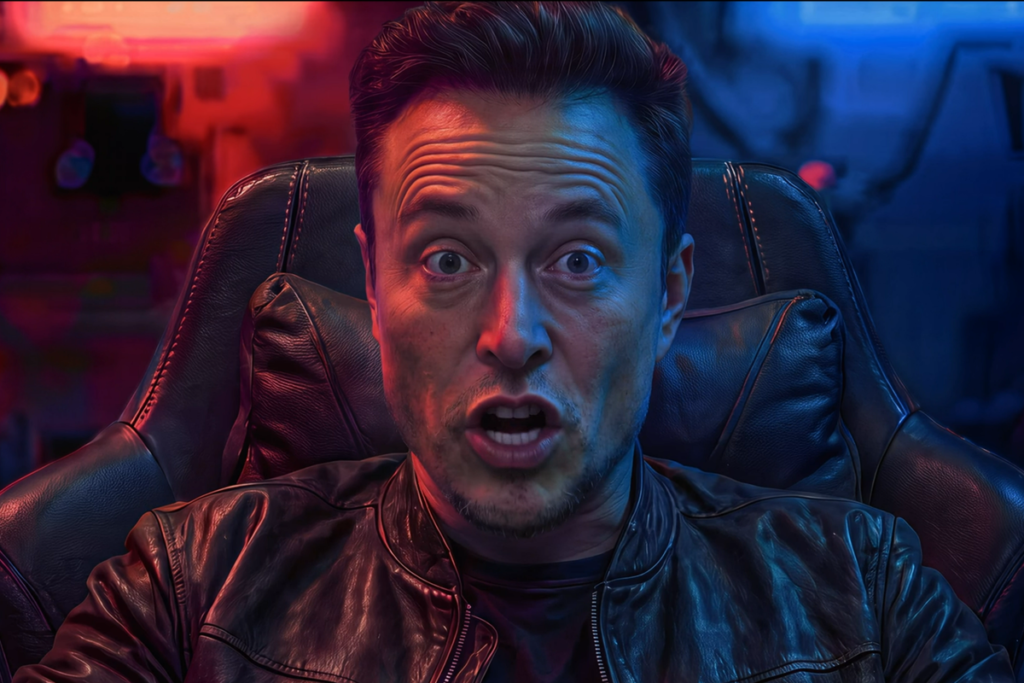
Musk is a good overview of the general arc of Elon Musk, the man. But there have been other Elon Musk documentaries told in much the same way. We made one at VICE several years ago that is similar in tone and vibe. And so, at a laborious four hours long, it is not clear who Musk is for, and the weird video game interstitials and ghoulish AI avatar of Musk himself are genuinely distracting. Musk would not talk to Gibney so the director generated an AI avatar of the billionaire to act as a stand-in. Throughout Musk, this hyperreal grotesque lends color commentary as if the billionaire is actually in the room.
The director cites Musk’s oft-stated belief that we are living in a simulation as a justification for the AI Musk. “He believed it likely that an artificial intelligence of the future had exfiltrated all knowledge and life experiences from planet Earth and was now running an ancestor simulation in which our past lives had become the training data for a kind of sim world,” Gibney says as the AI musk coalesces before the audience. “In honor of that idea, we decided to edit together recordings of his actual words to create a simulated interview at the heart of a kind of documentary video game.
I understand what Musk is going for here, and it is funny to watch Musk’s likeness and spirit rendered through the lens of AI and video games. But, on the whole, the AI Elon does not work. Its head is too big, its features are exaggerated, and it sits in a stereotypical gamer chair while bathed in the kind of blue and red lighting popular on Twitch streams ten years ago. The things the bot says are not fabricated, they are direct quotes from the man himself, though some are lightly edited.
In every instance, the quotes are more interesting and more informative when shown in their actual context, in the video interviews the real Musk gave.
“I lost my son, essentially. They call it dead naming because, uh, your son is dead. So my son is dead. Killed by the woke mind virus,” AI Elon says in the film.
This was part of an interview with Jordan Peterson for The Daily Wire. Learning that enriches the quote. There is crosstalk with Peterson. You see Musk’s real face when he talks about Vivian. It is a real video interview that you can actually watch. There is no need to use an AI avatar to do this.
In another clip the AI Elon explains the Twitter Files. “On Twitter, there was a lot of censorship. We sort of uncovered a lot of that with the Twitter Files,” it says. “Free speech is meaningless unless you allow people you don’t like to say things you don’t like.” The real clip comes from a Real Time With Bill Maher interview.
There is a lot of this in the film. “What is the most entertaining outcome for the election? That is probably what is going to happen,” the Musk bot grins evilly while paraphrasing a Musk catchphrase. Musk talking to Kara Swisher, Musk at a Vanity Fair conference, Musk delivering missives at CPAC, and Musk speaking to Joe Rogan are all condensed into an AI approximation of the real person. In every instance, the original quote in its context is more powerful and more illuminating about its subject.
Visual metaphors
And then there is the video game sequences. Musk uses Elon’s obsession with video games as an extended visual metaphor throughout. Under a pink filter that looks like it is designed to capitalise on the release of Grand Theft Auto VI, Musk picks different classes — shifting from gamer to founder to Kublai Khan. He drives a sports car along a digital track while Tesla’s stock pieces rises like a video game score, and uses Iron Man-style gloves to vaporise Twitter employees.
If the man believes we are living in a video game then this is what it might look like. His DOGE -fueled chainsaw rampage across DC ends with him dropping a nuke on the National Nuclear Safety Administration and his inauguration Nazi salute turned into a pixel-art version score screen.
Again, this is a four-hour long documentary. It has an intermission, even when you stream it. The video game sequences and AI Elon feel like a baby boomer grasping the aesthetics of a younger generation and misusing them. It is Steve Buscemi holding a skateboard in the hallway of a high school asking how his fellow kids are doing. It detracts from the overall message here, which is that Musk is a destructive force in our businesses and politics.
What it means
The documentary attempts to use technology to simulate the subject’s worldview, but the execution creates distance rather than insight. The visual choices feel dated and the synthetic avatar fails to replace the nuance of the original footage. For viewers interested in the man’s impact, the raw interviews remain the superior source material.