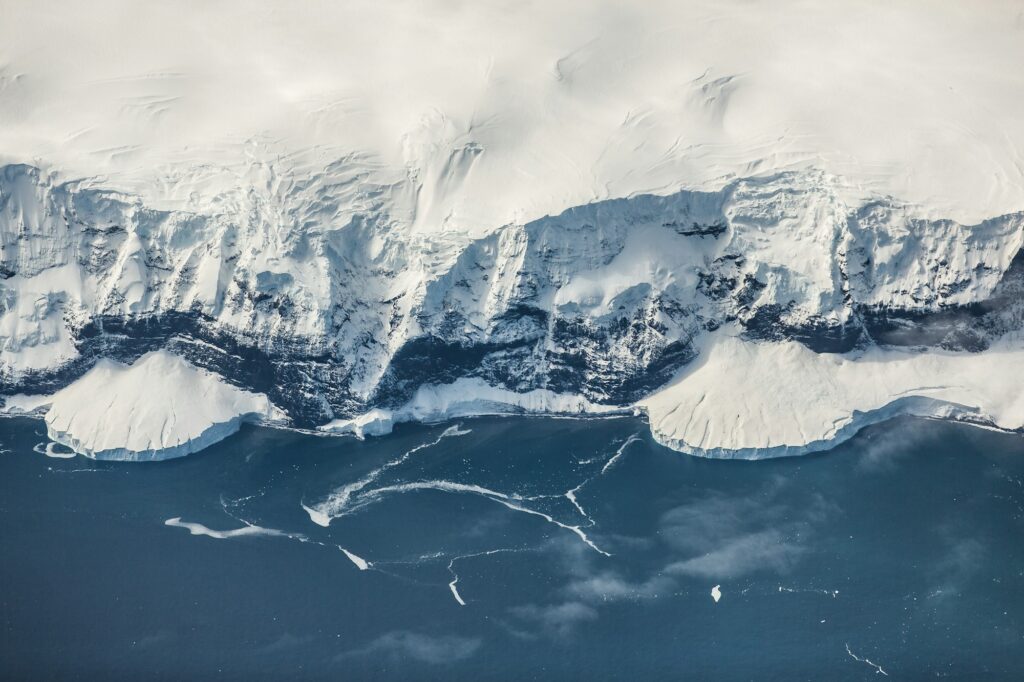
Scientists have found buried mountain ranges under Antarctica that likely caused a massive spike in life forms 538 million years ago.
Venus ate its own moon
Venus is a hostile world. Its day is longer than its year, its surface is scorching, and clouds of sulfuric acid blanket the sky. Now, researchers suggest the planet also ate its own moon.
Most planets have satellites, but Venus and Mercury do not. A new study led by Stephen Kane of the University of California, Riverside, suggests Venus once had a moon that it eventually tore apart and swallowed.
The team ran simulations of moons ranging from half to ten times the mass of Earth’s Moon. Because Venus rotates slowly, taking 243 Earth days, the gravitational pull drew these satellites inward until they crashed into the planet. By contrast, Earth’s faster rotation pushes its Moon away at a rate of 1.5 inches per year.
“The absence of a Venusian satellite can be understood as a natural consequence of tidal evolution alone,” the researchers said. They added that the destruction of a past moon may explain why the planet became so inhospitable. The impact would have delivered a massive energy pulse to the surface and atmosphere, potentially triggering the loss of water and a runaway greenhouse state.
NASA’s DAVINCI orbiter, scheduled for launch in 2029, could search for chemical signatures of this ancient event. Until then, the theory that Majora’s Mask is based on a true story seems plausible.
Antarctic mountains drove the Cambrian explosion
Geologists have identified the remnants of Himalayan-scale mountains buried deep beneath Antarctica’s ice sheet. These structures are linked to the Gondwana supercontinent.
Both the new findings and a recent study arguing that Gondwana was a genuine supercontinent point to geological upheaval as the cause of the Cambrian explosion of complex life, which began about 538 million years ago. The new work focuses on the role of these colossal mountains and the submarine fan systems underneath them.
Authors Bei Chen and Ian H. Campbell of the Australian National University noted the correlation between the era of evolution and the formation and erosion of the Gondwana Supermountains.
The team studied 1,700 zircons, minerals that allow scientists to reconstruct continental timelines. They found a disproportionate spike in Antarctic zircons dating from 650 to 450 million years ago. This aligns with the formation of Gondwana. The mountains and their fan systems provided the nutrients necessary for the rapid rise of animals and other complex life.
“Analyses of detrital zircons from Antarctica show that its tectonics were dominated by Himalayan-style mountains, the roots of which now underlie the ice sheet,” the team concluded.
Gondwana broke apart during the age of dinosaurs, but its geological body parts remain scattered under ice and across new continents.
Human brain tissue in mice
Studying human brain tissue in living subjects is difficult due to practical and ethical constraints. Scientists cannot simply remove a person’s skull to examine the interior.
A new workaround involves transplanting human brain organoids into mice engineered to have empty space in their brains instead of a cortex. This technique, called xenocortication, allows human organoids to grow in the cavities and develop similarly to real brain tissue.
The resulting mice, abbreviated XCX, behaved normally despite containing millions of human-derived neurons.
“We envision that xenocortication will be useful for obtaining circuit- and behaviour-level readouts using human neurons to study neurodevelopment, model disease and develop therapeutics,” said researchers co-led by Konstantin Kaganovsky, Kevin W. Kelley, Tilo Gschwind, and Paul M. Harary of Stanford University.
The team emphasised that establishing ethical guidance requires early and proactive engagement as they generate mice with more mature and canonical cortical organisation.
A Tudor-era manuscript saved
King Henry VIII ordered the dissolution of monasteries and the destruction of Catholic texts. Sir John Gage, a courtier who helped carry out these orders, may have secretly saved a forbidden manuscript.
Katie Walter of the University of Sussex and James Wade of Girton College, Cambridge identified a six-page fragment of Nicholas Love’s Mirror of the Blessed Life of Jesus Christ within Gage’s belongings. The text was popular in the 15th century but fell out of favour by Henry VIII’s reign.
The fragment, known as The Keep fragment, had gone undescribed until now. It appears Gage acquired the book during the dissolution of the monasteries and hid it in plain sight within his personal effects.
“John Gage possibly acquired the book at the time of the dissolution of the monasteries” and it later became “hidden in plain sight” in his belongings, the researchers said.