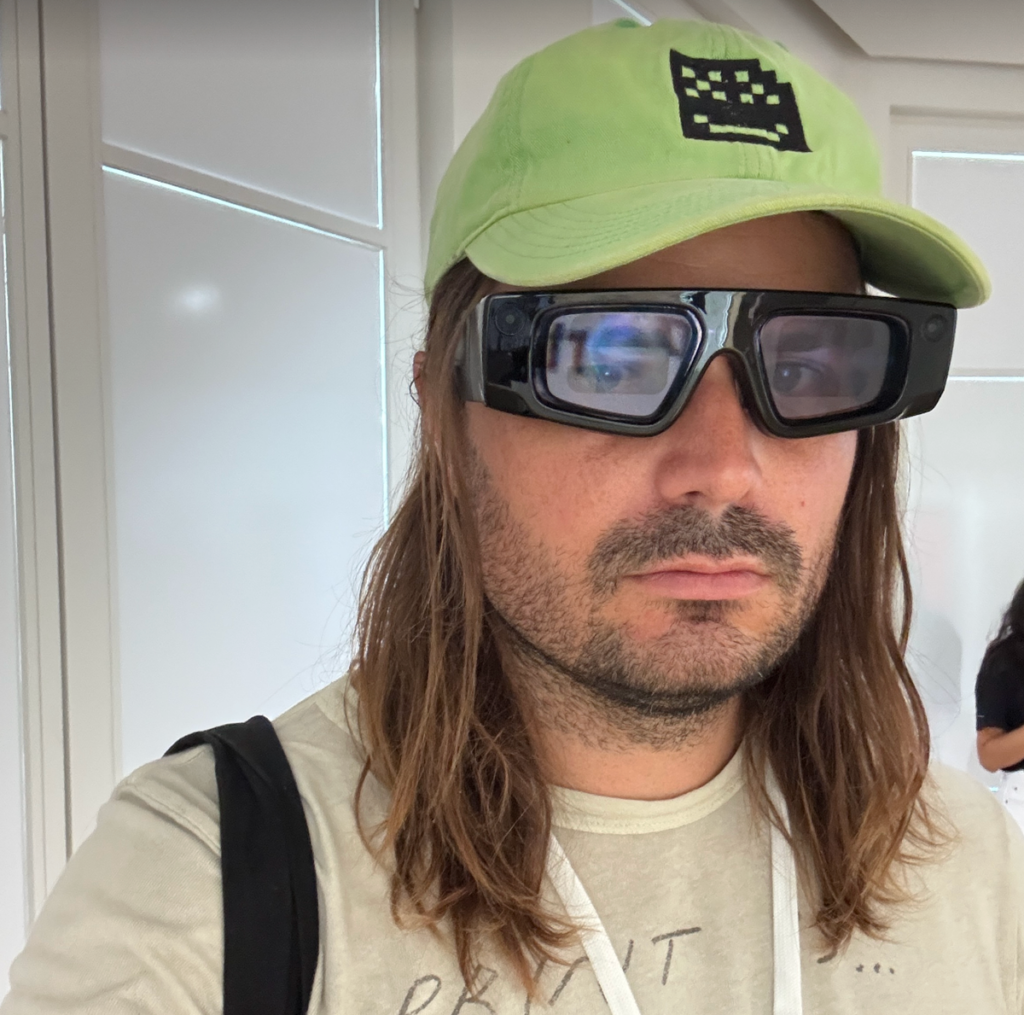
Snap’s new augmented reality glasses failed to work properly during a museum demo at Cannes Lions, stopping whenever the user looked away from the artwork.
The experience
I stood before a portrait of King Charles, dressed in red. The Snap Specs on my face were comically large and heavy. A digital overlay replaced the painting with a version of the real artwork. A narrator’s voice instructed me to touch a butterfly on the King’s shoulder. Through the lenses, I saw my hand reach out. The butterfly flew to my fingers and clipped through them.
The narrator suggested I imagine myself as royalty. King Charles’ face morphed into mine, processed by an AI filter to appear thinner, smoother, and older.
I moved to the next painting and stood on a marked spot on the floor. The canvas appeared blank. I expected my face to be painted on it, as had happened before. The narrator’s voice faded. I glanced slightly away. The experience stopped immediately. I asked a staff member to reset the glasses. When I looked back, the narrator spoke again. I turned my head a fraction. The system froze. I tried again, keeping my eyes fixed on the artwork. My face appeared on the canvas. I walked away without feeling like I had tested futuristic technology.
Context
Snap hosted this demo at “Spectacular, The Art of Jonathan Yeo in Augmented Reality,” a museum takeover at the Cannes Lions advertising festival in France. Nearly every major tech brand was pitching its advertising capabilities there. I was working on stories for 404 Media.
Snap’s experience was tightly curated. The glasses are not available for purchase for four months. The demo was essentially an audio and video tour of a few celebrity portraits.
What it means
The flagship augmented reality experience for Snap’s new glasses is the same thing brands have done at museums for 15 years. Instead of using a phone to make art pop off the wall, the $2,195 glasses, which weigh 132 grams, make paintings of celebrities blink at you. Regular glasses weigh between 25 and 50 grams.
At the start, my face was scanned on an iPad and run through AI filters to replace celebrity faces. A portrait of Jony Ive holding an iPhone placed my face on the device. A portrait of David Attenborough allowed me to look into the past and the future by running my face through age filters. The result was an AI-ified version of me with a tiny head and a goatee as a child, wearing an enormous hat, and an older version of myself that I could flick back and forth with my hand.
This was the type of brand experience I have seen a million times at different conferences. It was so surface level as to be barely notable. The glasses were indeed very heavy. They did not hurt to wear on my head for 10 minutes, but I could not imagine wearing them for much longer. The visuals did not make me dizzy or nauseous like some virtual reality glasses, but the visuals and audio were not that great. The glasses are augmented reality rather than fully engrossed virtual reality. There were clipping issues. Again, the experience stopped if I even slightly turned my head away from a painting. It is hard to imagine these things working well in real life. I have tried other VR and AR demos. So many are like this. They all have problems even in highly controlled environments and barely do anything more than your phone can do, with the added bonus of being incredibly expensive, uncomfortable, and branding you as an asshole. It was hard to imagine trying these and not dunking on them, and indeed what I thought would happen did come to pass.
This is to say nothing of the privacy concerns associated with shoving AI into a camera and a pair of comically large display glasses. We have written repeatedly about these dangers. They are not worth delving back into in a Snap-specific context, because these glasses are so big, heavy, dorky, and expensive that it is impossible to fantasise a world in which anyone wears them.