A team of researchers has built a digital model of an alien cell and dropped it into a simulated exoplanet to see how it behaves. This approach, detailed in a study published in Monthly Notices of the Royal Astronomical Society, aims to help astronomers spot signs of life on distant worlds.
The method
Previous studies often guessed what forms of life might evolve on specific types of exoplanets. This new work flips that idea. It starts with a general cell model and then tests how that model changes in different biospheres.
Arwen Nicholson, an astrophysicist at Exeter University who led the project, explained this is plausible life unconstrained by Earth-based conditions. The team placed the model into various environments to observe the resulting effects.
The goal is to simplify the search for alien life by focusing on one aspect of biology. Nicholson stated they wanted a generalized idea of what biology would roughly do, which they could then put in different places to start getting biosignature predictions.
Why methanogens?
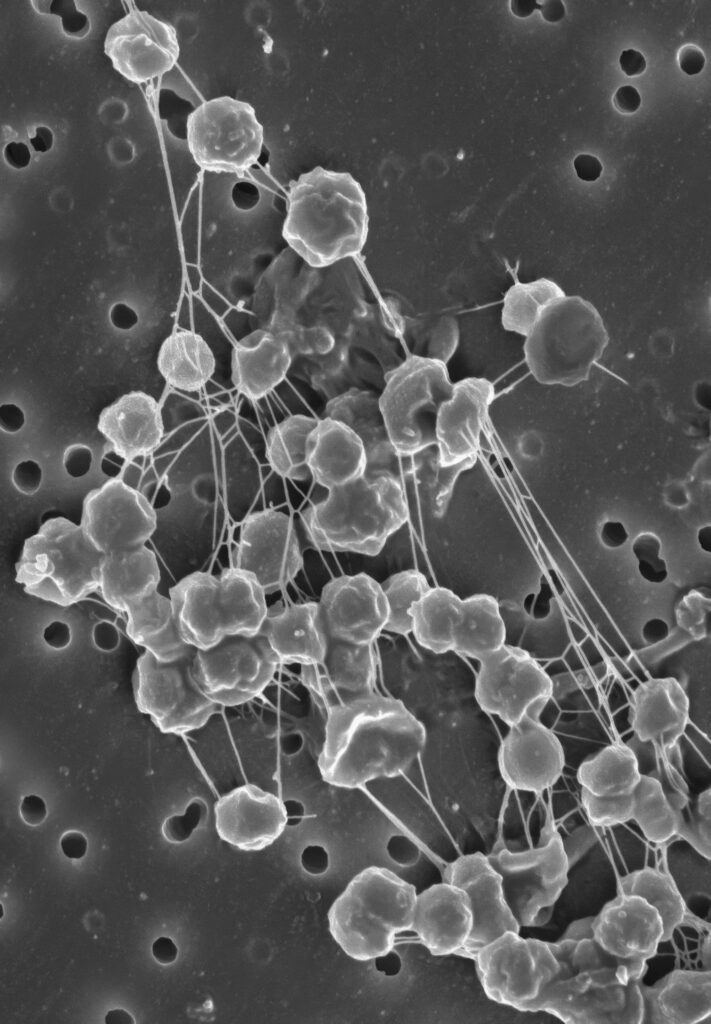
The model is based on methanogens, microbes that produce methane gas. It is possible the first lifeforms on Earth were methanogens, thriving some four billion years ago when the planet was far more depleted in oxygen. These microbes still exist in a wide variety of ecological niches today.
Unlike photosynthetic life, which needs sunlight, methanogens run on chemical energy through a process known as chemosynthesis. As a result, they are adaptable and provide a useful model for considering the emergence of life in diverse habitats, including dark regions that receive no direct starlight.
Nicholson noted that Earth’s early biosphere did have a big component producing and consuming methane. That gives a starting point to look at other planets. It is a reaction that works on Earth and is thought to work in environments very different from ours.
What the simulation found
The team developed a baseline model of a spherical methanogen microbial cell. They tinkered with different cell sizes, life cycles, and environmental effects that might evolve in various alien biospheres.
The results showed a planet’s levels of hydrogen and methane are sensitive to the microbe’s particular features. In this way, life acts to ‘erase’ abiotic aspects of its environment by transforming the composition of gases in the atmosphere in ways that could be detectable to astronomers.
The team also speculated that resource competition on alien worlds would likely favor methanogens that are smaller and longer-lived. These would outcompete similar species that are shorter-lived, larger, or require more energy.
However, predicting exactly what lifeform is producing those signals remains a challenge. Nicholson said you could have different life forms in your ocean and they would look the same in terms of a biosignature. You could have a single film of some algae covering the whole ocean, or a little amoeba, or maybe something else.
She added that using spherical microbes as a representation means that even if we found a biosignature and it all made sense, we still would not actually know what they look like.
Future steps
Nicholson and her colleagues plan to continue this line of research by modeling simplified cells of photosynthetic life and predicting their impact on different exoplanet environments. Ultimately, these studies will help scientists distinguish between genuine biosignatures and complex atmospheric chemistry that arises from geological activity.
What it means
The reality is, we are looking at a habitable planet like our own. If we find anything, they will be life forms embedded in their world, just like we are embedded in our world. We do not live in sci-fi. It is more likely that we would discover gassy signs of life in a distant world’s skies and then have to accept that we might never learn its specific nature.