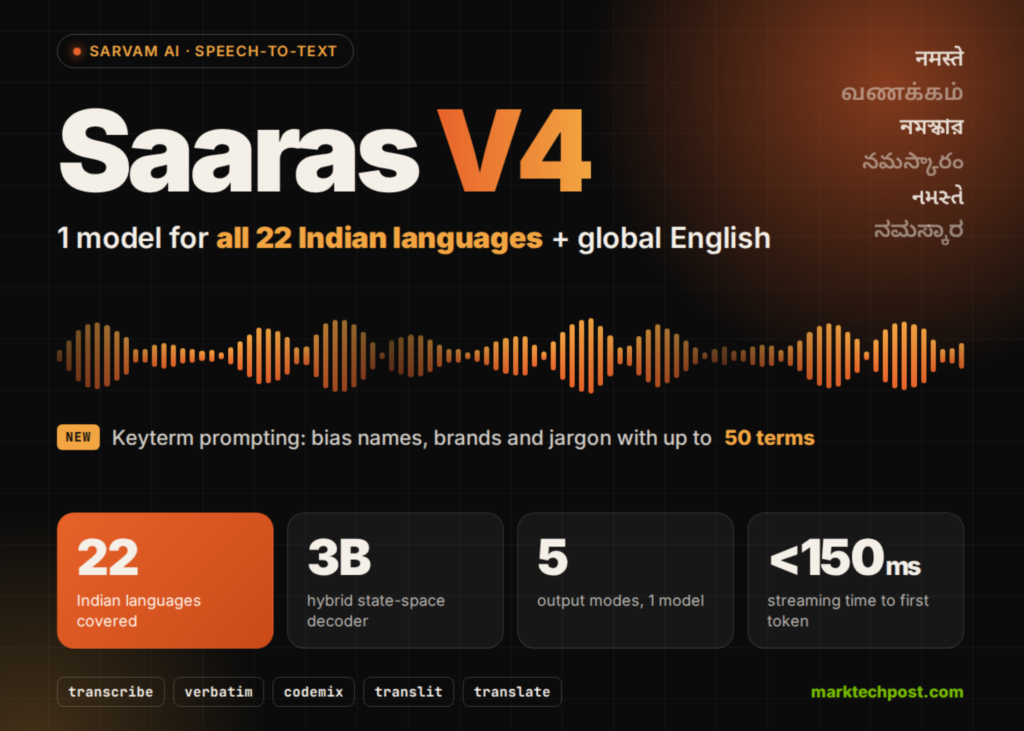
Sarvam AI has launched Saaras V4, a speech recognition model covering all 22 scheduled Indian languages plus global English.
The company claims state-of-the-art accuracy across the full language set. Deployment is available via API today using the model="saaras:v4" parameter. Weights remain private. Self-hosting documentation currently covers Saaras v3 only.
How the model works
Saaras V4 uses an encoder-decoder architecture. An audio encoder converts the waveform into embeddings containing phonetic and acoustic details. A temporal-downsampling adapter then shortens this sequence and projects it into the language model’s embedding space. This step keeps long recordings within the decoder’s context budget.
The decoder is Sarvam-3B, a 3-billion parameter hybrid state-space language model trained from scratch. It reads audio features alongside a text prompt. The system emits the transcript autoregressively, feeding each token back as input for the next step.
Performance figures
Sarvam evaluated 7 English datasets. Six come from Hugging Face’s Open ASR Leaderboard: AMI, GigaSpeech, LibriSpeech clean, LibriSpeech other, SPGISpeech and VoxPopuli. The seventh is AI4Bharat’s Indian-accented Svarah. Scoring follows the leaderboard’s normalization code. Saaras V4 posts the lowest average Word Error Rate (WER) among the models Sarvam benchmarked.
For Indian languages, results come from the Vistaar benchmark. Sarvam reports figures for 10 languages using both WER and LLM-WER. LLM-WER adds a semantic check. It separates real meaning errors from harmless spelling or formatting variants common in Indic scripts.
On Kathbath Noisy, measured with LLM-WER, Sarvam says Saaras V4’s error rate is under half that of Deepgram Nova-3 and GPT-4o Transcribe. The set includes compressed, clipped and background-heavy recordings.
Language identification error is 2.9% across the top 10 Indian languages on verified IndicVoices utterances. It is 5.22% across all 22 languages.
It is important to note that all numbers above are vendor-reported. Independent reproduction has not been published yet.
Five output modes from one model
The same audio can return 5 representations, selected through the mode parameter:
- transcribe (default): native script with numbers and dates normalized.
- verbatim: every word as spoken, fillers and spoken numbers kept.
- codemix: native script, with English words left in English.
- translit: the full utterance in Latin script.
- translate: an English translation with numbers normalized.
Sarvam’s argument is simple. Handling these inside the model removes post-processing steps that can compound errors.
Keyterm prompting
Keyterm prompting is new in V4 and works only with saaras:v4. You pass a JSON list under keyterms, with up to 50 terms of 64 characters each. Keyterms bias recognition; they do not guarantee output. Use codemix mode when a brand such as PhonePe must stay in Latin script.
On IndicContextEval, Saaras V4 reports 16.03% WER in the L5 keyword-prompting setting. Sarvam says that is the lowest score on the benchmark.
Streaming, long audio and pricing
- Streaming: WebSocket with partial results and time to first token below 150 ms.
- REST: synchronous transcription for clips up to 30 seconds.
- Batch: asynchronous jobs up to 2 hours per file, with optional speaker diarization.
- SDKs: Python 3.9+ and Node.js 18+, plus LiveKit Agents, Pipecat and Vercel AI SDK integrations.
- Price: Sarvam lists speech-to-text at ₹30 per hour for real-time, streaming and batch, and ₹45 per hour with diarization.
Saaras v3 stays the default model. V4 uses the same request shape, so switching is a 1-line change.
Comparison with competitors
These are the 3 systems Sarvam benchmarked against. Figures come from each vendor’s public docs and pricing pages, checked on September 26, 2026.
| Feature | Sarvam Saaras V4 | Deepgram Nova-3 | ElevenLabs Scribe v2 | OpenAI GPT-4o Transcribe |
|---|---|---|---|---|
| Indian scheduled languages (of 22) | 22 | 11 | 14 | Not listed per language |
| Total languages | 23 (22 Indian + English) | 45+ | 90+ | Multilingual |
| Keyterm biasing | Up to 50 terms | Yes, paid add-on | Up to 1,000 (batch), 50 (realtime), paid add-on | Free-text prompt |
| Built-in output modes | 5 (transcribe, verbatim, codemix, translit, translate) | Transcript plus Smart Formatting | Verbatim or no_verbatim | Transcript |
| Real-time streaming | WebSocket, under 150 ms TTFT (vendor claim) | Yes (WebSocket) | Scribe v2 Realtime, about 150 ms | File streaming; live via Realtime API |
| Speaker diarization | Batch API | Yes | Up to 32 speakers | Separate gpt-4o-transcribe-diarize model |
| List price | ₹30/hour | $0.0052/min (multilingual, pre-recorded) | $0.22/hour (batch) | ~$0.006/min |
| Self-hosting | Not for V4 yet (v3 on SageMaker) | Yes | Cloud API | Cloud API |
What it means
Developers in India gain a single API endpoint for 22 local languages and global English. The five output modes allow users to choose between strict transcription, verbatim speech, or code-mixed formats without writing custom post-processing scripts. Pricing at ₹30 per hour is competitive for real-time use, though self-hosting remains unavailable for this specific version.