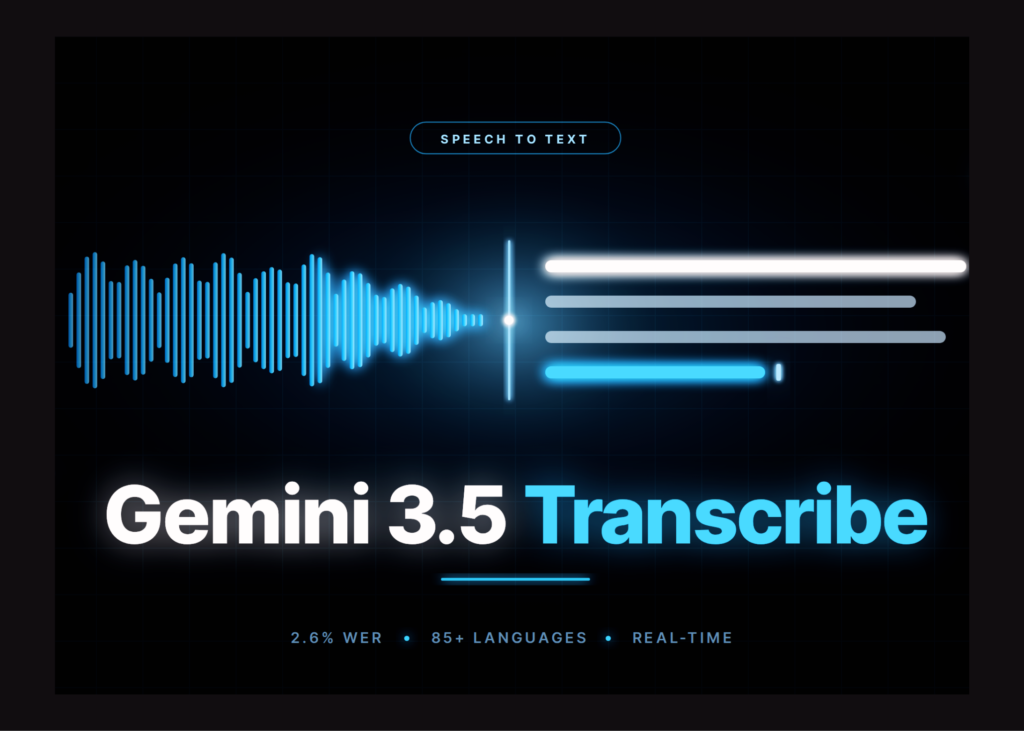
Google has released Gemini 3.5 Transcribe, a speech-to-text model designed for real-time voice interfaces and recorded audio. The service splits into two distinct endpoints rather than offering a single unified tool. The gemini-3.5-transcribe endpoint processes pre-recorded files via the Interactions API, while gemini-3.5-transcribe-live handles bidirectional streaming through the Live API. Google reports an average word error rate of 4.0% for streaming and 2.6% for non-streaming work, figures measured by Artificial Analysis. Time to final transcription improves by 70% compared to Chirp 3, the previous model. Automatic detection covers more than 85 languages, including mid-sentence code-switching. The separation between the two endpoints is the part worth planning around. They do not share the same feature set, limits, or price.
Is it deployable
Yes, but API-only. There are no open weights and no self-hosted path. This is a managed-service decision, not an infrastructure one.
- Company level: Any. Solo developers and startups can start on the Gemini API free tier via Google AI Studio. Mid-market teams move to the paid tier for higher rate limits. The paid tier also guarantees content is not used to improve Google’s products. Regulated enterprises route through the Gemini Enterprise Agent Platform, which adds provisioned throughput, compliance controls, and volume discounts. Both developer and enterprise tracks are in public preview, so treat production commitments accordingly.
- Industries: Contact centers and CX platforms, clinical documentation, media captioning and localization, legal and insurance intake, meeting tooling, and voice-driven developer tools.
- Applications: Real-time voice agents, live captioning, post-call analytics pipelines, meeting transcription with speaker attribution, dictation, and voice-controlled interfaces.
Two API surfaces, two different products
The Live API delivers sub-second, continuous transcription. It emits interim_input_transcription for speculative partials while someone is still talking, then input_transcription when the turn finalizes. Audio goes in as raw 16-bit PCM at 16kHz mono, in 100ms chunks. It supports automatic, hybrid, and manual voice-activity detection. Ephemeral tokens let mobile and web clients stream without holding an API key.
The constraints are real. Live sessions cap at 10 minutes of continuous streaming. Speaker diarization is not supported. Word-level timestamps are not supported.
The Interactions API covers what streaming cannot. It offers speaker diarization, word-level start and end offsets, and custom vocabulary biasing. The vocabulary list takes up to 1,000 terms, with best results below 100. Standard requests accept up to one hour of audio. That drops to 30 minutes once diarization or word timestamps are enabled.
Verbatim and smart are the real design decision
Both endpoints expose two modes. verbatim is the default and returns everything, including fillers, repetitions, and false starts. smart removes disfluencies, resolves spoken self-corrections inline, and applies structured formatting.
Google’s own documented example: “Um, so for the meeting, I think we should, uh, invite Alice and, wait no, Bob and Carol.” Verbatim keeps all of it. Smart returns “For the meeting, I think we should invite Bob and Carol.”
Smart mode cannot be combined with word timestamps or diarization. That is the tradeoff to plan around. A readable summary and an auditable transcript are now two different API calls.
Performance
As measured by Artificial Analysis, Google reports an average word error rate of 4.0% for streaming and 2.6% for non-streaming. On the multilingual FLEURS benchmark, across a set of top languages and locales, the model reports 5.50% streaming and 5.04% non-streaming.
Against Chirp 3, Google’s previous transcription model, time to final transcription improves by 70%. Language coverage spans over 85 locales with automatic detection and code-switching handled without configuration.
Ecosystem
The Live API is already wired into LiveKit, Pipecat, Agora, Fishjam, Vercel, and Vision Agents. On the consumer side, the model powers Rambler on Android, the Gemini app on macOS, and Google Antigravity. Chrome is listed as coming soon.
What it means
Developers building voice tools must choose between speed and detail. The Live API is for immediate feedback where missing a word or two is acceptable. The Interactions API is for records where accuracy and speaker identification matter. Users should note that cleaning up speech errors requires a separate call from generating a timestamped log. There is no free version for heavy usage beyond the initial free tier. The 10-minute live session limit means long interviews require manual segmentation.