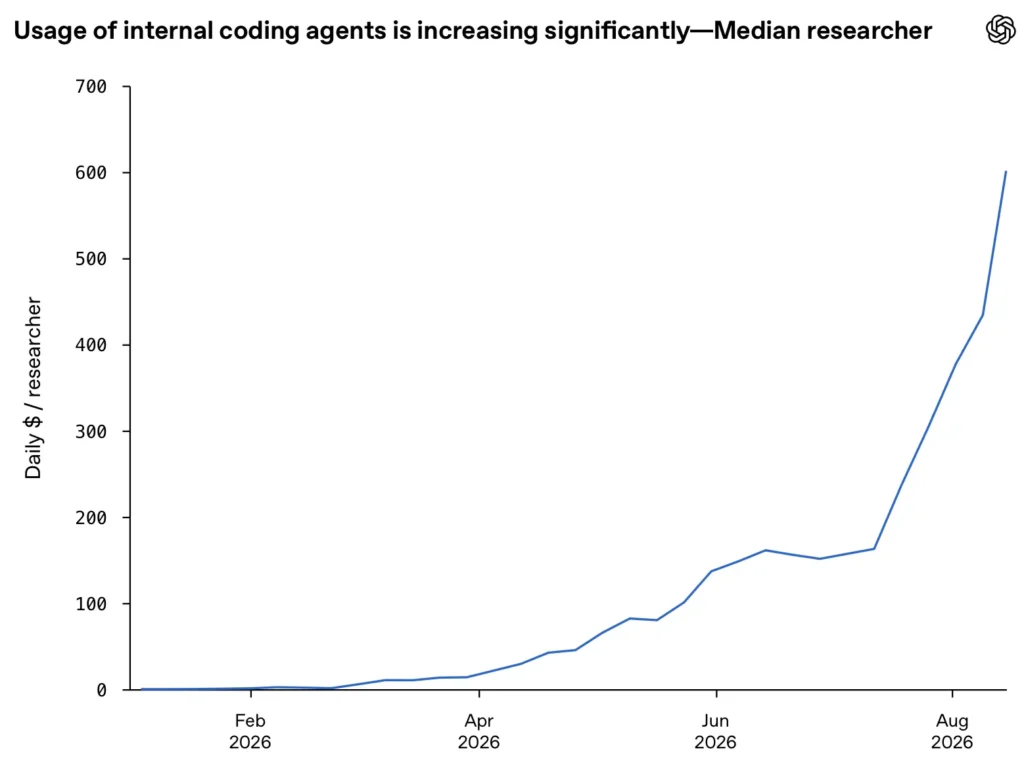
OpenAI has released a new internal report titled Research acceleration: The view inside OpenAI, alongside a companion essay called An Alien Mind by Chief Scientist Jakub Pachocki. The documents describe Recursive Self-Improvement as the company’s current approach to artificial general intelligence without expanding the acronym. The text details how internal research teams are deploying coding agents to automate tasks and increase output. A chart within the report tracks daily spending per researcher from February to late August 2026. The line graph shows costs remaining near zero until February, rising slowly to about fifty dollars by April and one hundred fifty by June. Spending then plateaus between one hundred fifty and one hundred sixty-five dollars through July before climbing steeply to roughly six hundred dollars by late August. Simon Willison suggests this sharp increase correlates with employees gaining access to a new model later released as GPT-6 Astra.
This shift indicates a move toward agentic engineering where software writes code and manages workflows rather than humans doing so directly. The data proves that internal tooling has fundamentally changed how the organisation allocates budget and measures productivity. The rapid rise in spend per head suggests the company is investing heavily in infrastructure to support these autonomous systems. This operational change marks a significant step in how large models are now integrated into daily work routines.
- Spending per researcher jumped from one hundred fifty to six hundred dollars in late summer
- The spike coincides with internal access to the GPT-6 Astra model
- Agentic engineering has become the primary method for daily research tasks