Over a decade in the making
Reason’s RV-9 is a major addition to Reason 14, featuring algorithmic reverb, spectral and granular effects, along with plate, spring, and reverb. It also includes many extras such as shimmer and enhanced patchability. Let’s take a deep dive into how you can make the most of these features.
Thanks to Reason Studios for sponsoring this guide.
Over a decade in the making
The original RV7000 MkII, which debuted in 2015, introduced full convolution reverb capabilities. It allowed users to load their own custom impulse response files (even sampling audio into them). This means you can use any waveform as a model of a reverberant chamber-whether real or imagined. The original version with convolution-based reverb presets and multi-tape delays was from all the way back in 2005, as seen in this vintage sound design guide from Sound on Sound.
While RV-9 doesn’t replace these functionalities, it does offer a more modern look and feel. The UI has been fully reworked with enhanced visual feedback. It introduces new features like beat sync on the predelay and a lowpass damping control. These additions are in addition to the existing modes.
Effects tour
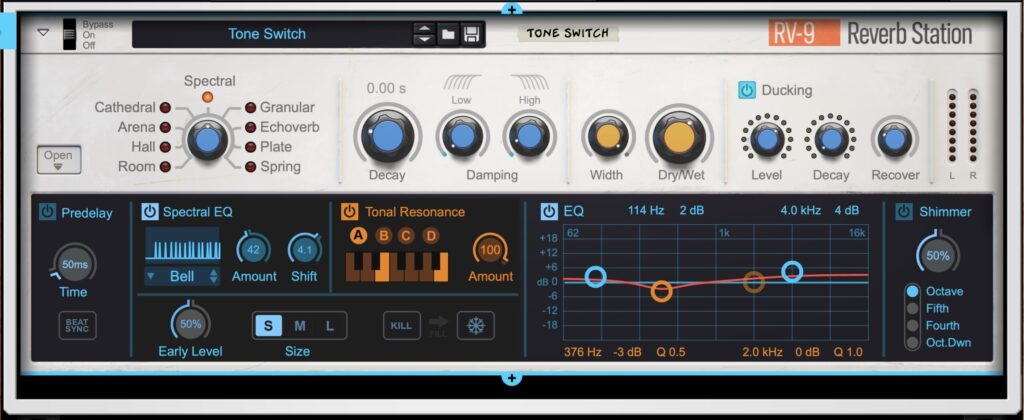
The RV-9 allows you to access various effect types via a dial on its main panel:
- Algorithmic/convolution reverbs: You can choose from Room, Hall, Arena, and Cathedral modes. Each mode offers early level, size, and modulation controls, along with a freeze function (with buffer reset).
- Plate and Spring modeling: Now available are fully modeled plate and spring reverb effects, each offering multiple models for diverse results.
- Echoverb: This is an echo/reverb combination with diffusion controls. The individual echoes can either run freely or be synchronized to the beat. It also features diffused amount and spread settings.
- Granular delay/reverb: RV-9 introduces a granular delay that morphs into textures and granular reverb. This effect is particularly noteworthy for its live processing capabilities, allowing you to manipulate audio in real-time.
- Spectral: The Spectral mode includes both Spectral EQ and Tonal Resonance options. These features are based on a phase vocoder, providing additional CV inputs for further customization.
The RV-9’s unique features include global controls like Predelay, Low Damping, High Damping, Dry/Wet (which can be set to 100% as an insert effect), Ducking with Level, Decay, and Recover settings. Width is also a stereo width control.
Granular
RV-9’s granular mode transforms it from a simple reverb into a live granular processor capable of morphing into textures and granular reverb. The relationship between the input buffer size and grain length determines how much of your recording is included in each grain. This allows for dynamic manipulation of sound textures.
Spectral
The phase vocoder in RV-9’s spectral mode adds a unique flavor to its reverb effects, giving them a distinctive character. The Spectral Size setting controls the size of the transform used to calculate the reverb. This results in a sound that is distinctly phase-vocoder-based.
- Spectral EQ allows for various unique shapes and morphing options.
- Tonal Resonance lets you choose individual notes to ring out while muting other parts of the spectrum, offering presets A-D for harmonic progressions.
- The freeze function (and kill) in Spectral mode provides additional control over these effects.
Patching
One of the most compelling features of RV-9 is its deep CV connectivity. Here’s a quick overview:
- All reverbs feature CV inputs for Decay, low-frequency damping, high-frequency damping, and dry/wet (giving an alternative to ducking).
- Kill and Hold work across associated reverbs, allowing you to trigger these functions with a simple LFO.
- Spectral EQ Shift, Spectral EQ Amount, and Tonal Resonance are available as CV inputs in the Spectral mode.
- Ducking CV lets you route the ducking effect through other modules using an envelope follower.
Let’s see how this works in practice. Here is a gradually modulating piano patch where I use LFOs to trigger kill and freeze functions, shift the spectrum, and add shimmer. This results in an undulating, organic texture that doesn’t require expensive sound libraries.
To learn more about RV-9 or other features of Reason 14:
Key Takeaways
- RV-9 offers a comprehensive suite of reverb, spectral, and granular effects in a single unit.
- The GUI has been updated with enhanced visual feedback and new features like beat sync.
- Patching RV-9 allows for deep integration with other CV-controlled modules, enhancing its potential as a creative tool.