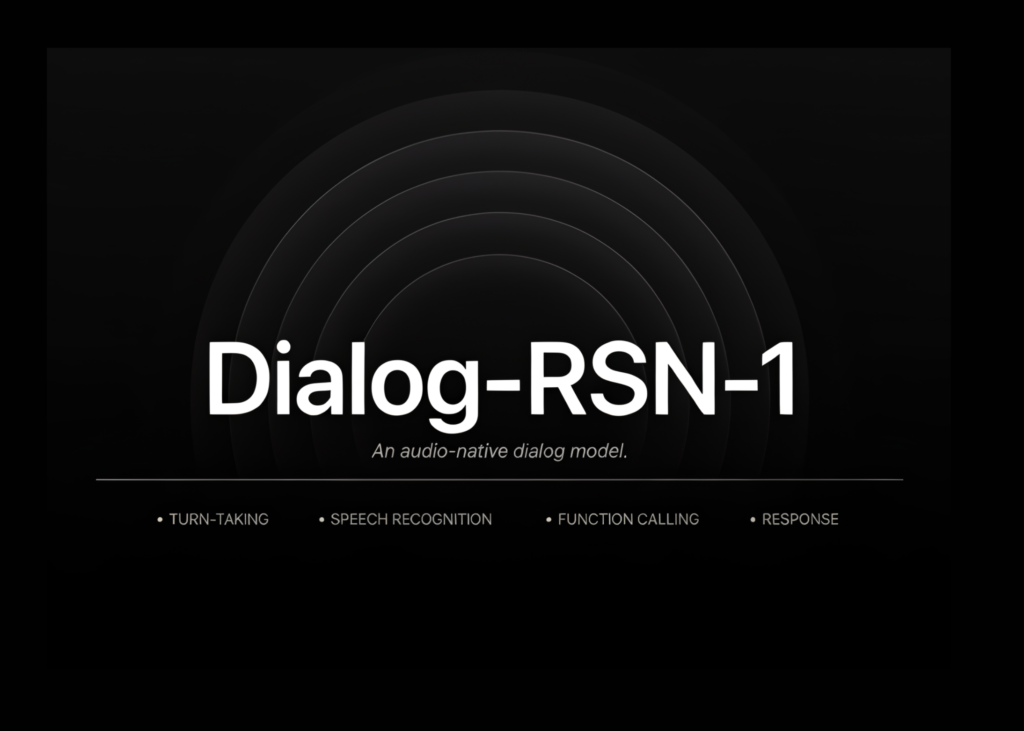
PolyAI has launched Dialog-RSN-1, a new system designed to handle live phone calls by processing raw audio directly rather than relying on text transcripts first.
How the system works
The model combines speech recognition, turn-taking logic, and response generation into a single unit. It listens to the caller and decides immediately whether to interrupt, wait, or reply. The system outputs three specific tokens to manage the conversation flow: EMPTY, ONGOING, or COMPLETE.
Crucially, the output voice remains separate from the listening engine. This means the text-to-speech component stays controllable, avoiding the pronunciation issues found in some all-in-one speech models. The system runs on demand when triggered, rather than keeping a GPU pinned for the entire duration of a call.
Performance and metrics
PolyAI reports response times under 300 milliseconds. Testing with a restaurant group showed an 11% increase in conversation containment, while an insurer saw a 37% drop in latency.
The company evaluated the model on an internal benchmark called Dialog-Eval. Dialog-RSN-1 achieved a score near 77 on audio-aware examples, placing it above cascaded stacks that lose tone and hesitation data. It also outperformed GPT Realtime 2.1 on similar tests. When acting as a transcription layer, the model reduced word error rates from 7.8% to 6.9% compared to gpt-4o-transcribe.
Deployment and availability
There are no open weights or public API access at launch. Existing PolyAI customers can enable the feature immediately. New clients must request early access through the company platform.
The target audience is large enterprises with high call volumes. PolyAI currently serves over 100 enterprise clients and has 2,000 live deployments, following an $86M Series D funding round in December 2025. Small businesses and individual developers are not the primary focus.
Supported industries include restaurants, insurance, financial services, healthcare, hotels, retail, telecom, travel, and utilities. Use cases cover booking reservations, billing payments, authentication, call routing, order management, and troubleshooting.
Technical construction
Developers post-trained open-weight models using supervised and reinforcement learning on internal data. The pipeline tested Gemma, GPT-OSS, Qwen, and Mistral. To hit sub-300ms targets on A100 GPUs, the team selected models between 8B dense and 30B sparse parameters.
Latency improvements came from prefilling the attention cache while users speak. The system uses an append-only prompt template to prevent cache invalidation and routes each caller to the same GPU. A finetuned speculative drafter accepts an average of 3.9 tokens per guess, while auto-reasoning capabilities were learned during the reinforcement process. Transcription runs only after the response or tool call, in parallel with speech generation.
What it means
For businesses managing high-volume support lines, this approach removes the need to tune separate speech-to-text and language models. It simplifies the stack by handling the timing of the conversation and the generation of the reply within the same audio stream, while keeping the voice synthesis distinct for better control.