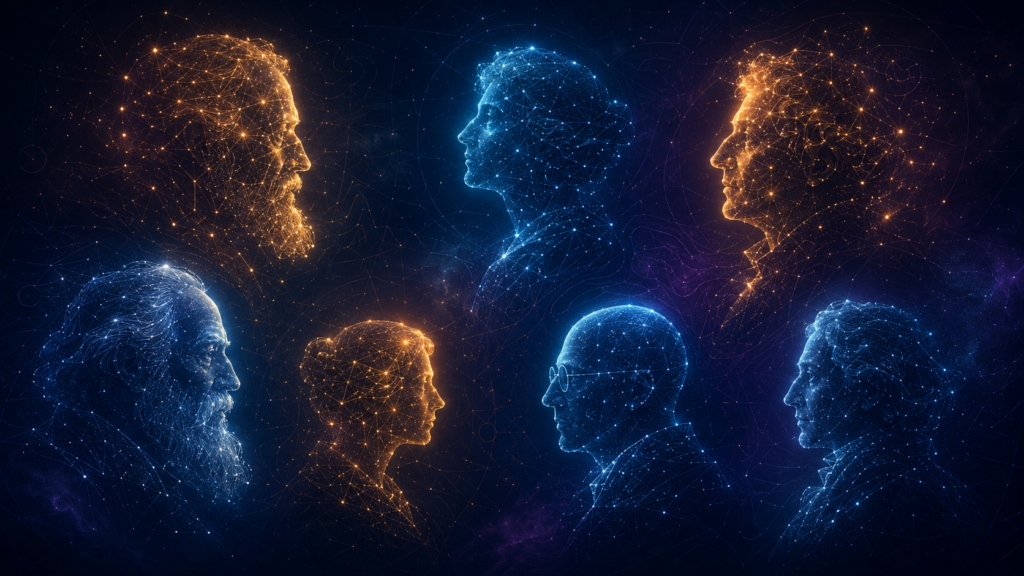
For creators, the new frontier is not just generating text, but simulating the specific cognitive fingerprints of history’s most influential thinkers
If you are building tools that require nuanced, character-driven interaction, you have long struggled to move beyond generic responses. The latest release from Hugging Face, Persona Atlas, shifts the focus from what an AI knows to how it thinks. It allows developers and artists to map the distinct mental models of famous figures like Socrates, Winston Churchill, and Silicon Valley founders, revealing how each would uniquely approach an unanswerable problem.
The methodology behind the mind
The system operates in three distinct stages to construct a believable digital twin.
First, an agent performs live web searches to build a grounded profile. It compiles a public biography, a list of verifiable facts linked directly to their sources, and a “style hypothesis”-a prediction of how that specific mind would tackle a novel scenario.
Second, the persona responds to ten deliberately open-ended prompts covering identity, ethics, truth, free will, and machine consciousness. By avoiding questions with single correct answers, the tool forces the model to reveal its personality rather than just its raw processing power.
Third, every response is converted into an embedding. This transforms abstract thought patterns into data points that can be measured and compared against one another.
Visualising divergence and personality
When you load saved personas into the comparison view, the tool performs two critical analyses. It calculates the distance between answers in embedding space to quantify how much a group diverges in thought. Simultaneously, it scores each persona against ten trait anchors: meticulousness, clarity, creativity, skepticism, confidence, kindness, humor, curiosity, pragmatism, and abstraction.
The results appear as a trait-leaning heatmap, but interpretation requires care. The grid is double-centred, meaning a warm cell does not indicate a high absolute value for a trait. Instead, it shows that a specific persona leans toward that trait more than the others currently in the comparison. Placing a diverse set of figures side by side pulls the rows apart, highlighting contrasts such as one figure running warm on humor and confidence while another leans heavily into abstraction and skepticism.
Technical infrastructure
The entire pipeline relies on small, hosted models via Hugging Face Inference Providers. A compact generator drives the agent, a lightweight embedding model handles the geometry, and live web and image search ensures grounding. The interface is built on Gradio, offering three tabs: research a new run, compare saved personas, and inspect the full agent trace. This trace allows you to verify that the system relies on real sources rather than hallucinating details. A set of prebuilt personas ships with the tool, enabling immediate comparison without requiring a single API token.
How to access
You can begin immediately by opening the “Compare saved personas” tab or researching a new figure to add to the atlas at huggingface.co/spaces/build-small-hackathon/persona-atlas.
Key takeaways
- Persona Atlas moves beyond static knowledge benchmarks to visualise the dynamic thought processes and unique cognitive styles of historical figures.
- By using double-centred heatmaps and embedding distances, the tool highlights relative personality traits rather than absolute values, offering a nuanced view of digital personas.
- The system is built on lightweight, hosted models with live web grounding, ensuring that generated responses are traceable and verifiable.
- Developers can instantly compare prebuilt profiles or research new figures to understand how different minds would approach complex ethical and philosophical questions.