For makers and artists, the current trajectory of artificial intelligence is a source of frustration rather than inspiration. Large language models are voracious consumers of energy and data, requiring massive compute clusters to learn nothing new once they are trained. This inefficiency means that creative tools are becoming prohibitively expensive and environmentally unsustainable. Flourish, a new venture backed by Jeff Bezos, aims to reverse this trend by building a synthetic intelligence system that matches the brain’s energy efficiency and continuous learning capabilities. The goal is to create a model that runs on 50 watts or less, allowing creators to train systems on small datasets without needing gigawatts of power.
The hunt for the core algorithm
Rob Williams, a former Amazon executive who led the S-team responsible for software products like Alexa, recently pivoted from pitching Bezos on building products to pitching him on funding a search. In December 2025, Williams collaborated with Thomas Reardon, a neuroscientist and serial entrepreneur, to present a proposal to Bezos. The pitch, titled Flourish, argued that the industry had solved the wrong problems. While current frontier models are powerful, they are biologically disconnected. A human brain processes information using about 20 watts of energy, whereas a single chip in an AI training cluster consumes more than 30 times that amount. Furthermore, these models require thousands of chips and gigawatts of energy to function, enough to power small cities.
Reardon argues that the current approach is fundamentally flawed. A human baby learns a language with a few hundred thousand utterances, yet current AI systems seem to require reading every book ever written multiple times to achieve basic competence. The solution, Reardon says, is to build a synthetic brain that adapts to its conditions and burns a tiny fraction of the compute power currently required. This approach is not entirely new; IBM and Intel have previously released neuromorphic chips inspired by brain architecture, and UC Berkeley computer scientist Ben Recht notes that scientists decades ago were exploring similar avenues before large language models took over.
Bezos was not deterred by the technical ambiguity of the proposal. After reading Williams’ two-page document, he committed $50 million. Additional funding followed from Lux Capital and Google Ventures. Bezos subsequently increased his stake to nearly double the initial amount, noting he would have invested more had the founders asked. With a war chest of $500 million and a reported valuation of $2.5 billion, Flourish is now focused on inventing a new way to do AI.
A team built for discovery
Thomas Reardon IV, who prefers to be called Reardon, has an unconventional background. He grew up in a working-class family with 18 siblings, dropped out of the University of New Hampshire at 15, and went on to help build Microsoft’s first web browser. He later earned a doctorate in neuroscience from Columbia University and worked at Meta, where he developed a mind-control wristband. Reardon grew dissatisfied with how companies like Meta were building AI, feeling that the industry had abandoned the potential of brain-like efficiency.
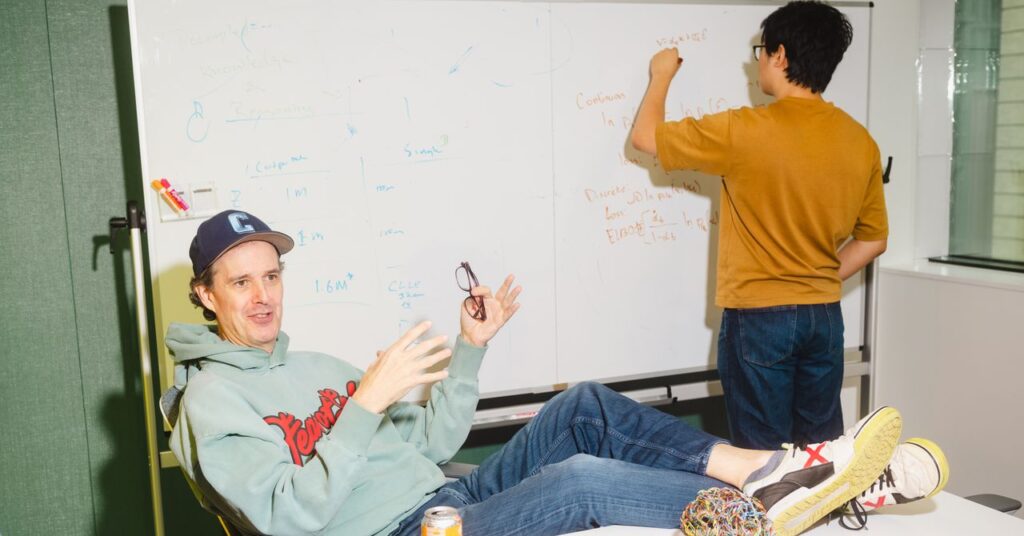
He convinced Williams to join him, leveraging their shared history at Microsoft. Another key recruit is Greg Wayne, a longtime researcher at DeepMind who heads Project Astra. Wayne agreed to split his time between DeepMind and Flourish, dedicating 20 percent of his effort to the new project. By the end of March, Reardon had hired around two dozen top neuroscientists and AI researchers. The company moved into a 10-story office in New York City’s West SoHo area, complete with a built-in data center.
The strategy relies on a tight feedback loop between wet lab experiments and algorithm development. Neuroscientists will use advanced equipment, such as electron microscopes, to study the brain’s architecture, while the algo team builds models informed by these discoveries. One of the investors is Jacob Vogelstein, a neuroscientist turned venture capitalist who co-founded the Open Connectome Project. Vogelstein and his brother Joshua recently coauthored a paper finding that a fruit fly’s neural network is 10 times more efficient than the transformer architecture used in large language models.
This efficiency gap is the target. Reardon’s team is developing a hippocampus-inspired method for handling memory, which would allow models to learn continuously without extensive training data. They are also negotiating with major chip manufacturers to embed these models onto silicon. The team is open to publishing original research to validate their findings.
A risky bet on the future
In early May, the Flourish team held an all-hands meeting to debate six potential experiments. These are high-stakes initiatives requiring multimillion-dollar microscopy machines and years of work. The scientists are debating whether to examine molecules and synapses or focus on larger-scale cells and circuits. The consensus is to attempt data collection across the nano, micro, and meso scales to support the discovery of the core algorithm.
Greg Wayne described the experimental plan as practical rather than insane. However, the mission remains a long-range bet. Rob Williams notes that Bezos wanted to know if the founders were committed to spending years on this challenge. When they affirmed their commitment, the funding was released. Williams emphasizes that you cannot make significant differences in three years; you must plan for value seven to 10 years out. Reardon hopes to have a big solution in five years.
Ben Recht, a Flourish adviser, admits he is not convinced the mission will succeed, but if it does, AI would never be the same. A lot of data centers might fall empty.
Key takeaways
- Flourish is raising $500 million to build a synthetic intelligence system that matches the human brain’s energy efficiency, aiming to run on 50 watts or less.
- The venture combines deep neuroscience with AI research, using wet lab experiments to discover the brain’s core algorithms for continuous learning and memory.
- Jeff Bezos and other investors are backing a high-risk, long-term strategy that could fundamentally change how AI models are trained and deployed.