Nvidia has released Nemotron 3.5 Lightning, an open-weight model that matches the intelligence of OpenAI‘s gpt-oss-120b using only a quarter of the parameters.
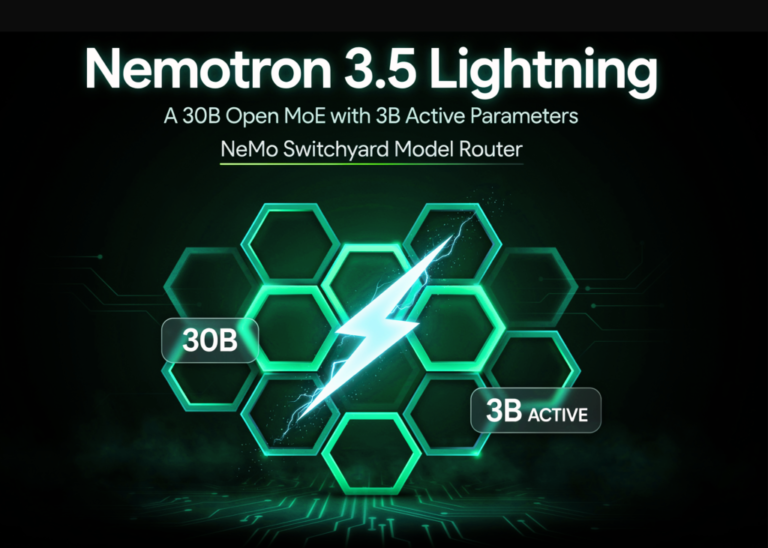
This is the first release in the new Nemotron 3.5 series. It replaces the Nemotron 3 Nano 30B A3B and retains a hybrid Mamba-Transformer structure. The model contains 31.6 billion total parameters, though only 3.6 billion are active at any one time.
Artificial Analysis, an independent benchmarking platform, scores the model 24 on its Intelligence Index. This represents a nine-point increase from the predecessor’s score of 15. The result places Lightning on par with gpt-oss-120b. It trails only Nvidia’s own Nemotron 3 Super, which scores 26 and is roughly four times larger. Models in the same size class, such as Qwen3.6 35B A3B (32) and Meta’s Muse Glimmer (35), still outperform it.
The focus here is on efficiency rather than raw scale. In pre-release tests using final NVFP4 weights, the model reached nearly 670 tokens per second. This is the highest throughput among all models tested and almost double the speed of Google’s Gemini 3.5 Flash-Lite, which achieved 386 tokens per second. A standard task from the Intelligence Index takes about 0.5 minutes to complete. By comparison, Qwen3.6 35B A3B requires around 3.5 minutes, while Gemma 4 31B takes roughly 5.8 minutes.
Proprietary models continue to lead the overall efficiency frontier. Gemini 3.5 Flash-Lite scores 37 on the Intelligence Index with a similar time per task. GPT-5.6 Luna (max) reaches 52 points in under two minutes.
Agentic benchmarks show the biggest gains
Improvements are most visible in agentic benchmarks. On GDPval-AA v2, Lightning achieves an Elo rating of 824. That is a 334-point gain over the Nemotron 3 Nano. It beats both gpt-oss-120b (800) and the larger Nemotron 3 Super (698). On Terminal-Bench v2.1, the score jumps from 7 to 24.3 percent, nearly matching gpt-oss-120b at 26.2 percent.
Nvidia ships the model under the permissive OpenMDW-1.1 license. The company positions it as a high-throughput workhorse for agent-based pipelines. Artificial Analysis reports that Nvidia worked with partners like CodeRabbit and Harvey on post-training to boost performance in specific domains.
Availability
The model is available in both BF16 and NVFP4 weights. The NVFP4 variant also scores 24 on the Intelligence Index with minimal quality loss compared to the higher-precision version. The reasoning model handles text only and supports a context window of one million tokens. Weights are available now. Serverless inference is offered by DeepInfra, Fireworks, FriendliAI, CoreWeave, GMI Cloud, Nebius, and Crusoe, among others.
Nvidia’s push for efficiency over size is not new. In a widely discussed paper last year, its researchers argued that models under 10 billion parameters can handle most agent workloads as well as 70- to 175-billion-parameter models at one-tenth to one-thirtieth the cost. Nemotron 3.5 Lightning has 31.6 billion parameters but activates only 3.6 billion per step, putting it in the same lightweight class. At nearly 670 tokens per second, it also beats gpt-oss-120b and the larger Nemotron 3 Super on agentic benchmarks, making it the clearest product-level proof of that thesis yet.
What it means
For developers building autonomous agents, this model offers a practical alternative to larger, slower systems. The speed allows for faster iteration and lower latency in complex workflows without sacrificing the ability to execute multi-step tasks effectively.