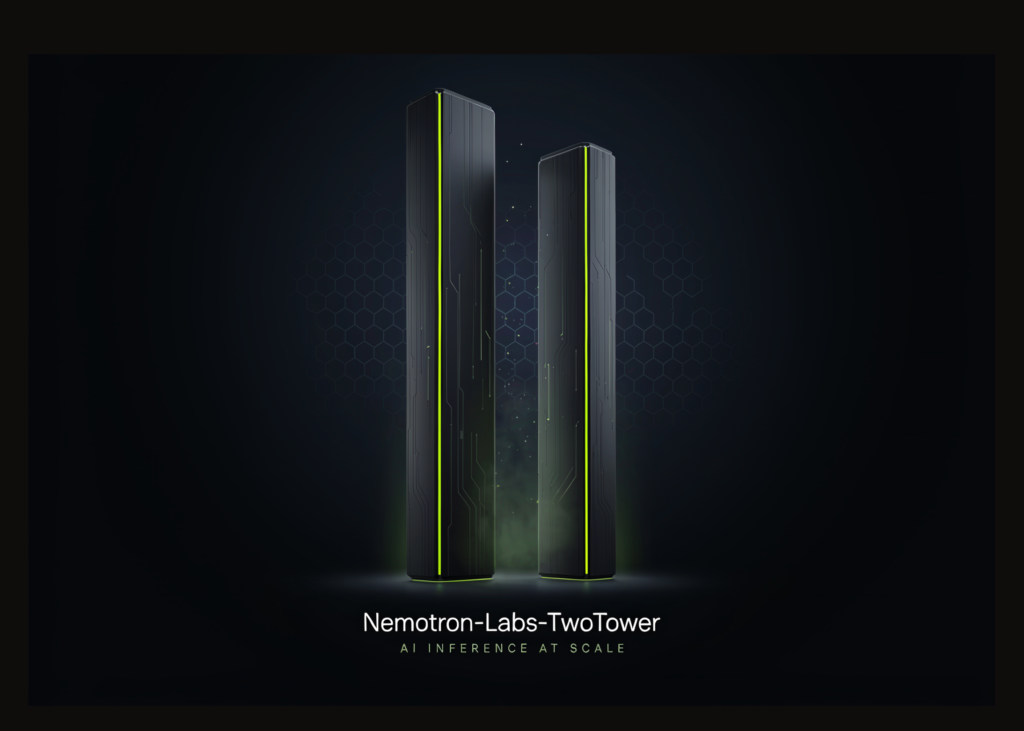
NVIDIA has launched Nemotron-Labs-TwoTower, an open-weight diffusion language model designed to speed up text generation. The release targets a specific bottleneck in how current autoregressive models decode tokens one by one. It runs under the NVIDIA Nemotron Open Model License.
Standard autoregressive models process text serially, limiting how much can be produced at once. Diffusion language models take a different route. They generate tokens in parallel and refine them iteratively.
Most diffusion models use a single network to handle two distinct tasks simultaneously. TwoTower separates these jobs into two separate towers. It maintains 98.7% of the quality seen in the autoregressive baseline while reporting 2.42 times higher wall-clock generation throughput.
Architecture breakdown
The system splits diffusion into a frozen autoregressive context tower and a trained denoiser tower. Each tower contains 52 layers: 23 Mamba-2 layers, 6 self-attention layers, and 23 mixture-of-experts (MoE) layers. The released checkpoint ships both towers, bringing the total parameter count to roughly 60 billion. Active parameters per token are about 3 billion for each tower. The MoE structure uses 128 routable experts, of which 6 activate, plus 2 shared experts.
Both towers start as copies of the same Nemotron-3-Nano-30B-A3B backbone checkpoint. Only the denoiser tower is trained. The autoregressive context tower remains frozen. The denoiser was trained on approximately 2.1 trillion tokens, a fraction of the backbone’s 25 trillion token pretraining.
How the Two Towers Work
The autoregressive context tower runs causally over the prompt and committed tokens. It produces per-layer key-value cache and final Mamba-2 states. This preserves the backbone’s autoregressive capability.
The diffusion denoiser tower refines noisy blocks. Within a block, it uses bidirectional in-block attention. It stays causal with respect to past clean blocks.
The towers connect layer-by-layer. Denoiser layer i cross-attends to context tower layer i. This layer-aligned cross-attention gives multi-scale access to the backbone’s representations. Prior approaches broadcast only the last hidden state.
Two more denoiser modifications matter. Mamba-2 layers seed their initial state from the context tower’s Mamba state. The diffusion timestep modulates each layer through adaLN-single time conditioning. That adaLN module adds only approximately 1.5 million parameters.
Generation runs block by block. Each block starts as S [MASK] tokens. The denoiser refines it over T steps, then commits it. The context tower then processes committed tokens to update its caches.
This explains why multiple denoising steps can still beat one-token decoding. Autoregressive decoding commits exactly one token per step. TwoTower commits multiple tokens per step early in refinement.
Benchmarks
Evaluations use BF16 on 2×H100 GPUs. The default operating point is confidence unmasking, threshold γ=0.8, block size S=16. The table compares the AR baseline against TwoTower diffusion decoding.
| Task | Nemotron-3-Nano-30B-A3B (AR) | Nemotron-Labs-TwoTower (diffusion) |
|---|---|---|
| MMLU (5-shot, acc) | 78.56 | 78.24 |
| MMLU-Pro (5-shot, CoT EM) | 62.59 | 60.93 |
| ARC-Challenge (25-shot, acc_norm) | 91.72 | 92.66 |
| WinoGrande (5-shot, acc) | 76.09 | 76.09 |
| RACE (0-shot, acc) | 88.90 | 88.90 |
| HumanEval (0-shot) | 79.27 | 75.58 |
| MBPP-Sanitized (3-shot) | 74.71 | 74.28 |
| GSM8K (8-shot, acc) | 92.49 | 90.14 |
| MATH-500 (4-shot) | 84.40 | 80.60 |
| MMLU Global Lite (5-shot) | 73.97 | 73.94 |
| MGSM (8-shot, avg acc) | 80.80 | 80.40 |
| Quality retained | 100% | 98.7% |
| Generation throughput (× AR) | 1.0× | 2.42× |
General knowledge stays within about one point of the AR baseline. Code and math show modest degradation. Commonsense and multilingual scores are recovered or slightly improved. Lowering γ commits more tokens per step and raises throughput, with reduced quality.
Running It: Three Generation Modes
The checkpoint exposes three inference paths. Full two-tower diffusion uses 2 GPUs, about 59GB per GPU in BF16. AR-only mode runs on a single 80GB GPU.
import torch
from transformers import AutoTokenizer, AutoModelForCausalLM

model_name = "nvidia/Nemotron-Labs-TwoTower-30B-A3B-Base-BF16"
tokenizer = AutoTokenizer.from_pretrained(model_name)
model = AutoModelForCausalLM.from_pretrained(
    model_name, torch_dtype=torch.bfloat16, trust_remote_code=True,
)
# context tower -> GPU 0, denoiser tower -> GPU 1
model.place_towers_on_devices("cuda:0", "cuda:1")
model.eval()

prompt = "France is a country "
inputs = tokenizer(prompt, return_tensors="pt").to("cuda:0")

outputs = model.generate_mask_diffusion(
    inputs["input_ids"], max_new_tokens=128,
    block_size=16, steps_per_block=16, mask_token_id=3,
    temperature=0.1, confidence_threshold=0.8,
    eos_token_id=tokenizer.eos_token_id,
)
print(tokenizer.decode(outputs[0][inputs["input_ids"].shape[1]:], skip_special_tokens=True))
The three modes are generate_mask_diffusion(), generate_mock_ar(), and generate_ar(). Mask diffusion commits up to block_size tokens per step. Mock-AR and AR commit one token per step.
Where It Fits: Use Cases
The most direct use case is faster batch generation. A data team producing synthetic text can trade a small quality drop for throughput. At γ=0.8, that trade is 1.3% quality for 2.42× speed.
A second use case is tuning the quality–throughput trade-off. Raising γ preserves more quality, as per the NVIDIA’s paper. Lowering γ commits more tokens per step for speed.
A third use case is drop-in adaptation. The context tower keeps its LM head for speculative decoding, verification, or AR scoring. Teams can run AR and diffusion from one checkpoint.
Strengths and Weaknesses
Strengths:
- Open weights under the NVIDIA Nemotron Open Model License; ready for commercial use
- 98.7% of AR quality retained at 2.42× throughput at the default operating point
- One checkpoint supports diffusion, mock-AR, and AR decoding
- Denoiser trained on ~2.1T tokens, not a full re-pretrain
- Sequence-length cache memory scales like the AR baseline
Weaknesses:
- Full two-tower diffusion needs 2 GPUs and ~59GB per GPU in BF16
- Code and math degrade more than general knowledge (HumanEval 79.27 → 75.58)
- Keeping both towers resident raises the fixed model-weight memory footprint
- Released checkpoint is a base model, before instruction tuning or alignment
- Throughput past 3× comes with larger quality loss
What it means
Developers now have a tool to bypass the serial decoding limit without retraining a massive model. The context tower preserves the original intelligence, while the smaller denoiser tower handles the heavy lifting of parallel refinement. This setup allows teams to generate text blocks rather than single tokens, offering a practical speedup for data generation tasks where a minor quality trade-off is acceptable.