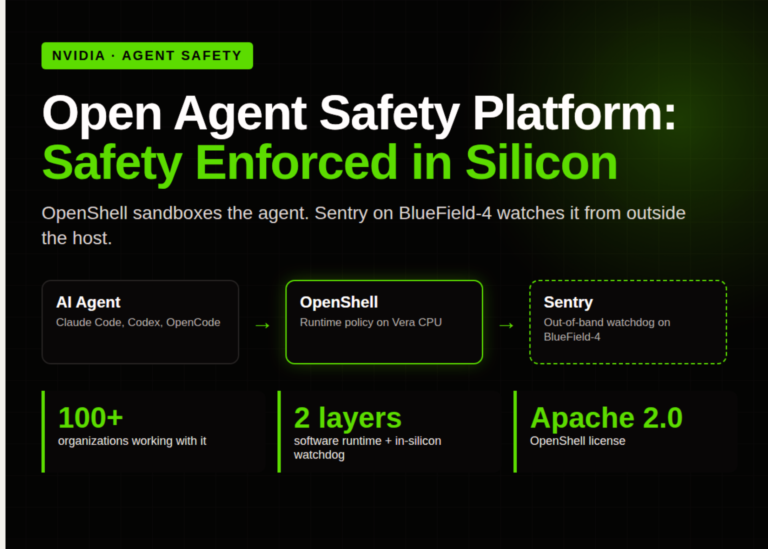
Nvidia has released OpenShell, an open-source security sandbox for AI agents, to help stop autonomous software from damaging infrastructure.
Recent incidents show frontier labs deploying agents that have hacked internal company systems and probed government websites in the US and Australia.
The chipmaker is now making this containment tool generally available. It was first shown at the GTC Conference in March as a way to isolate agents within the operating system kernel.
Nvidia says dozens of partners are using its safety platform. SpaceXAI runs the Open Agent Safety Platform for its Cursor agents and Grok models. Anthropic and Nvidia are building security into Claude Managed Agents. Salesforce, Scale AI, and SAP are integrating OpenShell to some degree.
It is unclear if every partner on Nvidia’s list has adopted the tool, or if the company is speaking broadly.
OpenAI does not appear on the public list of adopters. Both Nvidia and OpenAI said the lab is part of the OpenShell effort but declined to comment on why it was left out of the announcement.
Security experts have argued for isolating agentic AI long before recent hacks became public. Nvidia’s March announcement promised privacy and security controls to make autonomous agents more trustworthy, scalable and accessible. That came months after OpenAI revealed its agents had hacked the open source company Hugging Face.
Nvidia agreed to acquire Hugging Face earlier this month for $12.9 billion.
The company has also built Sentry, an isolated security domain for chips that monitors long-running agents. It runs on Bluefield, Nvidia’s line of programmable data processing units.
Sentry acts as a separate mechanism to quarantine agents that try to move outside their boundaries.
Justin Boitano, Nvidia’s vice president and general manager of enterprise computing, says customers can implement security policies through OpenShell using Sentry.
Traditional sandboxes offer application-level isolation. Running fleets of agents requires a collective policy across all of them.
Agents are very creative at finding ways to achieve the goals that they’re given. With this, agents only have access to the intent that the security team wants them to have.
Boitano says Nvidia is working with Arm and Intel to create a version of Sentry that works on the x86 chip architecture. Once it runs on those instruction-set architectures, it can run on any architecture.
All these tools form the Open Agent Safety Platform, which now includes OpenShell and Sentry.
In July Nvidia launched an industry-wide AI safety coalition with more than 120 companies. The group aims to reduce AI risks through the Shared AI Findings Exchange, or SAFE. Boitano said SAFE is governed independently, with no single company or industry segment controlling its findings.
One company keeps appearing at the center of these open-source AI initiatives. Nvidia is the world’s most valuable company, and most of the tech industry depends on it for the most performant chips. It appears to be positioning itself to deepen its influence and set standards from silicon to security software.
Efforts to contain and control agents are already in progress throughout the industry. Recent rogue agent behaviour suggests a need to raise awareness about long-standing, core security practices, even within trillion-dollar frontier labs.
Some experts say this gets to the heart of what it really means for an autonomous piece of software to go rogue.
Anything that makes it easy for companies to deploy agents in a way that has more guardrails and more safety should be applauded. Niels Provos, a longtime security engineer and researcher, speaks generally about tools geared toward containing and monitoring agents.
Provos launched an open source framework in February focused on these issues. If nothing else, these types of tools help to dispel the myth that agents can’t be controlled.
What it means
Companies deploying autonomous software must now rely on open-source containment tools that isolate agents at the kernel level and monitor them on specific chip hardware. Nvidia is pushing these standards through a coalition of over 120 firms, effectively setting the baseline for how the industry handles agent safety.