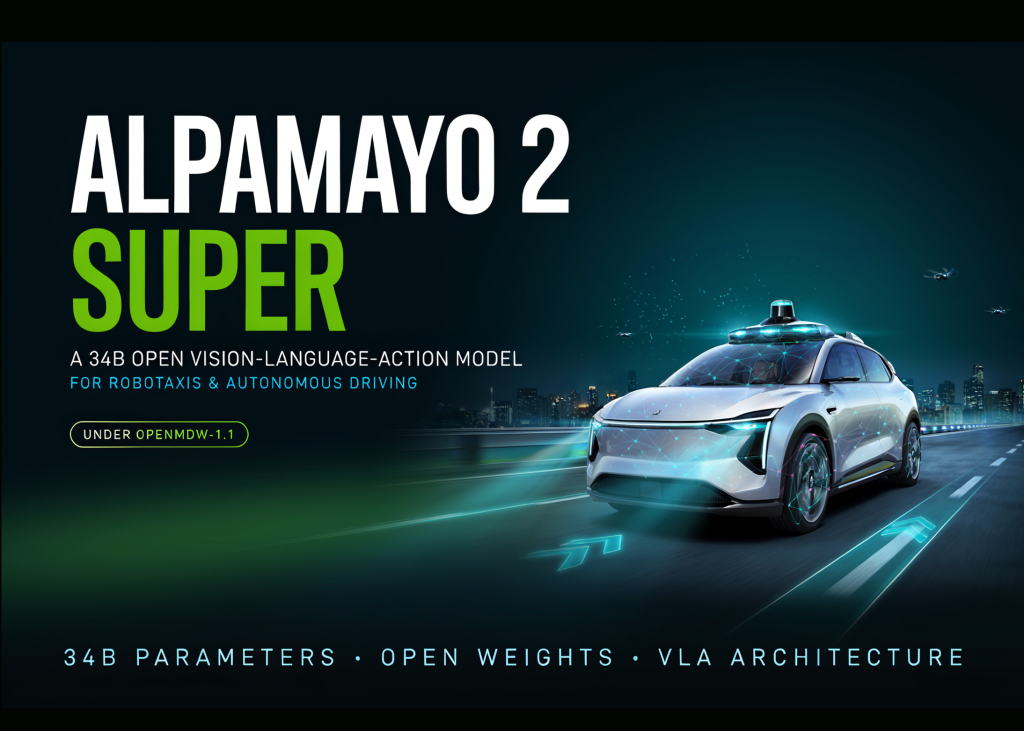
NVIDIA has released Alpamayo 2 Super, a 34-billion parameter vision-language-action model designed to handle the rare, multi-agent scenarios that standard autonomous driving stacks struggle with. The system runs under the OpenMDW-1.1 commercial license. It combines a 32-billion parameter VLM backbone built on the NVIDIA Cosmos 3 Super Reasoner with a 2.3-billion parameter diffusion-based action decoder. A single pass over full-surround camera video generates a planned trajectory, a causal explanation for that path, and a meta-action.
Commercial deployment status
Developers can use the weights for commercial purposes immediately. The OpenMDW-1.1 license, managed by the Linux Foundation, permits fine-tuning, the creation of derivative models, and commercial redistribution. Source code is available under Apache 2.0. NVIDIA is applying this license to the entire Alpamayo family, meaning earlier versions released for research and development are now deployable without further permission.
Inputs, outputs and training data
The model accepts multi-camera RGB video, text, and egomotion history with timestamps. Validated public notebooks profile the system using six cameras and four historical frames per camera. Egomotion data consists of 3D translation and a 3×3 rotation matrix across multiple timesteps.
The trajectory API returns 64 waypoints spanning 0.1 to 6.4 seconds at 0.1-second intervals. Each waypoint includes ego-frame XYZ coordinates and a 3×3 rotation matrix.
Training data comprises roughly 115,000 hours of multi-camera driving video annotated with egomotion and trajectory data. The dataset includes about 3,700,000 Chain-of-Causation traces, which provide structured, causally linked explanations of driving decisions. Image training data exceeds one billion images.
Benchmarks
On LingoQA, Alpamayo 2 Super records a Lingo-Judge score of 79.2 and ranks first among nearly 40 models evaluated. In NVIDIA’s testing it beat Qwen2.5-VL 72B by 17.0 points, Gemini 2.5 Pro by 15.1, and GPT-4o by 23.2.
Two more numbers matter for planning work. Closed-loop evaluation with AlpaSim on 910 scenarios from the PhysicalAI-AV-NuRec dataset gives an AlpaSim score of 1.50 ± 0.13. Open-loop evaluation on 937 challenging samples from the PhysicalAI-AV dataset gives minADE₆ at 6.4s of 0.911m.
Five outputs from one model
For each driving situation, the model produces a trajectory, a CoC trace explaining the decision, a meta-action such as yield or lane change, reasoning auto-labels, and visual question answering with 2D grounding.
That combination is what makes the release interesting operationally. Developers can tie what the model observed to the action it chose. CoC traces integrate with NVIDIA Halos safety-validation workflows and support AI safety aligned with ISO/PAS 8800.
Used as an autolabeler on proprietary fleet data, NVIDIA says the model compresses annotation cycles from months to days.
What it means
The shift to a single model for perception and planning removes the need to stitch together separate detection and prediction systems. For teams building robotaxis, this means the causal explanations generated by the model can feed directly into safety validation tools, simplifying the process of proving the car makes correct decisions. The ability to compress annotation cycles from months to days also lowers the cost of training custom models on specific fleet data.