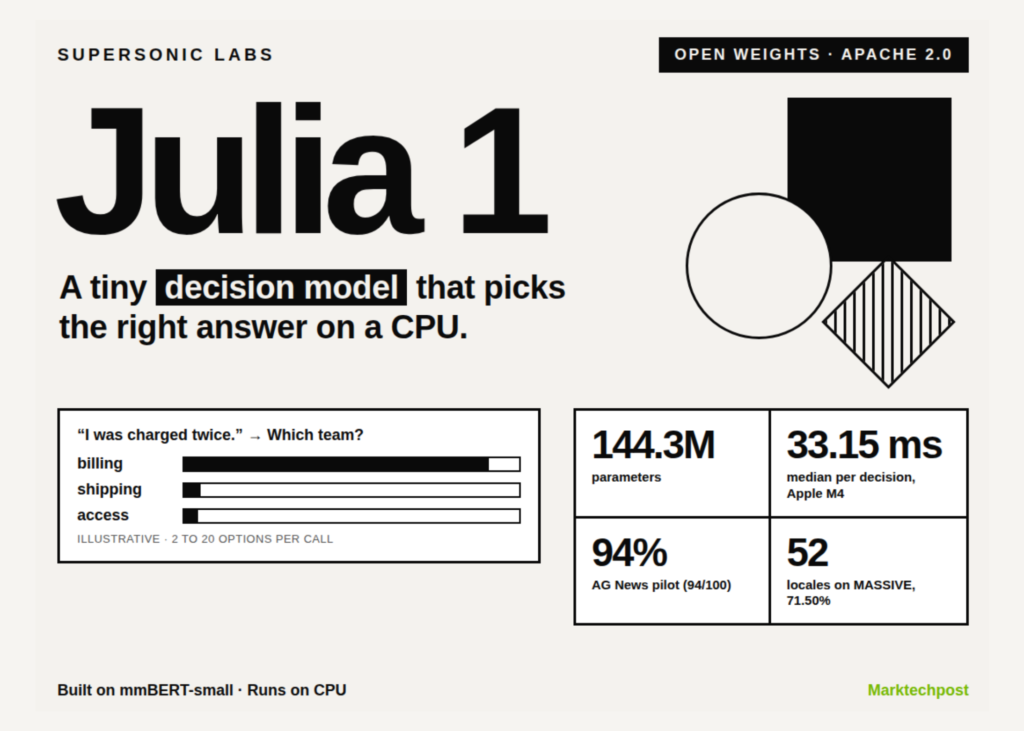
Supersonic Labs, a small Brazilian research group, has released Julia 1. It is a 144.3M-parameter decision model designed to run on a CPU. The system does not generate text or chat. Instead, it accepts context, a question, and a list of two to 20 candidate answers. It selects the best option and returns a probability score for every choice provided.
Deployment and availability
The model weights are available on Hugging Face under an Apache 2.0 license. Developers can run the model locally using Python 3.11 or higher on a CPU or a BF16-capable GPU. An ONNX build allows execution in the browser via WebGPU. A hosted API is announced but remains closed for now.
Functionality
Julia 1 handles three specific decision types through a single interface:
- Choice: Select one label from between two and 20 described options. This covers classification and routing tasks.
- Score: Return an expected index on an ordered rubric, such as low, medium, or high.
- Y/N: Return the probability that a yes-or-no statement is true.
Results return in the caller’s specified order with full softmax probabilities. Caller IDs, such as billing, pass through unchanged. The model is strictly for selection and does not generate text.
Architecture and cost
Julia 1 builds on JHU CLSP’s mmBERT-small, a 140M-parameter multilingual encoder trained on over 1,800 languages. The lab retained the encoder and tokenizer, added a decision head, and trained on decision-format examples. The team states Julia 1 is not a fine-tuned Qwen model. The runtime supports 8,192 combined tokens, though published benchmarks used a 1,024-token limit.
Total cloud GPU spend for training and experiments was approximately R$540 (US$104.08). FP32 weights occupy 550.5 MiB. The private training pipeline is not released. Julia 2, which uses the lab’s own foundation architecture, is currently in development.
Benchmark results
The evaluation on September 24, 2026, ran on H200 BF16 hardware with strict encoding. The comparison baseline is TypeSafe’s Jev, using reference values from the Jev benchmark protocol rather than a new Jev run.
- Typed Decisions: 73.15% (1,463/2,000) versus 72.70% reference.
- AG News, 4 labels: 94/100 versus 91% reference.
- DAIR Emotion, 6 labels: 86/100 versus 48% reference.
- Banking77, 72 labels: 64/100 versus 87% reference. This is the clear failure point.
- MASSIVE, 18 scenarios: 71.50% macro accuracy across 52 locales; 86.25% pt-PT, 86.75% en-US.
Classification pilots used only 100 examples each. A September 25 CPU run reproduced most figures: 72.55% on Typed Decisions and 60/100 on Banking77 with three abstentions.
On-device latency
The lab published per-device measurements. On an Apple M4, one decision per call took a 33.15 ms median. On a Samsung SM-X510 tablet via ONNX Runtime, the median was 203 ms with 393.1 MB peak RSS. On an Intel Core i5-1235U, AG News decisions took a 107.83 ms median. Banking77 took 3,713.54 ms because it narrows 72 labels first.
On X, the lab claims Julia 1 classifies 5x faster than Jev on an i5 laptop. Treat this claim carefully. The Jev pilot measured Jev as a hosted service called from France, so latencies are not like-for-like.
Introducing Julia-1:
Our first classification model that runs on almost anything.Learn more
https://t.co/YJCdEeIBSo pic.twitter.com/3cizsbG9ZB
— Supersonic Labs (@supersonicai) September 26, 2026

Comparison with competitors
| Feature | Julia 1 | TypeSafe Jev | GLiNER2.5 Multi |
|---|---|---|---|
| Developer | Supersonic Labs | TypeSafe AI | Fastino |
| Access | Open weights | Hosted API, early access | Open weights |
| License | Apache 2.0 | Proprietary | Apache 2.0 |
| Parameters | 144.3M | Not disclosed | 287M |
| Base encoder | mmBERT-small | Not disclosed | mDeBERTa-v3-base |
| Decision types | Choice, score, yes/no | Typed structured decisions | Classification, NER, relations, records |
| Options per call | 2 to 20 (Router for more) | Up to 255 | Label list per schema |
| Runs locally on CPU | Yes | No | Yes |
| Input price per 1M tokens | $0.025 (planned API) | $0.042 | Free (self-hosted) |
| AG News pilot | 94% | 91% | 70% |
| DAIR Emotion pilot | 86% | 48% | 44% |
| Banking77 pilot | 64% | 87% | 61% |
Sources: Julia 1 model card, TypeSafe launch post, GLiNER2.5 Multi card, Jev benchmark pilot. Julia 1 pilots ran separately from the Jev and GLiNER runs.
Limitations
Julia 1 compares the answers you supply. It cannot be relied upon for missing facts, algebra, or multi-step calculation. The Router can drop the correct label during narrowing. It is not a drop-in Transformers pipeline, and no Hugging Face inference provider currently serves it. Supersonic Labs advises evaluating on your own questions and keeping humans in the loop for consequential decisions.
What it means
For developers, this adds a lightweight option for structured decision-making without the cost of a full generative model. It allows routing or scoring tasks to run locally on standard hardware, which helps with privacy and reduces latency compared to calling a cloud API. However, the performance drop on high-label tasks like Banking77 suggests it is not yet ready for complex classification without human oversight.