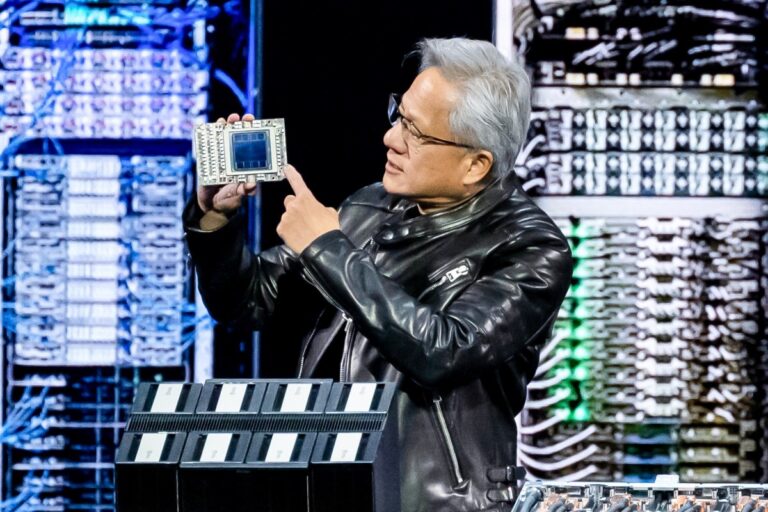
Nvidia’s latest push to deploy its graphics processors targets the Moon.
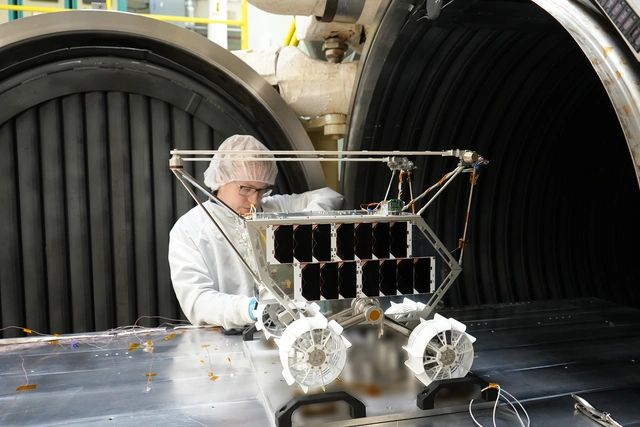
Lunar Outpost confirmed on Thursday that its next lunar rover will run Jetson chips to manage its LiDAR. This move would likely place the first GPU on the lunar surface.
“We’re taking the NVIDIA Jetson and comparing it to our flight compute platform that has a little bit more spaceflight heritage,” Lunar Outpost CEO Justin Cyrus said. “[We’re] seeing what the pros are, seeing what the cons are. And we’re really pushing towards trying to adopt these more capable GPU-powered systems in these extreme environments.”
NASA is currently paying private firms to explore the lunar surface ahead of plans to return human astronauts, perhaps as soon as 2028. The agency’s program, which mirrors its work with SpaceX, asks tech companies to build vehicles carrying scientific sensors. These tools must map the terrain and hunt for substances like water that could prove useful or even lucrative to exploit.
Nvidia recently announced a partnership with Firefly Aerospace. Firefly is the first private company to safely land a robot on the Moon. The deal will see the Jetson platform operate on a satellite orbiting the Moon to process imagery. That satellite aims to collect data for scientists trying to map the Moon, but also to track the growing number of robots on the surface.
Lunar Outpost’s next rover is packaged onboard a lander built by Intuitive Machines. The rover is designed to carry a package of sensors into craters and other places that are difficult to explore from orbit. The following mission will be exploring a place on the lunar surface called Reiner Gamma, where a magnetic anomaly has puzzled scientists.
Each mission is expected to take flight on a Falcon 9 rocket before the end of the year.
Nvidia’s Jetson platform isn’t as well known as AI workhorses like Blackwell and Vera Rubin, but it’s a vital part of many physical AI systems. Designed to be compact and power-efficient, Jetson lets robotic systems process sensor inputs locally, allowing them to understand and react to the world around them more quickly.
“Our autonomy stack was a bit more deterministic five years ago, and now it’s a combination of deterministic and physical AI, which is pretty fun,” Cyrus said. “We still run both in parallel, and then it’s our job to figure out where’s physical AI can actually plug into our stack and help us do things that no one’s done before.”
Why GPUs matter in space
Using GPUs in space is challenging because of the extreme environment. Most space-faring GPUs are in orbit close to the Earth, where they are relatively protected from radiation and dramatic temperature changes. The Moon is more directly exposed to cosmic radiation and swings in temperature as it goes through its phases.
“Your system has to survive lunar night and has to do so on very low power,” Cyrus said.
If they can operate the chips in that environment, Lunar Outpost’s engineers hope that their vehicles will be more capable—able to more quickly process their environment and make decisions. NASA has extensive ambitions for a sustained human presence on the Moon, but that will likely require autonomous systems to pave the way and do the heavy lifting.
“What we at Lunar Outpost are currently working on is how do we go from exploration to permanence, how do we actually build that outpost on the moon?” Cyrus said. “We do think combining our deterministic models plus the physical AI layer—that’s what allows us to make a human presence in space sustainable, actually having that robotic workforce.”
In the next few years, Lunar Outpost has several smaller autonomous rovers scheduled for launch to the Moon, and one larger one, Pegasus, that is intended to carry astronauts. Pegasus is waiting on a rocket built by Jeff Bezos’ space company, Blue Origin, to carry it to the Moon, but that launch vehicle suffered an anomaly this summer and it’s not clear when it will return to flight.
“It does seem like they’re making pretty darn good progress on the pad,” Cyrus said. “I can’t really answer Blue Origin’s timelines or NASA’s timelines on the pad reconstruction, but everything we’ve been told, we’re on the same timeline [for 2028].”
That leaves futuristic visions of space data centers and fleets of robots at work on the Moon both waiting on the same thing: A bigger rocket.