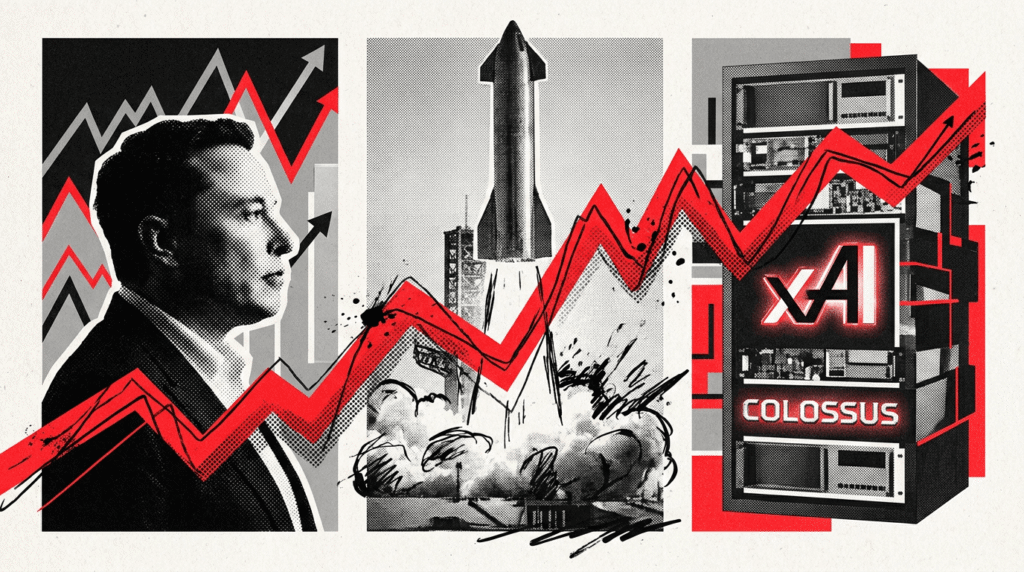
Elon Musk says SpaceX aims to run more than ten gigawatts of compute power by the end of 2027, a target that could demand over two million Nvidia Rubin GPUs.
The company currently operates at 1.4 gigawatts. SpaceX intends to expand its Colossus data centre clusters using Nvidia’s upcoming Vera Rubin architecture. Existing hardware runs on H100, GB200, and GB300 chips.
SpaceX’s IPO filings list the current fleet at roughly 100,000 H100 units, 110,000 GB200 units, and 110,000 GB300 units. The plan includes an additional 220,000 GB300 processors. This totals approximately 540,000 GPUs.
Reaching the ten-gigawatt goal would push the required count well past one million Rubin units. If the entire expansion relied on Vera Rubin, the number would exceed two million. SpaceX has not confirmed how many of the new units will actually be Rubin chips.
xAI merger and orbital ambitions
xAI merged into SpaceX in February 2026. The deal was funded mostly with stock and valued SpaceX at $1 trillion while assigning xAI a $250 billion valuation. The combined entity is worth $1.25 trillion. Musk has stated long-term plans to run data centres in orbit.
Revenue growth masks heavy losses
The AI segment, which includes xAI and X, generated $2.56 billion in revenue for the second quarter of 2026. An operating loss of $1.26 billion accompanied that figure. In the first quarter, the segment lost $2.47 billion on just $818 million in revenue. Total operating losses for the first half of 2026 reached $3.73 billion.
Most of the revenue increase came from new cloud contracts leasing out Colossus capacity rather than from Grok. One unnamed customer accounted for roughly $1.52 billion. That client is likely Anthropic.
Competitors distribute compute across multiple providers. Anthropic uses AWS Trainium, Nvidia GPUs, and Google TPUs. The company has announced plans for up to five gigawatts of additional AWS infrastructure using Trainium and Graviton systems, plus about 3.5 gigawatts of extra TPU capacity. OpenAI has announced six gigawatts of AMD capacity, at least ten gigawatts of Nvidia capacity, and around two gigawatts of AWS Trainium capacity.
What it means
For people building AI models, the shift to a single vendor like Nvidia for such massive scale creates a dependency on one supply chain. If Rubin chips face delays or shortages, SpaceX’s aggressive targets could stall. Competitors spreading risk across AWS, Google, and AMD avoid this bottleneck, even if their costs are higher.