Nvidia has secured commitments from Apollo, BlackRock, Blackstone, Brookfield, Goldman Sachs, and KKR to provide up to $500 billion for AI data centres. The headline figure dominated the news, yet the more significant move is Nvidia’s attempt to build a secondary market for older GPUs.
To persuade these financial institutions, the company agreed to guarantee the value of its chips used as collateral with its own funds.
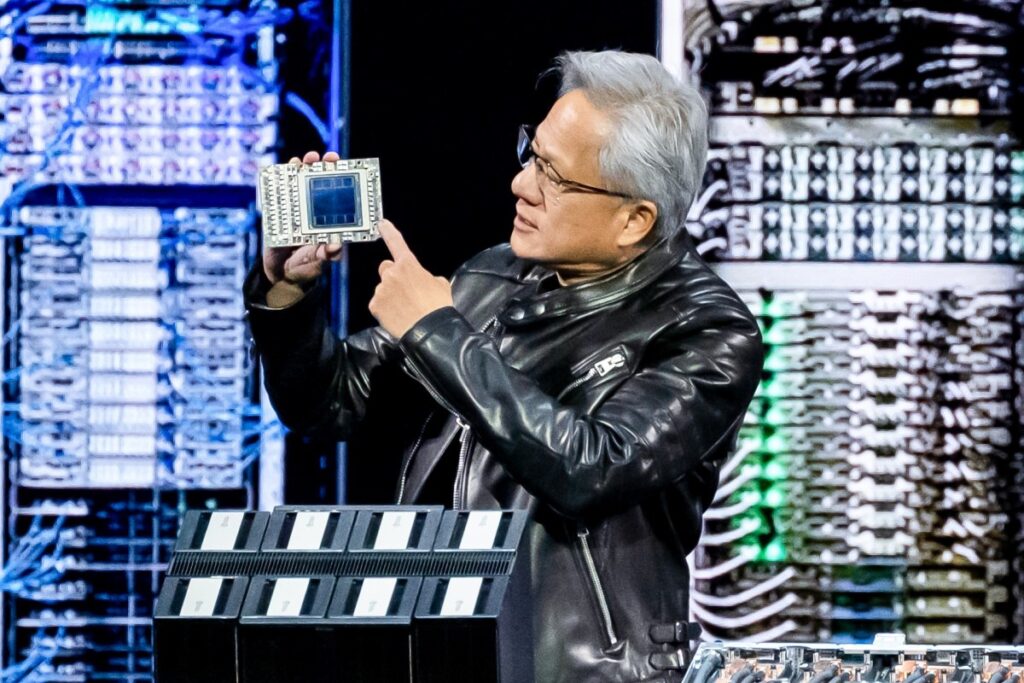
Analysts describe the strategy as unusual, clever, and dangerous. Bond markets reacted with alarm, prompting Nvidia CEO Jensen Huang to appear on X and business television to clarify the limits of the company’s exposure.
Beneath the financing mechanics lies a different objective for startups and large businesses. Huang aims to sustain an ecosystem of used AI hardware, ensuring demand remains for Nvidia equipment as it ages.
Nvidia promises to cover up to 25% of any shortfall in value if GPUs used as collateral do not retain their expected price. If a data centre owner defaults and the lender must sell the chips at a lower price than the books suggest, Nvidia will pay the difference.
This creates what financiers call “wrong way” risk. Nvidia’s obligations increase as demand falls. In that scenario, the company’s revenue would likely shrink simultaneously.
Despite the danger, the scheme differs from the comparison to Lucent Technologies. Lucent was a telecommunications supplier that rose and crashed with the dotcom bubble after lending customers money to purchase its own products.
Huang knows the comparison casts a shadow. It is not an unfair one. Nvidia has committed billions to buyers of its chips, including frontier AI labs OpenAI and Anthropic. Neoclouds such as CoreWeave, Nebius, Firmus, and Lambda have also received support. Bloomberg calculated another $750 billion worth of circular deals were underway this summer.
“Is this circular financing?” Huang wrote on X regarding the new initiative. “This initiative is designed to address that concern. We are bringing independent, long-term institutional capital into the AI infrastructure market.”
That is accurate. Unlike Lucent, Nvidia is asking others to shoulder the bulk of the capital and risk, requiring only that it protect a portion of its chips’ future value.
If successful, Nvidia will secure new funding sources for AI data centre construction as traditional methods wear thin. Some hyperscalers have already taken on heavy debt, issued new equity tranches, or burned cash reserves.
The situation has become so precarious that Microsoft CEO Satya Nadella recently recommended the book “1873” during an earnings call. The text details the railroad-era financial engineering that crashed the US economy.
The risk is that today’s AI boom, where demand far outstrips capacity, does not last. What if enterprises and consumers reduce AI usage? Or what if new technologies render existing infrastructure obsolete?
Then, like buggy whips facing automobiles, demand dries up and the sector crashes.
Huang argues this will not happen by selling AI as a long-term “investable infrastructure.” He describes his AI servers, which he calls “AI factories,” as akin to railroads or airlines rather than assets that quickly lose value like PCs.
“When needs change, the factory can be used by another customer, another cloud or another operator. This broad ecosystem gives NVIDIA compute a deep market of potential users and offtakers, helping protect residual value,” he stated.
In that future, Nvidia cares as much about aging architecture as it does new chips. Startups, enterprises, and researchers might tap into a broader variety of hardware, each tuned to different AI needs. This mirrors how they are already choosing affordable open-weight models alongside frontier choices.
As the dominant force in AI, Nvidia has the power and the window of opportunity to make that happen.
What it means
For people building models or running services, this plan could keep older, cheaper GPUs available for longer. Instead of being scrapped immediately after a new generation arrives, hardware might retain value and find new buyers. This lowers the cost of entry for smaller teams and extends the lifespan of expensive equipment.