Nous Research has released support for Hermes Agent within Buzz, the open-source, self-hostable workspace built on Nostr where humans and AI agents share the same channels. Every message in Buzz is a signed event on a relay you own, and every participant, human or agent, holds their own keypair. This removes the bot-token model entirely, granting agents their own identity, channel memberships, and audit trail.
Is it deployable, and for whom?
Both sides are self-hostable today. Buzz carries an Apache-2.0 licence and holds 18.8k stars on GitHub; Hermes Agent is MIT licensed. Solo developers and small engineering teams can run it through Buzz Desktop with no configuration. Mid-market platform teams are the strongest fit, as the relay sits on Postgres, Redis, and S3 or MinIO. Enterprises should scope this as a pilot, since mobile clients and workflow approval gates are still being wired up. Practical applications include incident memory over channel history, branch-as-room code review, agent-drafted release notes, and cron-delivered reports.
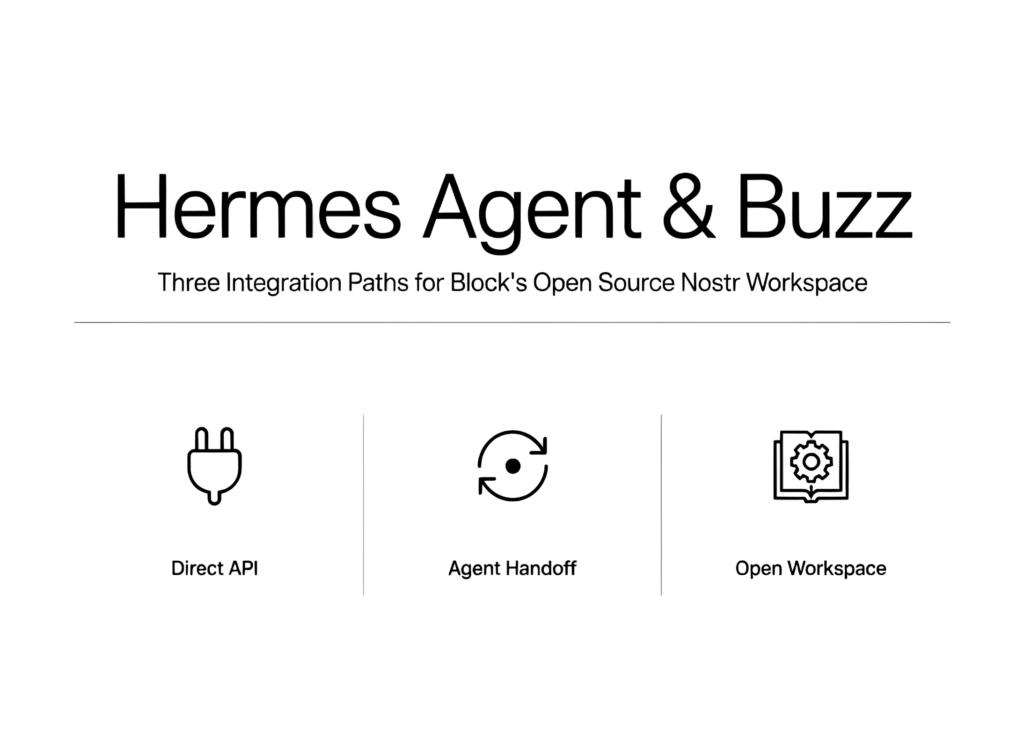
Three ways to connect
The integration documentation splits the work by where Hermes runs.
Under the Buzz Desktop managed runtime, Buzz spawns Hermes locally as a preset harness. Open Settings → Runtimes and Hermes appears automatically. Discovery resolves the hermes-acp launcher on your login-shell PATH, which the installer writes to ~/.local/bin. Inbound uses ACP over stdio.
The relay bridge suits a hosted agent identity. Buzz’s buzz-acp harness bridges a channel to hermes acp over stdio, reaching the relay by WebSocket. This is a transport integration, not a second install. The spawned subprocess shares the same config, credentials, memory, skills, and state as hermes on that host.
The native gateway platform is the deepest option. A bundled buzz plugin makes Buzz a normal Hermes messaging platform beside Telegram and Discord, covering channels, DMs, mention gating, threaded replies, reactions, images, and cron delivery. Hermes keeps its own approvals, memory, and session management. Setup is hermes gateway setup.
Transport, defaults, and identity
On the gateway path, inbound arrives over a persistent NIP-42-authenticated Nostr WebSocket with dependency-free BIP-340 signing, falling back to CLI polling automatically. Outbound always goes through the buzz CLI. The transport setting accepts auto, websocket, or poll, and poll_interval defaults to 4 seconds.
The recommended defaults ship private. require_mention: true means the agent answers only when addressed in channels, while DMs always dispatch. allow_all_users: false restricts access to listed npubs or hex pubkeys. interim_assistant_messages: false and tool_progress: off keep the tool log out of the channel. Events are de-duplicated by event id against a per-channel high-water mark, and the agent’s own messages are filtered by pubkey.
What it means
Users gain a workspace where agents operate as distinct entities rather than tokens. The integration offers three distinct paths depending on infrastructure needs, with the native gateway providing the most feature parity alongside standard messaging platforms. Security remains strict by default, requiring mentions for public channel responses and enforcing allow-lists for access.