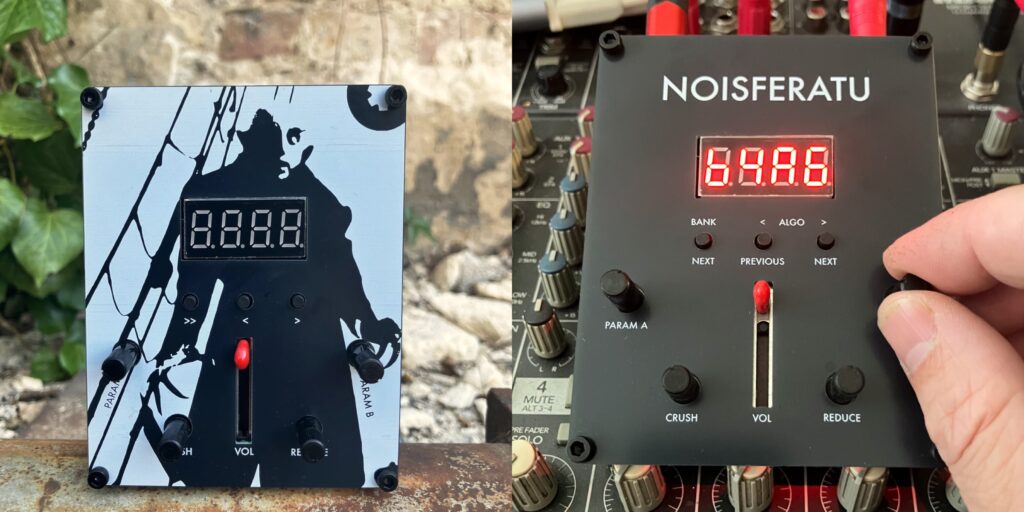
The DIY Noiseferatu kit is a handheld, open-source generative texture synthesiser built around the Seeed Studio XIAO SAMD21 microcontroller.
Rob Scape, the developer behind the project, describes it as a chaotic alternative to the Korg KAOSS Pad. The device warps wavetables and applies bitwise logic operations to create glitched textures. It is not intended for users seeking stability.
Hardware and controls
The unit offers 45 algorithms divided into five banks:
- Generative waveables
- Noisy textures
- BitBend for wavetable manipulations
- Blips and tones, which may be less alarming than other presets
- Logical operation disorder
Users can flip the front panel to switch between a visible interface and a minimalist all-black finish. Control is provided by four knobs, a large volume fader, an LED display, and trigger inputs. Power comes via USB-C.
The full DIY kit is available from Thonk.
The repository is hosted on GitHub. The author notes that the codebase is entirely free and open source.
Customisation and code
Creating custom algorithms is possible without extensive documentation. This feature allows developers to move between C and Arduino code and VCV Rack or gen~ in Max. Max now runs on Ableton Move.
The project encourages users to type code without understanding it fully and observe the resulting failures. The author compares this experience to having one’s arms gnawed on by rats, referencing the film Nosferatu. The original title of the film is not a horror movie if one roots for the rats and the plague.
What it means
This tool prioritises experimentation over usability. It removes barriers to entry for generating noise and chaos, allowing makers to break systems directly through code. The approach contrasts with modern assistance tools that prevent such errors.
Firmware and specifications are available on the GitHub page linked above.
* In deference to Korg, an NTS-3 KAOSS Pad would be a great companion to this device. That model is available from Perfect Circuit and Thomann.