

£199 / £45 upgrade / rent-to own available, oeksound.com
I reviewed Soothe2 in 2020. At the time, it was the undisputed champion of resonance suppression plugins. But since then, there’s been a tidal wave of competitors vying for the crown. Not content to rest on its laurels, Oeksound has finally released an update with improved sound, a streamlined interface and unique new features. It may be just enough to keep Soothe at the top of every producer’s essentials.
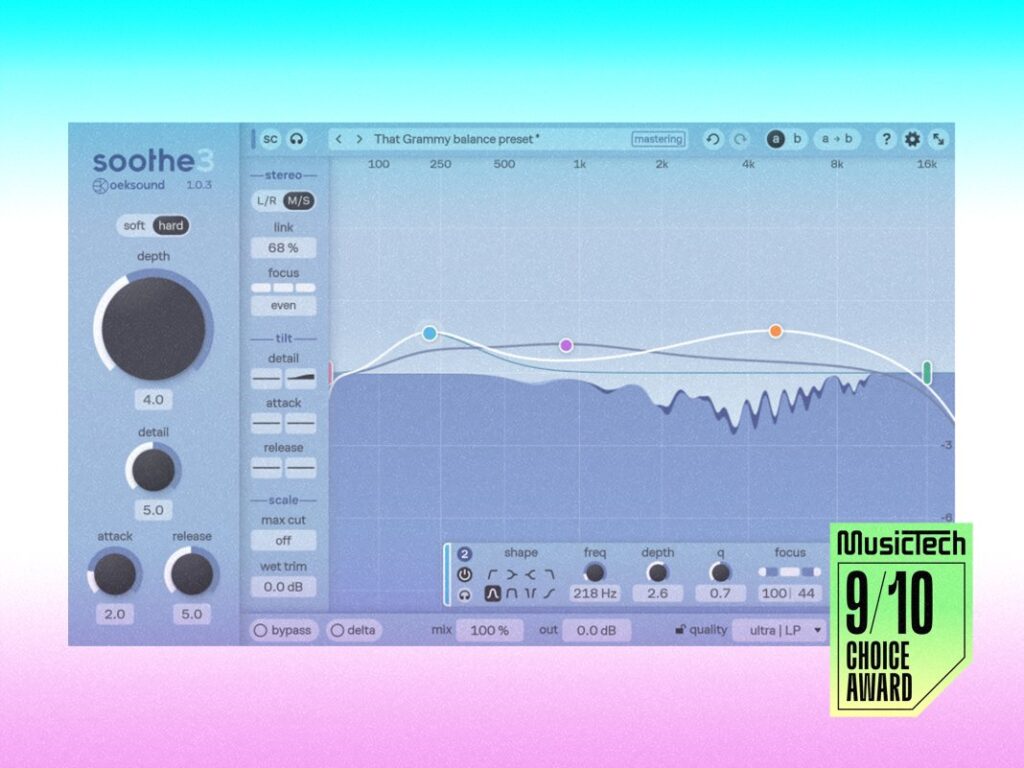
Soothe is the perfect tool to reach for when you’re wanting to tame multiple unwanted resonances. Although you could potentially notch these out using a standard EQ, it would be incredibly time consuming, whereas Soothe reacts dynamically in real-time to remove these out as they appear. The plugin window has had a re-jig since version 2, but it won’t take long to readjust if you’re upgrading. The separate controls for Sharpness and Selectivity have been simplified to a single Detail dial which you turn up if you want to target narrow notches, or down to make broader reductions.
Other controls, like Attack and Release have been made more prominent, and the stereo section that lets you switch between and edit the Left/Right and M/S balance has been moved to a collapsible sidebar. It’s here that we find the Tilt section, which is one of Soothe3’s new features. This lets you increase or decrease the Detail, Attack and Release amounts in the upper or lower portions of the spectrum. This is a welcome addition as it gives you more flexibility to target something like a kick drum more broadly, whilst narrowing in on sharp cymbal resonances within the same instance. That said, it would be even better if you could control the Detail amount via each node instead, which is something you can do with Baby Audio’s Smooth Operator Pro. Technically, the more you boost a node, the narrower the cuts become, but we find the results relatively negligible in practice. In fairness, the Tilt controls are effective for most tasks.
The sidebar also includes a new Max Cut control that raises a line to set the maximum amount of reduction Soothe is allowed to make. This is useful to drive the processing harder without any massive cuts from rogue frequencies.
The largest part of the interface provides a live visual of the suppressed frequencies. I’m not sure what tweaks have been made to the ballistics, but it feels smoother and easier to read than its predecessor. Here you can double-click to add up to eight nodes, with eight shapes including a new tilt and bandpass. I’m especially happy about the bandpass as it means you have a much quicker way to focus on a small region whereas before, you had to use a combination of low-cut and high-cut.
There are Soft and Hard modes, as before. Soft is the mode that most will use as it has an adaptive threshold that reacts to the relative levels of resonances, and works well with more dynamic sources. Hard mode has a fixed threshold and is used for more aggressive control, or when using the plugin to sidechain duck another instrument. Both algorithms have been improved to give a cleaner, more transparent output.

To get a better idea of how they sound, I push things to the extreme and compare the delta (removed) signal of Soothe3 with both Soothe2 and Waves Curves Equator. There’s a positive leap in cleanness between Soothe 2 and the Waves, and then a further leap with this new algorithm. On Ultra quality Soothe3 is silky smooth, with an open high end and minimal artefacts. It also has an improved ability to focus on resonances when the Detail control is turned up, which means less damage to the surrounding material. More than the various new features and user interface, this is what really makes the upgrade worthwhile to me. Some engineers complain that these kinds of tools can ruin mixes by making them sound over-processed, but this new algorithm allows you to dig into the signal while keeping things more transparent. Of course, you do still need to use your judgement to make sure you don’t overcook things.
Quality settings have been simplified to just Normal, High and Ultra in version 3, with no separate controls for oversampling. You can engage a separate feature in the settings menu that will always render on Ultra, giving the cleanest and most accurate sound. Also added is the ability to run Soothe3 in both linear phase and low latency mode. Linear phase might give better results if you’re processing in parallel, or provide more stable panning when using unlinked stereo. Oeksound released Soothe Live a few years back to provide an ultra-low-latency option for live sound and tracking, but this new version improves on that even more, with zero samples of latency at base sample rates. This makes it a fantastic option for controlling unpredictable live performances whether on-stage or whilst tracking.
For anyone working in Atmos and surround, the final new feature will be a legitimate game-changer; Soothe can now function in multichannel setups up to 9.1.6. There are various options for grouping and linking channels, and you can assign nodes to only affect certain channels. You also get separate metering and delta controls so you can hone in on problem areas, making Soothe3 a useful tool for taming multichannel masters.

If you’re looking for a simple resonance suppressor plugin and you don’t need some of Soothe3’s features such as the super transparent sound, low-latency mode and surround support, then there are cheaper options available such as Baby Audio’s Smooth Operator Pro and Three Body Technology SpecCraft, to name a couple.
Soothe3 isn’t cheap, but it’s a worthwhile investment if you’re serious about audio. Tweaks and new additions have refined an already excellent plugin. The sound quality now keeps up with—and often surpasses—the competition, while the interface is quicker and more pleasurable to work with. It’s definitely worth the upgrade price of £45 for existing users.
Despite a flood of competition, it turns out the real Soothe2 killer ended up being Soothe3.
Key features
- Resonance suppression plugin
- VST3, AU, AAX (requires iLok account)
- Updated algorithms
- Transparent Soft mode with adaptive threshold
- More aggressive Hard mode with fixed threshold
- New Low Latency mode adds zero samples at base sample rates
- Streamlined, resizable window with simplified Detail control
- Flexible nodes with 8 band shapes
- Tilt controls for Detail, Attack and Release
- New Linear Phase mode & Max cut parameter
- Up to 9.1.6 multichannel support
The post Is Oeksound’s Soothe3 the most transparent resonance suppressor yet? appeared first on MusicTech.