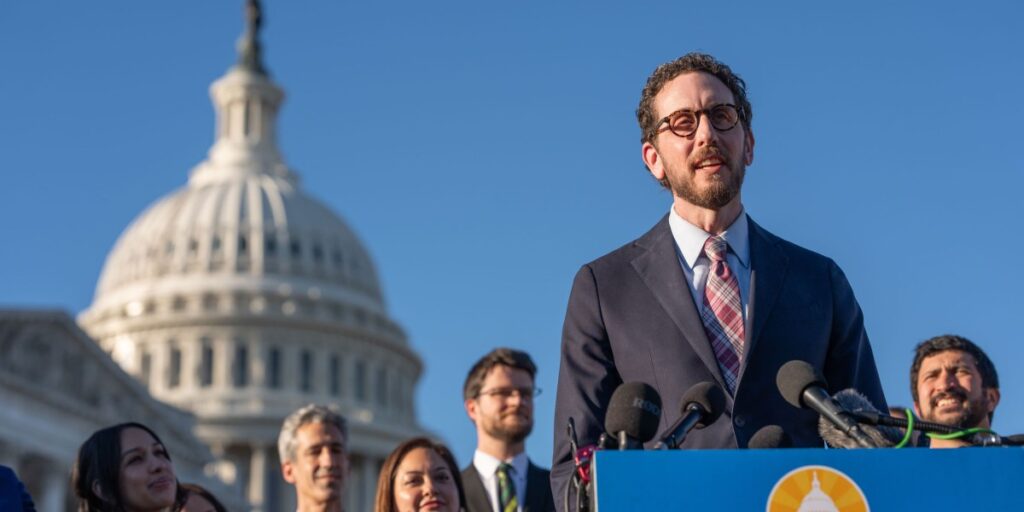
Scott Wiener was declared the winner of the San Francisco congressional seat vacated by Nancy Pelosi on Friday, just hours after the election. The new representative now faces immediate pressure regarding artificial intelligence regulation following a recent report from the nonprofit METR suggesting Anthropic has achieved recursive self-improvement.
Urgency over optimism
Wiener told reporters that the METR findings indicate we are rapidly losing the window to control AI development. “It’s very concerning,” he said. “It was my hope that Congress would take decisive action before [the end of] this year. That does not appear to be happening.”
During a 20-minute interview, he repeated the phrase “recursive self-improvement” at least six times. He warned that technology is advancing too fast for current safeguards. “We need to slow this down,” he said. “Because it’s moving very quickly, and we could sleepwalk into a disaster.”
His focus on these safety issues has grown over recent years. He aligns closely with the AI safety movement’s core concerns. He previously authored SB 1047 in 2024, intended as the first major frontier AI bill in the nation, before California Governor Gavin Newsom vetoed it. He subsequently sponsored SB 53, a less stringent measure that Newsom signed. Both state bills have influenced proposed federal legislation.
Funding and criticism
Wiener’s campaign received more than $3 million from Public First Action, a nonprofit advocating for AI regulation that receives substantial funding from Anthropic. Critics argued this contribution made him too close to the industry. Wiener rejected the notion. He wrote that Public First supported him because he was the first lawmaker to introduce AI regulation and the first to pass and implement it. He described the attacks on this support as “shockingly cynical,” claiming opponents falsely accused him of being aligned with Big Tech while he actually regulated the industry against their objections.
Proposed federal structure
Wiener expressed willingness to join a select committee on artificial intelligence if Democrats establish one, a topic of discussion since September. He supports Representative Ro Khanna’s proposal for a strong, empowered, nimble federal regulator. He emphasised whistleblower protections, testing and auditing requirements, and a kill switch mandate. He also wants Congress to use its oversight powers to hold AI labs accountable. “This is about the future of humanity, and we want to make sure that the public has a say and that the public knows what’s going on,” he said.
He opposes broad federal preemption of state laws, arguing that states should remain flexible regulators. “States are, as Brandeis says, laboratories,” he noted. He believes states can remain nimble in ways that Congress sometimes cannot.
Real teeth versus data centers
Wiener insists Congress must pass policies with real teeth. He stated it is “critically important that when Congress acts, that we do so in a way that is truly meaningful and that meets the moment.” He discussed the possibility of AI catastrophe using language typical of safety experts. “We’re in a moment that is very dangerous in terms of the risk of loss of control over AI,” he said. “We need to deal with recursive self-improvement. Once you’re in that realm, that really is potentially a recipe for total loss of control.”
He has allies in the fight against catastrophic risk. Senator Bernie Sanders has met with influential figures from the AI safety movement and has spoken repeatedly about AI and existential risk. However, a gap remains between Wiener’s perspective and the national mood, which is anchored by opposition to data centers. Voters approved 40 out of 41 anti-data-center ballot measures on Tuesday. Wiener views this as a sign of local concern rather than an understanding of broader AI risks. “Peoople who are really opposed to where AI is going—this is an area where they can actually do something about it,” he said. “But the data center revolt—to me, I think it’s more so that people are upset that there could be something like this in their community, with all the impacts near people’s homes, driving up electric bills and using water. I think that’s the bigger issue for most people, from what I can tell.”
Political hurdles
Wiener describes himself as only “cautiously optimistic” about Congress’s ability to rein in AI, given its poor track record on regulating the tech industry. He also worries about legislation passing President Donald Trump. Trump called concerns about catastrophic AI risk a “hoax” in September and has shown a stark unwillingness to collaborate with China, a step Wiener sees as essential to preventing the worst consequences of AI.
Wiener noted that Trump’s unpredictability offers some hope, though a fraught kind. “So far what we’ve seen are some problematic things, but not complete disasters,” he said. “I hope that it doesn’t take a disaster to spur the president into acting. And I hope if that’s what it does take—which, like I said, I hope it doesn’t—but if it does, I hope it’s as small as possible.”