Mistral AI has launched Voxtral 3, a family of speech models paired with a Voice Agent SDK built on LiveKit. The release includes three transcription models, one text-to-speech model, and an SDK available in public preview on the Mistral API. The suite offers a single interface for listening, reasoning, tool calls, and speaking.
Specs and capabilities
The family consists of four models and the SDK. Voxtral Mini Transcribe 3 contains 4 billion parameters. Voxtral Small Transcribe 3 has an undisclosed parameter count. Both batch models support a 32k context window.
Deployment options include the Mistral API endpoints in Europe, the US, and globally, or self-hosting via Mistral sales. Mistral states the Mini model suits resource-constrained environments. Specific GPU and VRAM requirements are not disclosed.
In independent benchmarks, the models rank in the top three for speech-to-text. Voxtral Small Transcribe 3 achieves a 2.1% AA-WER on Artificial Analysis, placing it third overall. The model performs strongest on diarisation and multilingual batch transcription. Conversely, the realtime model shows a higher error rate. At 240ms latency, it records a 7.4% WER on FLEURS 35, compared to 4.2% for Gemini 3.5 Realtime.
The Voxtral 3 lineup
Mistral lists four specific models within the family:
- Voxtral Small Transcribe 3: This is the flagship model for batch transcription and diarisation. Documentation also notes support for translation, speech Q&A, summarisation, and function calling.
- Voxtral Mini Transcribe 3: A 4B parameter model designed for cheaper and faster batch jobs.
- Voxtral Mini Transcribe Realtime 3: Streaming ASR over WebSocket with end-of-turn detection.
- Voxtral Speech 3: The text-to-speech component, referred to as Voxtral Mini TTS 3 in the announcement.
All transcription models support diarisation and context biasing. Context biasing allows users to input key terms or free text to improve recall. Batch transcription covers 50 languages, including 24 official EU languages.
The Voice Agent SDK
The SDK runs three stages as a single streaming pipeline. Realtime Transcribe 3 listens and detects when a caller stops speaking. A general LLM, such as Mistral Small 4, handles reasoning and tool calls. Voxtral Speech 3 replies in the tone established by the conversation so far.
Each turn completes in under one second. The agent stops speaking if the caller cuts in. It handles phone calls over SIP and browser or app sessions over WebRTC. Because each stage uses a separate model, teams can swap the LLM, voice model, or language.
Transcription accuracy
These figures are self-reported by Mistral:
- FLEURS 45 (WER, forced / inferred language): Small 4.1% / 4.0%. MAI-Transcribe-2 ties at 4.1% / 4.0%. Mini 4.6% / 4.5%. Whisper large-v3 16.0% / 14.9%.
- Diarisation (cpWER, 5 public sets): Small 18.4% and Mini 18.6%. Pyannote scores 19.0% and MAI-Transcribe-2 20.3%.
- Keyphrase recall (Earnings 22): Small 94.6% with context, 81.4% without. Scribe v2 posts 94.3% and 84.0%.
On Artificial Analysis, Small scores 2.1% AA-WER and Mini 2.2%. Only Fun-Realtime-ASR-preview (1.7%) and MAI-Transcribe-2 (2.0%) rank higher. Speed is the gap: Small’s speed factor is 65.8x, against 307.5x for MAI-Transcribe-2.
Realtime and TTS comparison
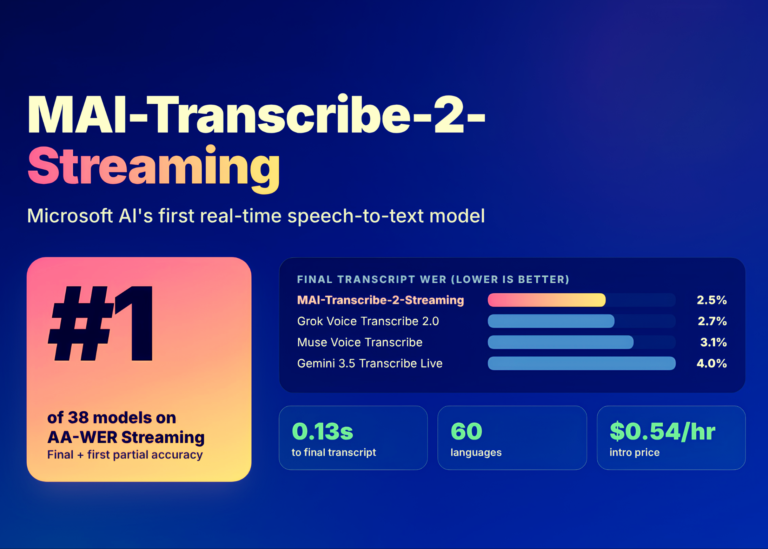
On FLEURS 35, the realtime model trades latency for accuracy. It scores 5.7% WER at 2,400 ms and 6.4% at 480 ms. At 240 ms, WER rises to 7.4%. Gemini 3.5 Realtime Transcribe scores 4.2% and MAI-Transcribe-2 Streaming 5.8%. GPT Live Transcribe (8.4%) and Scribe v2 Realtime (8.7%) trail every Voxtral setting.
Voxtral Speech 3 costs $13 per 1 million characters. Mistral says that undercuts OpenAI TTS-1, Deepgram, ElevenLabs Flash and Gemini Flash. Explicit controls cover emotion, pacing and emphasis. The model page lists ~90 ms time-to-first-audio and 34 emotion tags. Pro Voice adapts a speaker’s style from 30 minutes of audio. Artificial Analysis places it in the top 12 of both TTS arenas.
Voxtral 3 vs competitors
| Voxtral Small Transcribe 3 | MAI-Transcribe-2 | ElevenLabs Scribe v2 | Gemini 3.5 Transcribe | |
|---|---|---|---|---|
| Developer | Mistral AI | Microsoft AI | ElevenLabs | |
| Parameters | Not disclosed (Mini: 4B) | Not disclosed | Not disclosed | Not disclosed |
| Languages | 50 | 60 | 90+ | 85+ |
| FLEURS 45 WER, forced / inferred | 4.1% / 4.0% | 4.1% / 4.0% | 4.9% / 4.9% | 6.1% / 4.5% |
| Diarisation cpWER | 18.4% | 20.3% | 23.0% | 38.4% |
| AA-WER | 2.1% | 2.0% | 2.2% | 2.6% |
| AA speed factor | 65.8x | 307.5x | 65.4x | 89.5x |
| Price per 1,000 min | $4.00 | $1.67 | $3.67 | $5.00 |
| Vendor list price | $0.004/min | $0.10/hour, limited-time offer | $0.22/hour | Token-billed, see Google pricing |
Cost and deployment
According to Mistral’s price table:
- Voxtral Mini Transcribe 3 (batch): $0.0035/min
- Voxtral Small Transcribe 3: $0.004/min
- Voxtral Mini Transcribe Realtime 3: $0.008/min
- Voxtral Speech 3 (batch and realtime): $13 per 1 million characters
- Voice agent API: $0.04/min with Mistral Small 4, $0.08/min with any other reasoning model
The models run on Mistral’s European, US and global endpoints. OpenRouter also lists all 3 new models with EU-hosted, zero-data-retention endpoints.
What it means
Developers can now build voice agents where the transcription, reasoning, and speech generation are handled in one pipeline. The ability to swap individual models means teams can optimise for cost or speed without rewriting the agent logic. The pricing for batch transcription is notably low compared to competitors, though the realtime accuracy lags behind Google’s offerings. Users get explicit control over voice emotion and pacing, which is useful for customer service bots or roleplay applications.