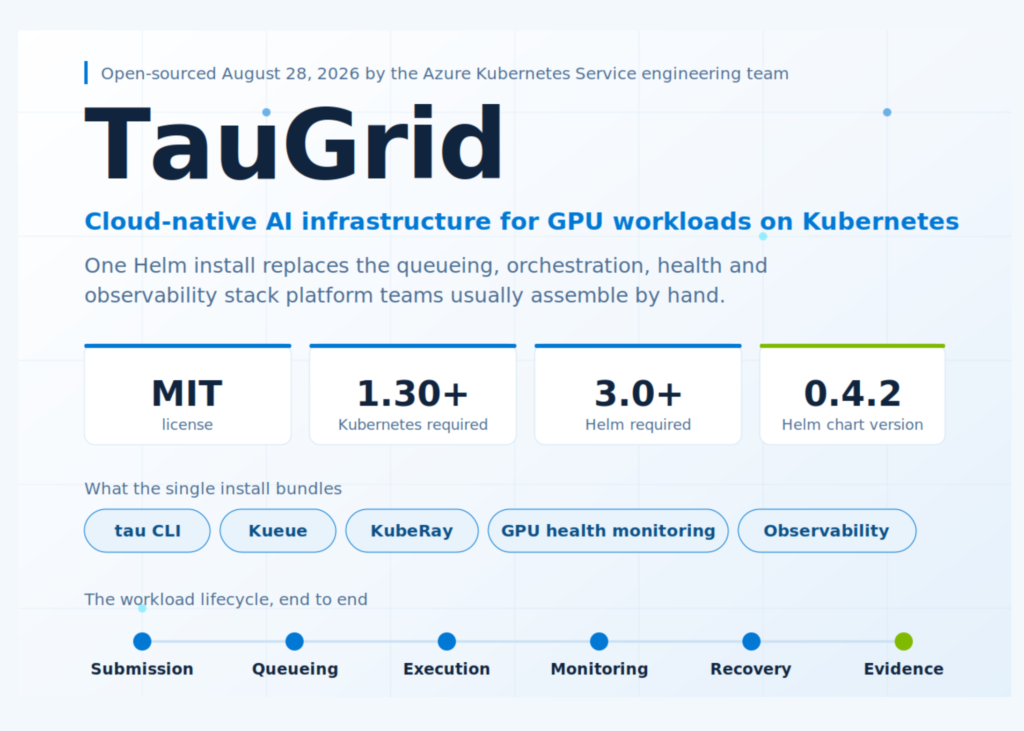
Microsoft has open-sourced TauGrid, a Kubernetes-native stack designed to simplify GPU AI workloads. Released on 28 August 2026 under the MIT license, the project is available on GitHub at Azure/taugrid.
What is TauGrid
Platform teams managing AI on Kubernetes typically stitch together a queueing system, a distributed runtime, GPU health checks, dashboards, and submission scripts. TauGrid collapses that assembly into a single Helm install.
The system combines five components that teams usually integrate by hand:
- The
taucommand-line interface - Workload queueing and admission via Kueue
- Ray cluster orchestration via KubeRay
- Node-level GPU health monitoring
- Cluster and workload observability
The design splits responsibility clearly. Platform teams own workspaces, queues, compute profiles, storage, identity, and observability. Researchers access a repository and the CLI to submit workloads without configuring Kubernetes directly. The codebase is written primarily in Go.
How a job moves through it
A workload is defined in a tau.yaml file. The GPU training example published by Microsoft runs a PyTorch job on a single A100:
schema_version: 1
name: aks-gpu-quickstart
run:
  entrypoint: train.py
  workload_kind: rayjob
compute:
  gpus: 1
  workers: 1
  cpus: 16
  memory: 64Gi
runtime:
  image: mcr.microsoft.com/aks/ai-runtime/ray:py3.12-ray2.56.0-cuda13.0
  pip:
    - torch>=2.4.0
Running tau run resolves platform policy, renders a Kubernetes Job or a KubeRay RayJob, and submits it through Kueue. Microsoft documents six stages: submission, queueing, execution, monitoring, recovery, and evidence.
Recovery covers retry, resuming from a checkpoint, and failure diagnosis. Evidence records capture workload metadata, configuration, logs, metrics, checkpoints, and execution history. This ensures runs remain reproducible and auditable later.
When multiple teams share a cluster, their jobs land in a shared Kueue ClusterQueue. Kueue admits each one based on quota and priority, while Kubernetes places it on healthy GPUs.
Interactive explainer
Install footprint
Installation uses a Helm chart pulled from the Microsoft Container Registry:
helm install taugrid \
  oci://mcr.microsoft.com/aks/ai-runtime/helm/taugrid \
  --version 0.4.2 \
  --namespace tau-system \
  --create-namespace
First-party images ship under mcr.microsoft.com/aks/ai-runtime/ for Tau, the TauGrid Portal, and the tau core controller. Microsoft advises pinning versioned tags or immutable digests rather than latest. The CLI installs from GitHub Releases on Linux and macOS, with a PowerShell installer for Windows amd64. The installer verifies the release checksum and does not modify PATH.
Two operational details matter for anyone evaluating this outside Azure. First, TauGrid sends no telemetry to Microsoft by default, and remote export stays off unless an operator configures a destination. Second, some integrations are still Azure-specific, notably observability through Azure Data Explorer. The stated intent is to support cloud and on-premises Kubernetes without an Azure dependency, and contributions toward that are open.
What it means
For researchers and data scientists, the change is practical rather than theoretical. You no longer need to manage the plumbing of queueing systems, Ray clusters, and GPU health checks manually. A single command handles the submission, and the system tracks every step of the run automatically. This reduces the time spent on infrastructure setup and allows teams to focus on the model training itself.
Related articles