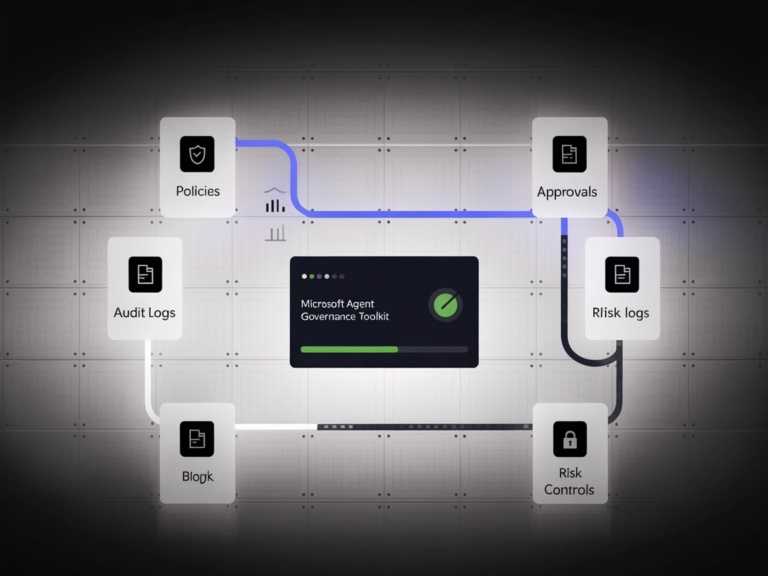
For creators and audio engineers building with generative models, the ability to dictate exactly how an AI agent behaves is no longer a luxury-it is a necessity. As these autonomous tools expand from simple chatbots into complex workflows that handle sensitive data and critical operations, the risk of uncontrolled actions causing cascading failures grows. Microsoft has responded by releasing the Agent Control Specification (ACS), an open-source standard designed to give makers and artists a consistent, granular way to enforce guardrails without reinventing the wheel for every framework.
Putting guardrails in a single file
The core innovation of ACS is its ability to let developers, compliance officers, and security teams define precise policies that agents must follow. These rules specify what an agent is permitted to do, what actions are strictly forbidden, when human approval is required before execution, and which evidence must be logged for later audit. Crucially, these policy files are validated at multiple “interception points” throughout an agent’s lifecycle to ensure it never strays outside its designated boundaries.
This initiative arrives at a time when builders are often forced to improvise controls, particularly as conversations increasingly highlight AI workflows failing due to tool misuse or unintended outputs. Currently, teams might rely on system prompts, custom code checks, or input classifiers to manage behaviour. While functional, these methods often result in fragmented controls that are difficult to audit and impossible to reuse across different interfaces and systems.
Integration across the workflow
ACS aims to unify these disparate controls into a single governance layer. The specification allows for checks at every critical stage: before an agent receives input, before it invokes a tool, after a tool returns a result, and before the final response is sent to the user. A defined policy can allow an action, block it entirely, redact sensitive information, or trigger a request for human approval.
Developers can further enhance this layer by inserting classifiers to categorise data and predict outcomes, deploying large language models to act as a “judge” for policy adherence, and implementing logic to verify tool calls, selection accuracy, and output usage. Because these policies can be written as single files, they can be bundled directly with agents, ensuring that a security policy travels with the agent across different frameworks and environments.
Immediate availability for major frameworks
The specification is currently shipping as a software development kit (SDK) with plugins ready for integration into popular ecosystems. This includes support for LangChain, the OpenAI Agents SDK, the Anthropic Agents SDK, AutoGen, CrewAI, Semantic Kernel, Microsoft.Extensions.AI, and MCP tools, among others.
Key takeaways
- ACS provides a unified, open-source standard for enforcing granular policies on AI agents across multiple interception points.
- Security rules can be bundled as single files, allowing them to follow agents seamlessly across different frameworks and environments.
- The SDK is immediately available for major development platforms including LangChain, OpenAI, Anthropic, and Microsoft’s own AI stack.