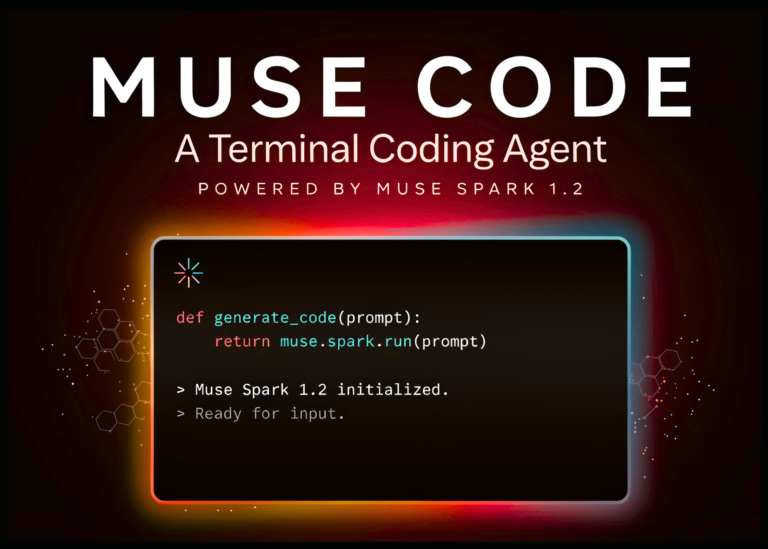
Meta released a new version of Muse Spark on Thursday to challenge OpenAI and Anthropic in the field of agentic coding.
The model and its price
Spark 1.1 builds on the April announcement of the first version. It handles multistep reasoning, manages complex digital workflows, and deploys new features into enterprise systems. Meta claims the tool can manage large agentic workloads, fix bugs, and assist with large code migrations.
Reuters reports the pricing is $1.25 per million input tokens and $4.25 per million output tokens. This places the cost slightly above Anthropic’s Claude Haiku 4.5 and OpenAI’s GPT-5.6 Luna.
Meta’s pitch focuses on the ability to orchestrate tasks across external apps and services. The company stated in a blog post: “Muse Spark 1.1 delivers exceptional performance in personal agentic tasks that require planning and orchestration across a range of external apps and services.”
A rare CEO post
The release was significant enough to prompt CEO Mark Zuckerberg to post on X for the first time in three years. His last update appeared in July 2023, coinciding with the platform rebrand from Twitter to X.
Zuckerberg described Spark as “a strong agentic and coding model at a very low price.” He added that the model is “strongest at agentic performance, tool use, and computer use.” He also noted there is “more to come soon,” suggesting further model releases are planned.
Context for the wider market
This launch occurred during a busy week for AI news. Meta also unveiled Muse Image, a new AI image-generation model, on Tuesday. SpaceXAI released a new version of Grok, and OpenAI dropped GPT-5.6 on Thursday.
The competition remains intense. Companies must work hard to stand out from their peers.
What it means
Developers and IT teams now face a new option for automating complex coding tasks without paying a premium. The pricing structure allows enterprises to deploy agentic workflows at a rate comparable to current market leaders, potentially lowering the barrier to entry for automated code migration and bug fixing.