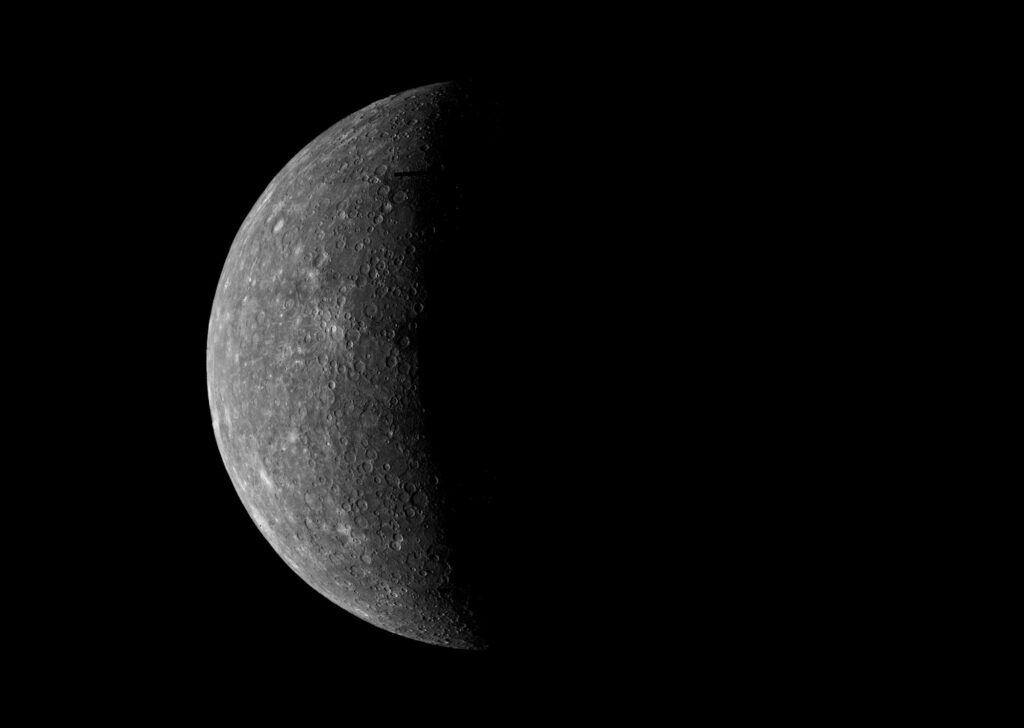
Mercury has shrunk by four to six miles more than scientists previously calculated, a discovery driven by new surface mapping.
Researchers have found that earlier models underestimated the planet’s contraction by 10 to 30 percent. This error occurred because surface roughness and debris from ancient impacts obscured many of the wrinkles formed as the planet cooled.
Feathers in fossilised dung
O’Connor, Jingmai et al. “Bird feathers from a Late Cretaceous coprolite.” Current Biology.
Some 66 million years ago, a fish-eating bird was swallowed by a theropod dinosaur, which was subsequently eaten by a larger predator. The final predator defecated, preserving the remains of the bird within the fossilised dung.
This coprolite was discovered in 2016 at the Hell Creek Formation in Montana. Advanced imaging revealed exceptionally preserved feathers and fish scales from the bird’s last meal.
“Here we report on an exceptionally preserved three-dimensional pennaceous feather preserved in a medium-sized theropod dinosaur coprolite,” said Jingmai O’Connor of the Field Museum of Natural History in Chicago.
The specimen fills a critical gap in understanding feather morphology during the Late Cretaceous. While feathers from pterosaurs and dinosaurs are known, very few survive from the final days of the age of dinosaurs.
The team identified the first known feathers from hesperornithiformes, a family of aquatic birds that did not survive the asteroid impact. The researchers suggest their plumage was less efficient at trapping air compared to the feathers of Neornithean birds, which survived the K-Pg extinction event.
“These primitive plumaceous morphotypes may have been less effective for trapping air, resulting in extinction during the asteroid-induced impact winter largely responsible for the K-Pg mass extinction,” the researchers said.
Titans nesting at high latitudes
Tanaka, Kohei et al. “Titanosaur eggshells from the latest Cretaceous of Patagonia, Argentina: implications for nesting at high latitude.” Royal Society Open Science.
Paleontologists have found fossilised titanosaur eggs at the Chorrillo Formation in Patagonia, Argentina. These findings update knowledge on the breeding habits of the largest land animals in history.
Adult titanosaurs weighed up to 70 metric tonnes and grew longer than 120 feet. Hatchlings, by contrast, weighed between six and eight pounds, similar to human newborns.
Most eggshells found previously come from low latitudes, suggesting these giants preferred warm climates to aid incubation. However, these new specimens were laid at latitudes between 55 and 60°S, where solar radiation was insufficient.
“These eggshells provide, to our knowledge, the first indication that titanosaurs nested at relatively high latitudes,” said Kohei Tanaka of the University of Tsukuba.
The eggs were likely buried under nesting materials and vegetation. Heat generated by decaying plant matter would have allowed the embryos to develop in an environment lacking direct sunlight.
Correction to planetary models
Nishiyama, Gaku et al. “Underestimation of Planetary Contraction due to 2 Obscuration by Surface Roughness: The Case of 3 Mercury.” Geophysical Research Letters.
Mercury is the smallest planet in the solar system, with a surface area roughly comparable to the Indian Ocean. As the planet cooled, its radius increased by four to six miles from its original birth size.
Previous models predicted a certain amount of shrinkage, but updated maps show “shortening structures” are not evenly distributed. Debris from impacts, known as ejecta, has hidden many of these features.
“Our correction for Mercury’s radial contraction provides new insights into the planet’s thermal evolution” and “has a wide range of implications for the interior structure of the planet,” said Gaku Nishiyama of the German Aerospace Center.
The European-Japanese BepiColombo mission is scheduled to enter orbit around the planet this November to study its interior structure in greater detail.
Roman blue pigment in a fishpond painting
Dilaria, Simone et al. “An Uncommon Instance of Egyptian Blue in the “Pigmented Intonachino” of the Fishpond Wall Painting From the Roman Villa of Torre di Pordenone (Northeast Italy).” Archaeometry.
Scientists have identified Egyptian blue in a fragment of a wall painting from the Roman Villa of Torre di Pordenone in northeast Italy. The artwork depicts a fishpond and once adorned a luxury home near Friuli-Venezia-Giulia.
Egyptian blue is the world’s oldest synthetic hue, dating back at least 5,000 years. Analysis shows the pigment was mixed with lime to create a homogeneous, pale blue tone for the water background.
The study offers “a rare example of Roman ‘blue lime-painted mortar’.”
The villa now survives only as puzzle-piece remnants of its former resplendent appearance.
What it means
The revision to Mercury’s contraction rates alters how we understand the planet’s thermal history and internal composition. The discovery of titanosaur eggs at high latitudes indicates these massive creatures adapted their nesting strategies to colder climates, likely relying on microbial heat rather than the sun. Finally, the identification of Egyptian blue in a Roman fishpond painting provides concrete evidence of how ancient artists manipulated pigments to achieve specific aesthetic effects in architectural decoration.