For makers and artists, the arrival of always-on AI agents like Microsoft Scout signals a shift where your digital assistant never clocks out, potentially automating the mundane logistics that often stall creative momentum. While the immediate impact targets corporate teams, the underlying technology promises to handle the repetitive scheduling, email triage, and meeting coordination that frequently interrupts deep work.
The New Enterprise Agent
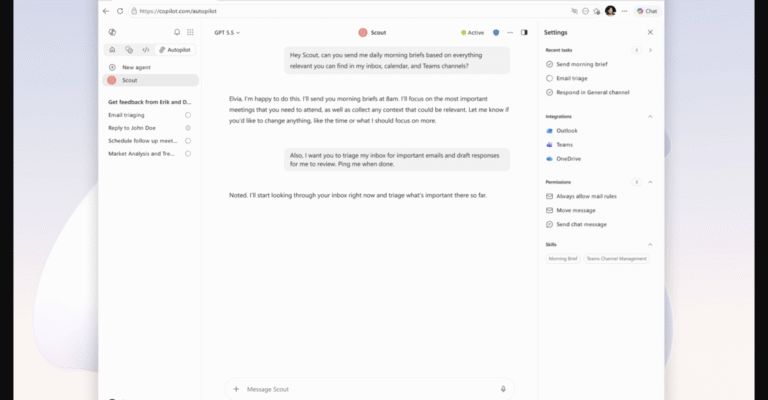
Unveiled at Microsoft’s Build developer conference on Tuesday, Scout is an always-on AI agent capable of scanning work messages, calendars, and email inboxes to automate tasks or resolve scheduling conflicts. Built atop OpenClaw, the engine that captivated early adopters in San Francisco earlier in 2026, Scout is engineered specifically for office environments. Users can issue commands directly within Microsoft Teams, interacting with the software as if it were a human colleague sitting at the next desk.
Automating the ‘Doritos Moment’
This release marks a significant step in Microsoft’s agent-first strategy, embedding AI assistants into the daily rhythm of knowledge work. Omar Shahine, the newly appointed corporate vice president of Microsoft Scout, frames the relationship this way: “Your company essentially hires your assistant.” The core value proposition is clear; a personal assistant works when you are not. While you are taking a break to snack near the office vending machine, Scout is already clearing calendar space for next Tuesday’s all-hands meeting and drafting talking points based on recent correspondence.
Access and Capabilities
Microsoft is initially rolling this feature to a select group of customers, with plans to broaden access shortly. Beyond the Teams integration, a desktop application is available today to subscribers who have opted into “frontier” feature access. Currently, using this desktop app requires an active GitHub Copilot subscription.
Once configured with user goals and preferences, Scout can proactively assign tasks. Shahine demonstrated this by instructing his agent to protect family dinner time. Consequently, whenever a meeting was proposed during that window, the agent flagged the conflict and automatically suggested rescheduling options to colleagues.
With permission to access email and messages, the agent tailors tasks to specific workloads. Shahine tasked Scout with analysing his data to create a live list of every promise made to him and every commitment he made to others. The agent then sends reminders regarding open tickets and drafts follow-up plans.
Rough Edges and Risks
Early users should anticipate imperfections as Microsoft refines the agent. Shahine noted that his own Scout, nicknamed Sebastian, once sent an email that was “just one big run-on sentence, no formatting.” This highlights the critical need to balance which tasks are safe for automation with those requiring direct human supervision.
Despite these growing pains, Shahine views Scout as a vital tool for knowledge workers, particularly those less comfortable with technical interfaces like the terminal. “Internally our sales organization is probably the largest and fastest growing group that’s using this,” he noted.
However, increased automation introduces new security vulnerabilities. Agentic tools like Scout are susceptible to prompt injection attacks, where malicious actors manipulate bots to perform unwanted tasks or leak sensitive information. To mitigate this, Microsoft is proceeding with a limited rollout while building administrative tools to track every action an agent takes.
The Wider Landscape
This development is part of a broader agentic transformation reshaping white-collar employment and team communication. Software developers were the first to face radical workflow changes when agents arrived. Now, less technical staff are expected to automate their daily logistics and internal messaging. Unlike humans, Scout never logs off, ensuring that work projects remain on track and stakeholders are contacted even when you are away from the office.
Competitors are moving in the same direction. Google announced its own version, Gemini Spark, at a recent developer conference. While Google showcased personal life automation, such as planning birthday parties, the enterprise version is also expected to roll out to business customers later this year.
Key takeaways
- Microsoft Scout is an always-on AI agent built on OpenClaw that integrates with Teams to automate scheduling, email, and task management without needing constant human input.
- Access is currently restricted to a limited customer group and specific desktop app users with an active GitHub Copilot subscription, though a broader rollout is anticipated.
- While powerful, these agentic tools carry security risks like prompt injection attacks, necessitating careful oversight and administrative tracking tools.
- Similar initiatives from competitors like Google’s Gemini Spark indicate a permanent shift in how knowledge workers and creative teams manage their daily operations.