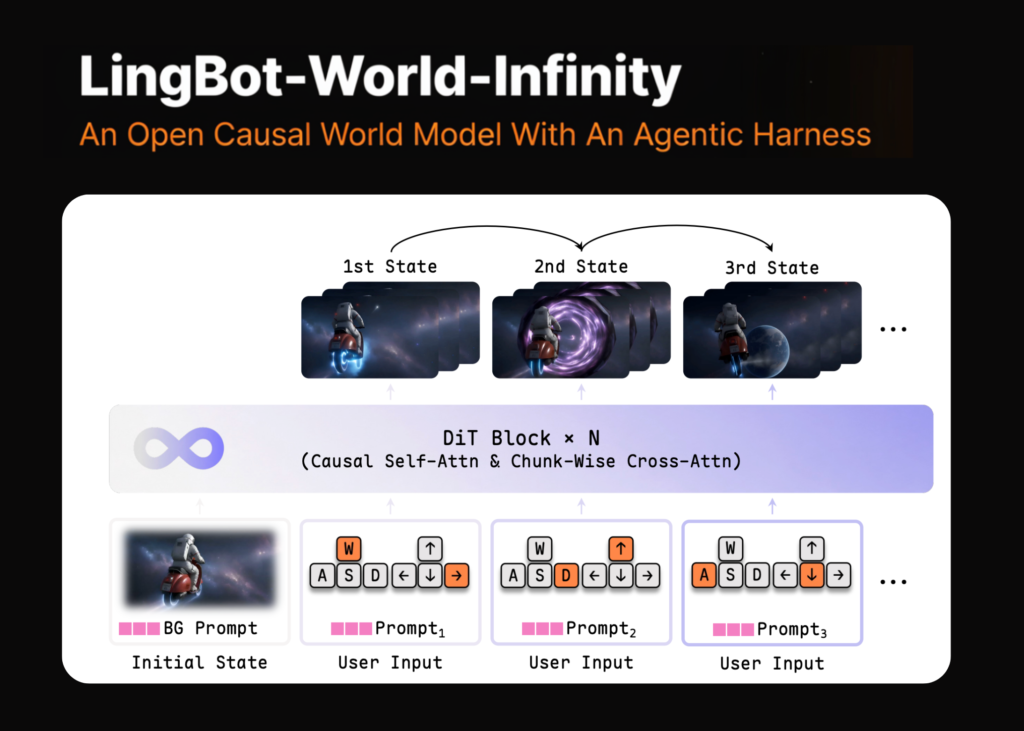
Robbyant, the embodied-intelligence unit within Ant Group, has released LingBot-World-Infinity. This causal video generation model functions as an interactive world simulator designed to solve long-horizon drift and interactive latency.
What is LingBot-World-Infinity?
The system generates video frame by frame, conditioned on a stream of user actions. Each state relies only on past frames and the current input. The research team formalises this as a causal factorization:
p_θ(x_1:T | a_1:T) = Π_t p_θ(x_t | x_<t, a_≤t)Here x_t is the visual state at time t. The action a_t combines a camera pose and a text prompt. Camera pose uses Plücker embeddings, injected through adaptive layer normalization (AdaLN). Text enters as chunk-wise prompts through cross-attention.
The research team claims four upgrades over LingBot-World:
- An unbounded interaction horizon with consistent output quality.
- A distilled real-time variant sufficient to drive 720p video streams at 60 fps.
- A broader action space, including attacking, archery, spell-casting, and shooting.
- An agentic harness pairing a pilot agent with a director agent.
The primary model is 14B. A lightweight 1.3B counterpart is described as deployable on a single GPU.
The Architecture: MoBA and Two-Stage Training
The core contribution is the Mixture of Bidirectional and Autoregressive (MoBA) Attention Mask. It explains the drift.
Standard autoregressive video training uses a teacher forcing mask. Each noisy frame attends to itself and its clean context. The research team found a failure here. As context grows, the model leans on that context instead of predicting future frames. The result is overfitting and visual quality degradation.
MoBA appends a bidirectional full-attention block to the teacher forcing mask. That block acts as a regularizer. It also helps the model handle flexible-length generation.
The cross-attention mask mirrors the split. The autoregressive component attends to a background prompt along with chunk-wise prompts in a lower-triangular pattern. That prevents future semantics from leaking backward. The bidirectional component attends to one global prompt.
Pre-training optimises a conditional flow-matching objective with rectified-flow interpolation. Post-training then compresses the multi-step teacher into a few-step student:
- Consistency distillation: Latents on the same teacher probability-flow ODE (PF-ODE) trajectory must map to identical predictions.
- Distribution matching distillation (DMD): The generator follows the KL gradient between noised student and noised data distributions.
The important detail sits in the DMD. The research team applies it over long self-rollout trajectories, not only teacher-forced states. The student is therefore optimised on the state distribution its own predictions induce. That is the stated mechanism behind anti-drift.
The Agentic Harness: The Feature Worth Taking Seriously
A frame predictor does not play itself. The Robbyant research team wraps the generator in a Director-Pilot Co-Simulation Framework.
As described in the research paper, a Vision-Language Model is the Director. It governs macroscopic semantic rules and causal reasoning. The Diffusion Transformer video generator is the Pilot. It simulates low-level physical dynamics and renders transitions.
The harness exposes two interaction modes:
Mode A: Direct Semantic Interaction. The VLM reads the current frame and generates event cards. No object masks are required.
Mode B: Tracking-Assisted Object Interaction. A SAM-based (Segment Anything Model) action-proposal loop tracks objects across chunks. Users select a tracked object and trigger actions. The research paper shows door-opening and ball-rotating rollouts.
Users can also intervene textually. Global state shifts change time of day or weather. Local entity injection spawns creatures, and the VLM picks plausible entry points.
The interface follows game conventions. WASD drives movement, IJKL controls view. Space triggers a jump; P triggers a wing glide. Keys U and O carry VLM-proposed character actions. Keys F and G carry environmental events. Numeric keys are user-registered event slots.
Hands-On: What Ships and What Doesn’t
Expectations need calibration here.
The codebase is built on Wan2.2. Only lingbot-world-v2-14b-causal-fast is downloadable today. The causal-pretrained 14B, the bidirectional 14B, and both 1.3B variants are marked TODO.
git clone https://github.com/robbyant/lingbot-world-v2.git
cd lingbot-world-v2
pip install -r requirements.txt            # torch >= 2.4.0
pip install flash-attn --no-build-isolation
huggingface-cli download robbyant/lingbot-world-v2-14b-causal-fast \
  --local-dir ./lingbot-world-v2-14b-causal-fast
The provided generate.py runs causal inference with KV caching. It processes frames chunk-by-chunk rather than all at once. The reference command is eight-GPU and 480P:
torchrun --nproc_per_node=8 generate.py \
  --task i2v-A14B --size 480*832 \
  --ckpt_dir lingbot-world-v2-14b-causal-fast \
  --image examples/03/image.jpg --action_path examples/03 \
  --dit_fsdp --t5_fsdp --ulysses_size 8 \
  --frame_num 361 --local_attn_size 18 --sink_size 6 \
  --prompt "A serene lakeside scene with a lone tree standing in calm water..."
The released reference script is 480×832 across eight GPUs. The 60 fps figure describes the deployed stream, which passes a spatio-temporal refiner. That refiner upsamples decoded frames, then synthesises intermediate frames for a higher frame rate. Both stages compile into TensorRT engines.
A Diffusers checkpoint also exists:
import torch
from diffusers import DiffusionPipeline
from diffusers.utils import load_image, export_to_video

pipe = DiffusionPipeline.from_pretrained(
    "robbyant/lingbot-world-v2-14b-causal-fast",
    dtype=torch.bfloat16, device_map="cuda")
frames = pipe(image=load_image("seed.png"), prompt="...").frames[0]
export_to_video(frames, "output.mp4")
For a hosted path, Reactor serves the model as reactor/lingbot-world-2. Its docs list 48 fps at 1664×960. Sessions are command-driven and stateful: