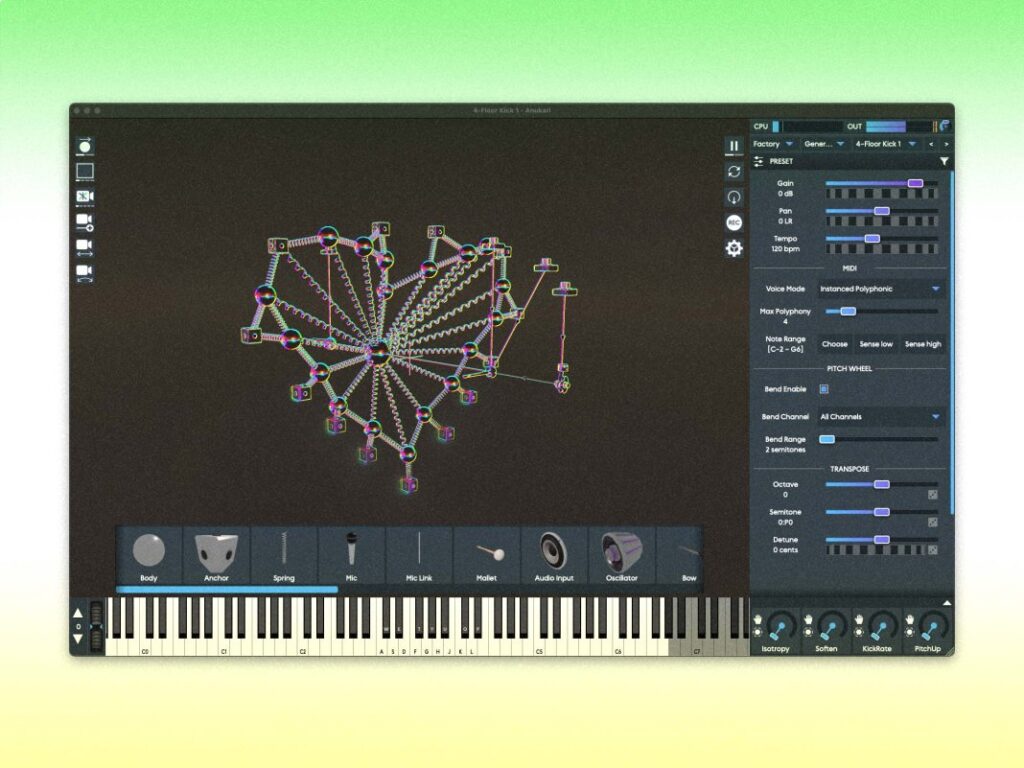
A new virtual instrument called Anukari lets users build virtual objects like masses, springs, mallets, and bows, then play them to create kooky sounds.
Described as part synth, part virtual physics playground, Anukari has just launched following a beta testing phase and several years of development. It works as a plugin or standalone instrument, but is said to be “built more like a game”.
Anukari is visually malleable, and its outputs are shareable on social media. It functions as both a virtual instrument and an effects processor, able to process external audio sources such as vocals, guitars, and other instruments.
Users can shape and change how their object creations behave and place virtual microphones around them. Designed as an alternative to efficiency-based music tools that are popular across the market, Anukari is built for experimentation and discovery instead.
Evan Mezeske, founder and creator of Anukari, is a musician, autodidact, and a former engineering leader at Google with “a long history of playing with tech”.
“I grew up in my granddad’s autoshop surrounded by pistons and crankshafts. Perhaps because of that, I like machines and building things. Translating mechanical things into a simulation tickles that part of my brain that loves mechanical contraptions, and it makes playing Anukari feel different from other synths,” he explains.
“Chips or transistors are very abstract, but with 3D graphics and physics, you see what it’s doing in real time, it’s tactile. ‘It’s jiggling like this and making a sound.’”
See how it works in the videos below:
“I built Anukari for the intrepid sonic explorer. They may simply want to play and discover, or they may be a professional artist or producer looking for inspiration or a new sound to work with. Either way, I want people to push it, try to break it, and to see what surprises emerge in the process. I thought it was cool, and I want to invite others to make cool shit. That’s really our whole mission,” continues Mezeske.
“Lots of people assume Anukari is an audio engine with a cute visualiser on top, but the reality is it wouldn’t work without the graphics. The 3D visuals make the audio happen, not the other way around. Anukari is ridiculously efficient thanks to the way it’s designed.
“My past work at Google involved extremely large-scale systems, coordinating work across thousands of machines that have to cooperate. What I had learned about distributed systems applied to building an audio plugin and coordinating things happening in parallel.”
Anukari currently has an introductory price of $99 ($149 standard). You can find out more or try it for free by heading over to the Anukari website.
What it means
For musicians, this approach changes the workflow from selecting presets to manipulating physical objects within a 3D space. The tool relies on the graphics engine to generate the sound, meaning the visual feedback is not just cosmetic but essential to the audio output. This design allows users to experiment with how mechanical interactions translate into audio, offering a method to find new sounds that standard synthesizers might not provide.