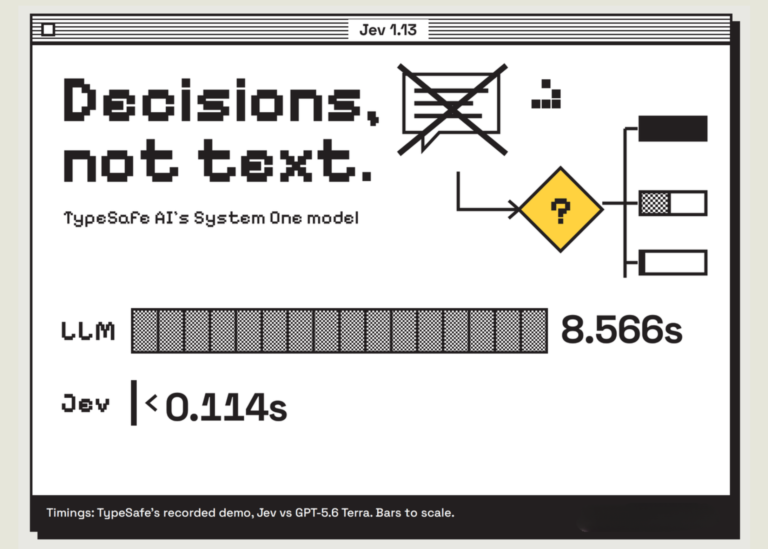
TypeSafe AI has released Jev, a new model that outputs floating point numbers rather than text. It accepts text inputs but returns probabilities for categories, yes/no questions, and ratings.
The company describes the system as a function call for frontier intelligence, taking unstructured state and returning typed probabilistic decisions.
Speed and cost are the main selling points. Standard large language models charge for both input and output tokens, with outputs usually costing more. Jev charges only for input. The first model costs $0.042 per million tokens, which is lower than OpenAI‘s GPT-5 Nano at $0.05 per million.
You send a state object containing strings or name-value pairs to the API. You then ask questions and receive a reply for each.
There are three types of queries:
- Yes/No questions, called “Noul” questions. The CEO confirmed this is short for Bernoulli, referencing the Bernoulli distribution. You get a number between 0 and 1 indicating confidence.
- Choice questions. The model selects one option from a provided set, returning a confidence score and a probability distribution.
- Score questions. You provide a sequence of numeric levels with descriptions, and the model returns a floating point score within that range.
The API accepts a single document and as many questions as fit in the context window. Questions are evaluated in parallel, so sending many takes roughly the same time as sending one.
Thinking of this as a decision model helps identify where to use it. It works well for classification tasks like spam detection, suggesting labels, or prioritisation.
I have also tested it for search reranking. You can fetch 100 likely matches using an inexpensive algorithm like BM25, then have Jev score those candidates for relevance against the original query.
Black boxes are back in fashion
Jev represents a move further towards opaque machine learning systems. Large language models are already opaque; you can ask them to justify decisions, but you cannot guarantee the accuracy of their explanation.
Jev does not even provide that. You put in all the text you want, and the only output is a floating point number. If the system marks content as spam, there is no way to know which signals tipped it off.
This means concerns about bias must be central. I hope nobody uses Jev to rank job applicants. A single number could hide unseen bias baked into the model, and experimentally picking that apart would be difficult.
I tried one experiment where I asked Jev to score every city in the San Francisco Bay Area on whether they were a “Good city”. It rated Cupertino top and East Palo Alto bottom.
In practice, this means evaluations and structured experiments are more important than for regular large language model projects. Fortunately, Jev is so cheap that running hundreds or thousands of experimental prompts costs just a few cents.
Unconventional uses for Jev
The wider community has quickly identified potential use cases. Here are some examples:
- jevchat by Kyle Pena turns Jev into a chat model. At every step it asks Jev one question: “Given the user’s question and the reply written so far, which symbol comes next?”.
- jev-leftpad by Fatih Kadir Akın implements left-pad using the prompt “How many spaces are needed before value to reach targetLength?” and a choice query allowing options from “0 spaces are needed” to “10 spaces are needed”.
- jev-2048 by Andy Gayton uses Jev to play the 2048 sliding puzzle game.
Open weight recreations
There has been a flurry of projects attempting to create a model like Jev using open weight models. Kev is one interesting example, using Qwen 3.5 to produce 0.8B, 4B, and 9B models.
A benchmark called JevBench has already appeared to compare “Jev-class decision models”.
Given Jev was released just under a week ago, the amount of activity around it is impressive.
What it means
For people making things, this changes the workflow. Instead of generating paragraphs, you feed data and get a score. It is useful when you need a quick, cheap answer to a specific question rather than a creative response. You can treat it as a specialised tool for filtering or ranking data.