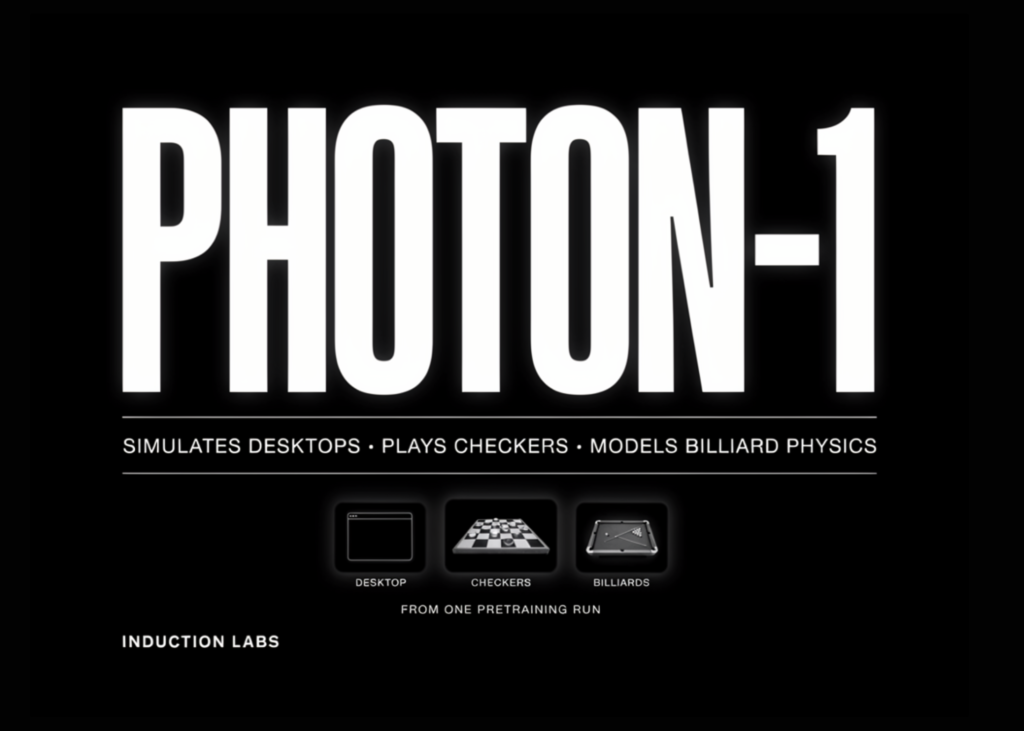
Induction Labs has released Photon-1, a foundation model trained on 18 years of screen recordings that can simulate desktop environments, play checkers, and model billiard physics without ever being shown an action label during pretraining.
The system is a sparse 106B-A5B mixture-of-experts transformer. On an internal benchmark, it outperforms Gemini 3.1 Flash-Lite while costing roughly three times less to serve.
How the model predicts future states
The architecture uses a next-latent-token-prediction objective. It does not generate pixels during the initial training phase. Instead, everything is modelled in a learned representation space.
The core claim is that predicting future states teaches the model to complete tasks. Induction Labs calls this an implicit policy. The system learns concepts of what a person is doing, rather than a label for each mouse click.
The compression method
The vision encoder uses finite scalar quantization. Each frame is compressed into 960 discrete tokens. Each token is an 8-dimensional vector where each dimension takes one of five values: −1, −1/2, 0, 1/2, 1. This creates a codebook of 5⁸ possible codes.
The resulting encoding is about 2.2 KB per frame. Induction Labs reports over 100 times better compression than existing OCR and multimodal representations, while preserving text, layout, and state changes.
To achieve this rate, Photon-1 uses a differential latent encoder. It encodes video frames as pairs, so the latents describe differences between frames rather than frame contents.
Data and training figures
The corpus starts from an internal index of 2 billion publicly available videos. Filtering reduces that to roughly 2 million computer screen recordings. An internal keyframe detection model strips redundant frames.
The final dataset is 575 million frames, sampled at 1 frame per second. That equals 552 billion tokens, or about 18 years of video. Photon-1 was pretrained from scratch for a single epoch.
Training the 106B-A5B MoE at 32K context took approximately 30,000 H200 GPU-hours, or 4.4×10²² training FLOPs. The team implemented training in PyTorch with custom fused kernels, sustaining 40% end-to-end MFU. Those three figures are mutually consistent: 30,000 H200-hours at 40% MFU lands almost exactly on 4.3×10²².
From imagination to action
Induction Labs finetuned Photon-1 on fewer than 35,000 computer use trajectories to teach the action and instruction format. Special computer use tokens let the model emit actions. At inference, Photon-1 predicts the next frame’s state first, then outputs the action that gets there.
Online reinforcement learning follows. Rollouts run in real time on virtual machines at scale, and outcomes are verified programmatically to produce reward. The Linux VMs run five desktop environments (LXQt, Xfce, MATE, GNOME and Plasma), each with a Google account for login-restricted web apps and an internal ChatGPT clone with no rate limits.
Compute and cost comparison
| Model | Pretraining compute | Weighted inference cost / 1M tokens* |
|---|---|---|
| Gemini 3.1 Flash-Lite | 1.200 × 10²⁴ FLOPs | $0.36 |
| Photon-1 | 0.044 × 10²⁴ FLOPs | $0.11 |
*Weighted at a 10:1 input-to-output token ratio, which Induction Labs says matches its computer use tests.
Two caveats belong next to that table. First, the Gemini figure is Induction Labs’ own conservative estimate, assuming 8B active parameters and 25T pretraining tokens. Taken at face value the ratio is about 27 times, not the 30 times headline; Induction Labs states “at least 30 times” on the basis that the true Gemini number is likely higher and the model was likely distilled. Second, the benchmark is internal and unreleased, so the result is not independently reproducible today.
Photon-1’s own breakeven cost on Induction Labs’ hardware is $0.06 per 1M input tokens and $0.60 per 1M output tokens, with no speculative decoding.
Does it generalise past the desktop?
This is the more interesting test, because Photon-1 saw only computer use video. The research team finetuned it on domains absent from pretraining and compared against two baselines: a vision encoder baseline with the same architecture and size but no imagination pretraining, and an LLM baseline (Ling-flash-2.0 from Inclusion AI, pretrained on 20T tokens).
On 20,000 tournament checkers games from the Open Checkers Archive 2.0, Photon-1 beat both baselines on world simulation and on move quality. On 10,000 synthetically generated billiard games simulated at 5 fps, it produced a mean absolute error of 0.47 against the ground-truth physics engine, versus 1.15 for the LLM baseline and 1.44 for the vision encoder baseline.
Photon-1 also picked up human priors from the pretraining video. After RL, it learned to use the in-VM ChatGPT clone to draft artifacts and answer knowledge questions, steering the LLM the way a person would.
Key Takeaways
- Photon-1 learns an implicit policy from 18 years of screen recordings with zero action labels, using next-latent-token prediction.
- FSQ compresses each frame to 960 tokens (~2.2 KB), a reported 100 times gain over OCR and multimodal representations.
- Trained for ~30,000 H200 GPU-hours, it beats Gemini 3.1 Flash-Lite on an internal benchmark at ~27 times less pretraining compute.
- Despite seeing only desktop video, it beats an LLM baseline at checkers and billiard physics after finetuning.
- No weights, no API, no license — this is a research result, not a deployable model.
Check out the full technical writeup from Induction Labs and the announcement thread on X. All credit for this research goes to the researchers of this project.