IBM launches Granite Time Series PatchTST-FM-r2, the top-performing zero-shot model under a permissive commercial license
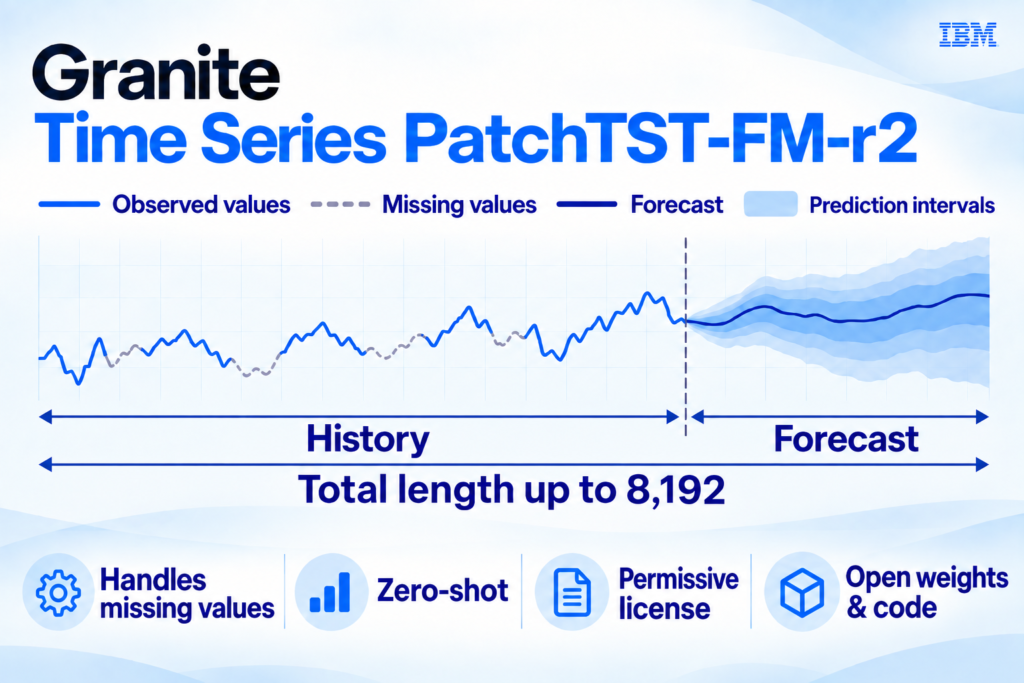
IBM has released Granite Time Series PatchTST-FM-r2, a foundation model designed to generate forecasts without prior training on specific datasets. The release targets users who previously had to build and maintain separate models for every data source.
As of September 8, 2026, this model ranks first among replicable, zero-shot models with permissive licensing on the GIFT-Eval leaderboard. It also holds the second position overall in that same category.
The system weighs in at approximately 385 million parameters. It supports a context length of up to 8,192 steps and delivers probabilistic forecasts through a 99-quantile prediction head.
All weights, architecture details, inference pipelines, and code required to reproduce benchmark results are available. IBM also notes integration with Confluent for streaming applications.
Ready to try it? Open Granite Time Series PatchTST-FM-r2 on Hugging Face
TL;DR
- General-purpose zero-shot forecasting for demand, prices, energy loads, traffic, telemetry, and other time series.
- Approximately 385M parameters, context length up to 8,192, flexible forecast lengths, and probabilistic forecasts through a 99-quantile prediction head.
- The model backbone is constructed from conformer blocks that combine multi-head self-attention with temporal convolution to capture long- and short-range temporal structure.
- Permissively licensed model with top performance in the replicable zero-shot category of the GIFT-Eval benchmark (dual-licensed under Apache-2.0 and OpenMDW-1.0, users may select either license).
- Available open weights, architecture, inference pipeline, and code to reproduce the benchmark.
Strong zero-shot forecasting on GIFT-Eval
A foundation model is most useful when it generalizes to time series it has not been specifically trained on. For that reason, we focus first on zero-shot performance.
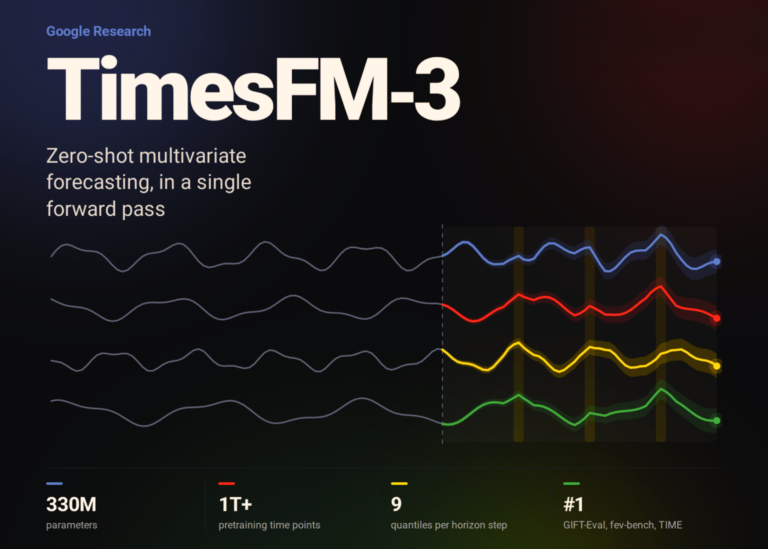
GIFT-Eval provides a broad evaluation of forecasting models across heterogeneous datasets and forecasting scenarios. When restricting the leaderboard to models that are zero-shot, replicable, and evaluated without test leakage, PatchTST-FM-r2 ranks second for both CRPS and MASE as of September 8, 2026, as illustrated in Figures 1 and 2 (lower values are better for both metrics). Importantly, PatchTST-FM-r2 is the highest-performing model in the same category among models with permissive, commercial-friendly licensing.
Figure 1. GIFT-Eval CRPS for leading replicable zero-shot models. PatchTST-FM-r2 achieves a geometric-mean CRPS of 0.467, placing it immediately behind TimesFM-3 in this comparison, and first among the models with permissive licenses.
Figure 2. GIFT-Eval MASE for leading replicable zero-shot models. PatchTST-FM-r2 achieves a geometric-mean MASE of 0.6846. Blue bars denote models released by the IBM time-series foundation-model team.
Competitive even against models allowed to use benchmark training data
Some models on GIFT-Eval are categorized as pretrained rather than strictly zero-shot. These models are allowed to include the training portions of GIFT-Eval evaluation datasets in their pretraining corpora.
Even when these pretrained models are added to the comparison, PatchTST-FM-r2 remains near the top as seen in Figures 3 and 4: 3rd for CRPS and 4th for MASE among the replicable models. It outperforms several pretrained models, including Chronos-2, Timer-S1, and Toto variants, despite some competing models being considerably larger.
Figure 3. GIFT-Eval CRPS when both zero-shot and pretrained replicable models are considered.
Figure 4. GIFT-Eval MASE when both zero-shot and pretrained replicable models are considered.
Architecture: What changed from PatchTST-FM-r1?
PatchTST-FM-r2 retains the patch-based representation that made the PatchTST family effective, but the internal architecture is redesigned to capture long- and short-term relationships efficiently and to smoothen inter-patch predictions — both of which substantially improve error measures.
One change is the move from standard transformer layers to layers which incorporate convolution along with the multi-head self-attention. These layers are referred to as conformer layers and has its origin in speech processing applications.
Figure 5. Architectural evolution from PatchTST-FM-r1 to the Conformer-based PatchTST-FM-r2.
A PatchTST-FM-r1 block combines multi-head self-attention with a feed-forward network. In r2, we replaced this with a conformer-style block containing two half-step feed-forward layers surrounding multi-head self-attention and a temporal convolution layer.
This gives the model two complementary mechanisms for reasoning over a time series. Self-attention can model long-range relationships between patches, while convolution provides an inductive bias toward local temporal structure. The convolution component can therefore capture shorter-term interactions while allowing attention to concentrate on relationships over longer horizons. This phenomenon is observable in attention patterns captured in the transformer and conformer versions (see example figure below using real samples from the ETTh1 dataset). While a significant portion of the transformer’s self-attention (left in the figure) concentrates near the diagonal, i.e., capturing local relationships, attentions in the conformer block (right in the figure) show long-distance (far-off-diagonal) focus, thanks to the convolution layer covering the short distances. The conformer blocks in the backbone use alternating convolution kernel sizes of 3 and 5, in a repeating pattern {5, 5, 3, 3}.
Figure 6. Comparing attention patterns captured in the transformer (left) and conformer versions(right) using real samples from the ETTh1 dataset.
Additionally, PatchTST-FM-r2 uses 50% overlapping patches with Hamming-window weighting and overlap-and-add forecasting to smooth patch boundaries and improve forecasting accuracy. Finally, the architecture adds normalization for stability and expands from 20 to 30 blocks.
With these changes, the resulting model has approximately 385M parameters, supports very long contexts of up to 8,192 steps, and predicts 99 quantiles over flexible forecast lengths. The model provides both point forecasts and quantile outputs for forecasting distributions and uncertainty intervals.
Training data
For foundation models intended for real applications, model quality is only one consideration. Developers increasingly need to understand what data went into a model, whether benchmark data may have leaked into training, and what the implications are for deploying the model.
PatchTST-FM-r2 uses a documented pretraining corpus consisting of four sources: selected datasets from GiftEvalPretrain; custom synthetic data based on KernelSynth with modified periodic kernels and limited augmentation; a TSMixup corpus generated using the approach described by Chronos but restricted to datasets outside the GIFT-Eval evaluation set; and approximately 500,000 synthetic CauKer sequences, each of length 4,096.
For enterprise adopters, this kind of transparency can be as important as another few points on a leaderboard. This does not eliminate the need for an organization’s own model-governance and licensing review, but it gives users considerably more information with which to perform that review than an opaque pretraining corpus would.
Open for research experimentation — and for commercial use
To provide greater choice for the community, Granite Time Series PatchTST-FM-r2 is dual licensed under Apache 2.0 and OpenMDW 1.0. Users may select either license, both of which provide broad, permissive rights to use, modify, and distribute the models, with the Linux Foundation’s OpenMDW offering a licensing framework specifically designed for AI models and related materials. By making the models available under permissive open-source licenses, IBM aims to reduce barriers to adoption and enable organizations, researchers, and developers to build on the technology with confidence that comes with licenses that don’t restrict your use. The architecture implementation is also available through Granite-TSFM repository and is backward-compatible with PatchTST-FM-r1 checkpoints.
Try PatchTST-FM-r2 in a few lines of Python
The easiest way to evaluate a foundation model is on your own time series data.
Install the Granite TSFM package:
pip install "granite-tsfm>=0.3.9"Then load PatchTST-FM-r2 directly from the Hugging Face Hub:
import pandas as pd from tsfm_public import PatchTSTFMForPrediction, TimeSeriesForecastingPipeline # Load model weights model = PatchTSTFMForPrediction.from_pretrained( "ibm-granite/granite-timeseries-patchtst-fm-r2" ) # Read some sample data from ETTh df = pd.read_csv( "https://raw.githubusercontent.com/zhouhaoyi/ETDataset/main/ETT-small/ETTh1.csv", parse_dates=["date"], ) # Set up the forecasting pipeline pipe = TimeSeriesForecastingPipeline( model=model, id_columns=[], timestamp_column="date", target_columns=["HUFL"], max_context_length=model.config.context_length, context_length=512, prediction_length=64, impute_method=None, quantile_levels=[0.1, 0.5, 0.9], explode_forecasts=True, freq="1h", ) # Create a forecast from the last 512 samples of the input dataframe forecast = pipe(df.iloc[-512:])As you can see, no fine-tuning and no task-specific model fitting is needed. The pipeline consumes just the recent history of the series and generates the future forecast, including the requested quantiles.
The above is a simple example on publicly available data – you can replace the example input data with your own, including demand, sensor telemetry, CPU utilization, energy consumption, transaction volume, traffic, prices, or another regularly sampled time series.
Try it on your own data: Open PatchTST-FM-r2 on the Hugging Face Hub
From notebooks to streaming time series
This release connects to a broader effort around IBM Granite Time Series models, adding a new model to the broader portfolio.
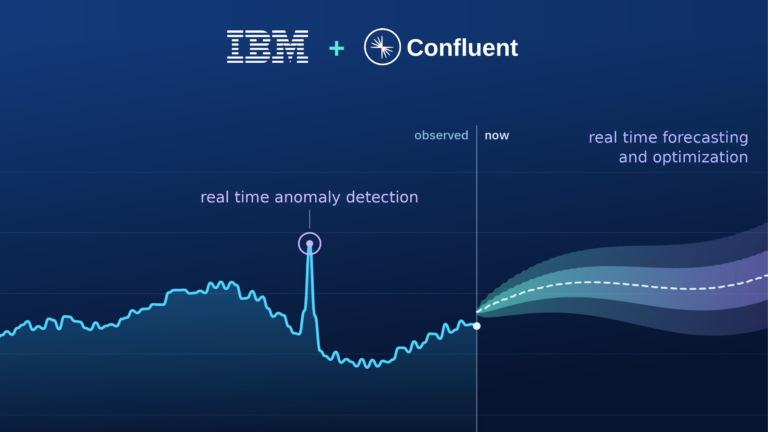
For applications where data arrives continuously rather than in static DataFrames, IBM and Confluent recently made several Granite Time Series models available through an Early Access program
Source Read original →