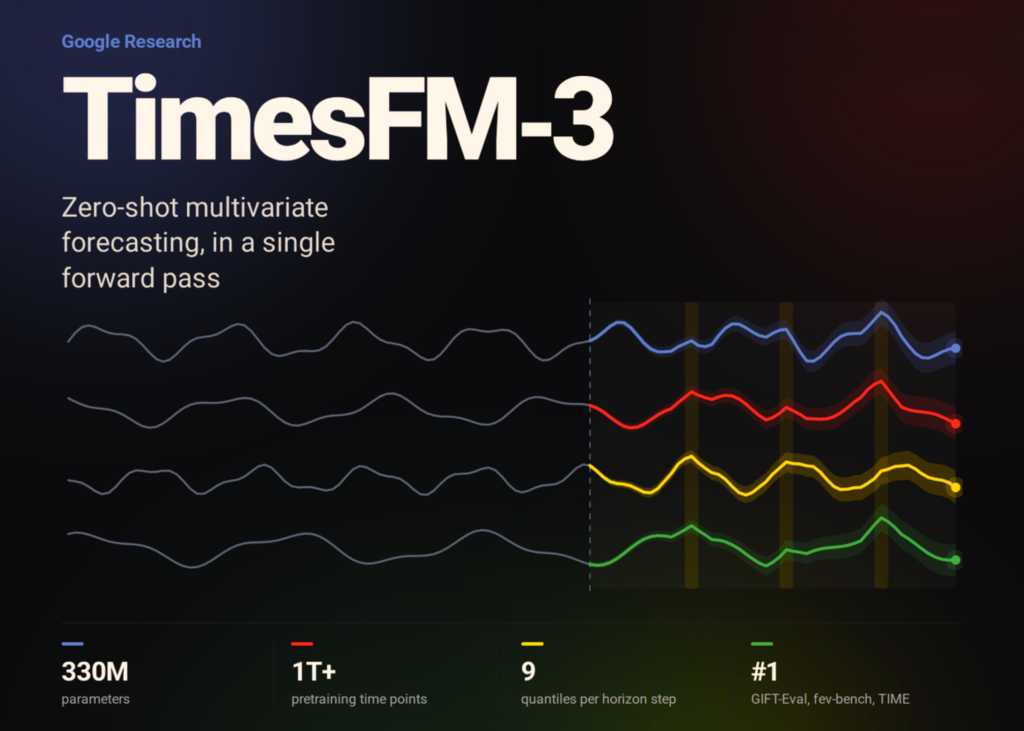
Google Research has released TimesFM-3, a 330 million parameter model capable of forecasting multiple related series in a single pass. Previous versions up to 2.5 were limited to univariate forecasting, handling only one series against its own history. This new checkpoint is pretrained natively for multivariate forecasting on more than 1 trillion time points. It accepts multiple targets, past covariates, and past-future covariates without requiring task-specific fine-tuning. On the GIFT-Eval, fev-bench, and TIME leaderboards, it holds the top average rank among pretrained foundation models for both point and probabilistic metrics.
Is it deployable?
Partially. The code repository is released under an Apache-2.0 licence, but the model weights ship under a non-commercial licence. You can benchmark the weights today, but you cannot ship them behind a production forecast API. If you need to deploy for production, TimesFM 2.5 remains the Apache-2.0 option.
What changed
Most real forecasting problems involve multiple variables. Google’s example involves ice cream sales, where related product sales, foot traffic, weather, promotions, and holidays all influence the target. TimesFM-3 is pretrained to handle these relationships directly. It carries 330 million parameters and was trained on more than 1 trillion time points of real and synthetic series.
Three input types work zero-shot with no task-specific fine-tuning:
- Multiple targets are forecast jointly, providing point and quantile outputs for each.
- Past covariates are known only historically, such as past foot traffic.
- Past-future covariates have future values known in advance, such as a promotion calendar.
Architecture: patches, then two kinds of attention
The backbone remains a decoder-only transformer. Contiguous points are grouped into patches of 32 steps. These are then normalised per series so that wildly different scales do not dominate the model. Target and past-covariate tokens come from a single patch. Past-future covariate tokens use a lookahead trick: the current patch is concatenated with future patches, allowing the model to see scheduled events before they occur.
Tokens enter a 2D grid and pass through two alternating attention mechanisms:
- Causal temporal attention runs horizontally. It is strictly causal and confined to earlier tokens inside the same series, which blocks data leakage.
- Full variate attention runs vertically. At a given time step, a token reads every other series at that step, learning cross-series correlations.
One forward pass instead of many
Earlier TimesFM versions decoded one patch at a time. That approach added latency, compute cost, and compounding error. TimesFM-3 uses Contiguous Patch Masking, the training-time masking strategy introduced with TiRex. Masked placeholder tokens are appended for the whole horizon. Targets and past covariates are masked there. Past-future covariates stay visible, so known future signals still reach the model. The alternating attention layers fill every masked horizon patch simultaneously. Each target receives 9 quantiles, the 10th through 90th percentile, at every horizon step.
Benchmarks
Google evaluated the model on GIFT-Eval, fev-bench, and the TIME leaderboard, comparing it against Chronos-2, the Toto 2.0 family, and TimesFM-2.5. Among pretrained foundation models, TimesFM-3 takes the top average rank on all three for both point and probabilistic metrics. The package release notes record rank #1 overall on fev-bench across 100 real-world tasks, rank #1 overall on TIME across 50 domain datasets and 98 evaluation tasks, and rank #1 among foundation models on GIFT-Eval.
What it means
For data scientists building forecasting pipelines, this removes the need to stitch separate models for different data points. You can feed the model a single dataset containing sales, weather, and marketing calendars and receive correlated predictions for all variables simultaneously. The ability to ingest future knowns, like a holiday schedule, allows the model to account for scheduled events without manual feature engineering. However, the non-commercial weights mean this specific architecture is not ready for immediate commercial deployment.