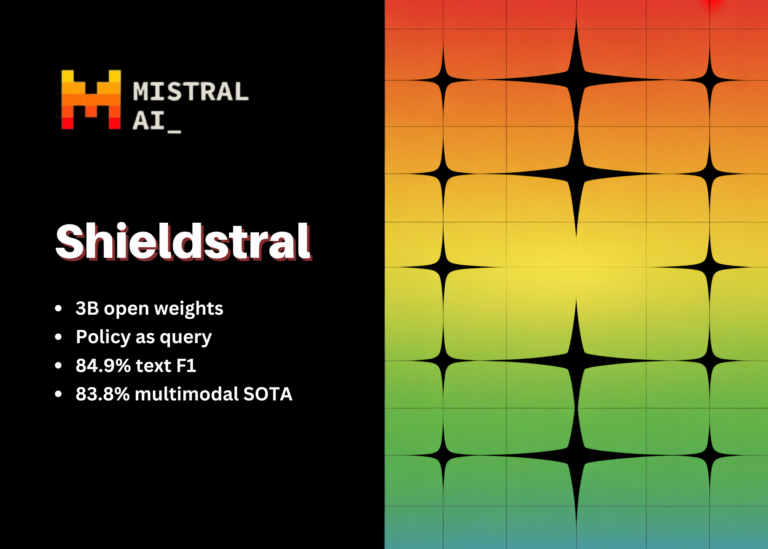
Mistral AI has released Timestral, a new family of time series foundation models. The collection includes four zero-shot forecasting options ranging from 5 million to 209 million parameters. The largest variant, Timestral-209M, ranks first among pretrained, zero-shot models on GIFT-Eval, TIME, and fev-bench benchmarks. It achieves this performance without requiring a GPU for inference. Developers can run probabilistic forecasts on standard server CPUs using the open weights and provided inference code.
Technical specifications
The family consists of four dense models with 5M, 28M, 123M, and 209M parameters. Each supports a context window of up to 32,768 time steps. The 209M model weighs 837 MB in fp32 format. GPU usage is optional but not required for operation.
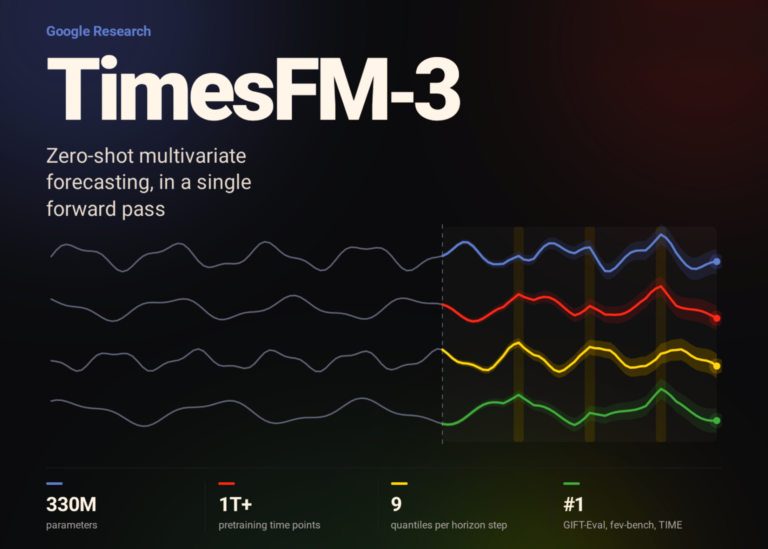
In terms of performance, the 209M model scores a SQL skill of 50.39 on fev-bench, surpassing Google’s TimesFM-3 which sits at 48.99. On GIFT-Eval, the MASE score of 0.658 edges out t0-gamma’s 0.661 by a margin of 0.003.
How the model works
Timestral operates as a causal, patch-based transformer. It uses time attention and variate attention mechanisms. The 209M version contains 24 layers with an embedding dimension of 768. Each patch covers 32 time steps, allowing a single forward pass to forecast up to 1,024 steps. Longer horizons run in blocks, feeding the median of each block back as context.
Mistral lists four technical contributions. Decoupled Horizon Forecasting (DHF) allows learned forecast tokens to read the full history while keeping observed values in context rather than masking them. Covariate-aware attention treats each series as a target, accepting past-only or known-future covariates while preventing future data leakage. The training data relies heavily on synthetic sets containing trends, seasonality, noise, and nonlinear cross-series dependencies. A two-stage training process pretrains on synthetic data at a context of 8,192 before post-training on mixed data with four times the context length. The loss function is pinball loss across 21 quantiles.
Performance on benchmarks
The following scores are zero-shot results from a single checkpoint without ensembling.
- GIFT-Eval: MASE 0.658, CRPS 0.446.
- TIME: MASE 0.626, CRPS 0.522.
- fev-bench: SQL skill score 50.39, MASE skill score 39.49.
Performance scaling flattens at the top end. The 123M model scores 0.659 MASE on GIFT-Eval, nearly identical to the 0.658 achieved by the 209M variant. Mistral states the 28M model beats Chronos-2 on GIFT-Eval and TIME. Chronos-2 is approximately four times larger than the smallest Timestral option.
Inference speed
Testing on a standard server CPU with eight threads involved forecasting one day ahead from three weeks of 15-minute history. The 5M model completed the task in 10 ms. The 209M model took 140 ms. The 28M model is five times faster than the 209M version. The 123M model lands within 0.2% of the 209M score while running at three quarters of the latency.
Comparison with competitors
Timestral-209M uses a causal patch transformer with DHF. TimesFM-3 relies on a decoder-only architecture with contiguous patch masking. Chronos-2 uses an encoder-only design with group attention. Toto-2.0 is decoder-only with contiguous patch masking.
Timestral supports a maximum context of 32,768 steps. Chronos-2 supports 8,192 steps. Toto-2.0 and TimesFM-3 do not disclose their maximum context limits. Timestral forecasts a single-pass horizon of 1,024 steps. Chronos-2 also supports 1,024 steps as a maximum. Toto-2.0 and TimesFM-3 do not disclose their single-pass limits.
The model outputs 21 quantiles. TimesFM-3 and Toto-2.0 output 9 quantiles. Chronos-2 does not disclose its quantile count.
Weights licensing differs significantly. Timestral uses a Modified MIT licence. TimesFM-3 uses a non-commercial v1.0 licence. Both Chronos-2 and Toto-2.0 use Apache 2.0. Timestral weights total 837 MB in fp32. Toto-2.0 weights are 9.1 GB. TimesFM-3 and Chronos-2 do not disclose their exact fp32 weights.
Deployment and access
Developers can install the package using pip. The command is pip install git+https://github.com/mistralai/timestral.git. The environment requires Python 3.10 or higher and torch 2.4 or higher. Dependencies include PyTorch, NumPy, safetensors, and huggingface_hub. Weights download from Hugging Face range from 21 MB for the 5M model to 490 MB for the 123M model.
Mistral lists Timestral 1.0 209M as Public Preview. Fine-tuning on proprietary data runs through Mistral Forge. The pipeline supports deployment on-prem, within a VPC, or in an air-gapped environment.
What it means
Users of forecasting tools now have an option that runs on standard server CPUs without needing dedicated GPU clusters. The model outputs 21 quantiles, providing a clearer picture of uncertainty than the nine quantiles offered by some competitors. Licensing is open under Modified MIT, removing the commercial restrictions found in Google’s TimesFM-3. The ability to handle 32,768 time steps allows analysis of longer historical data in a single pass compared to models capped at 8,192 steps.