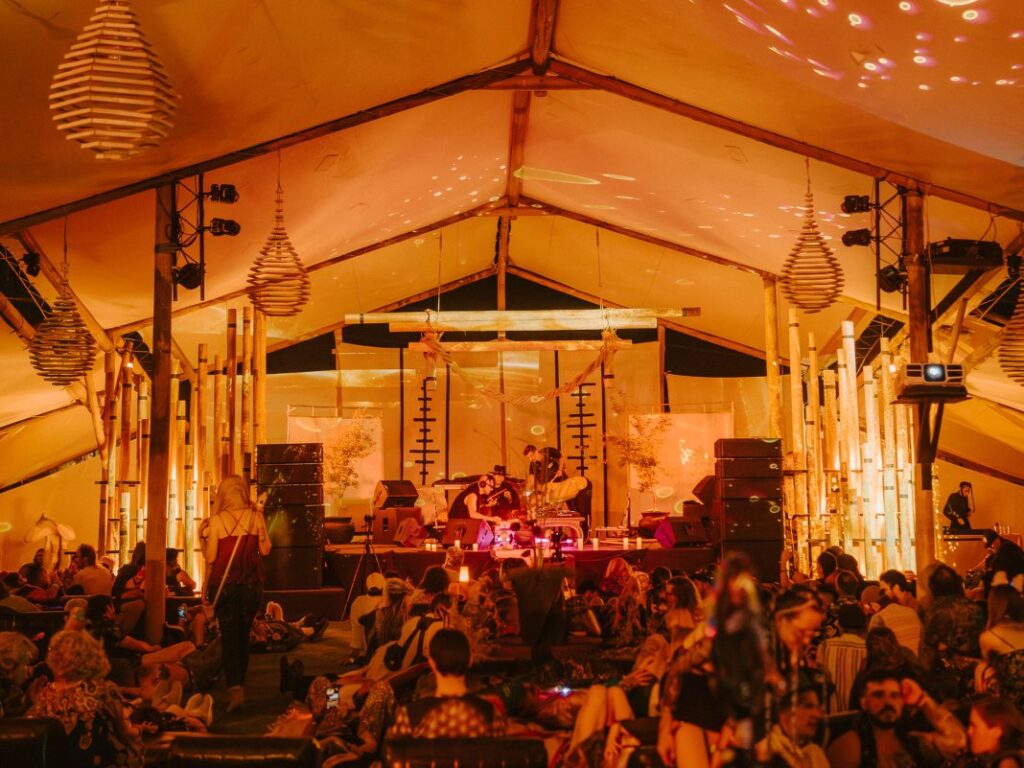
Julianna Barwick was on stage at 2:15 am on 25 May in Bakersfield, California, using a Boss RC-50 Loop Station to layer her vocals inside the Moon Room at Lightning in a Bottle.
The festival added this space this year to host ambient, downtempo, and slower electronic styles. Thousands of attendees face five days of house, techno, drum ‘n’ bass, and dubstep across the main stages. The Moon Room offers a place to step away from that intensity.
Megan Perez-Carpenter, senior producer of music and content at Do LaB, designed the room. She emailed Barwick to ask her to close the weekend, calling it her dream booking. Barwick accepted the challenge.
“It was so earnest and really sweet,” Barwick says. “Her words, saying that she curated the ambient corner of the festival, and it was her dream to have me close it out. I was like, ‘You know what? Why not?’ Why not do something weird that someone’s gonna really love?”
Perez-Carpenter also books the primary stages where headliners like Sara Landry, Mau P, and Chase & Status performed during this sold-out edition. Booking those acts involves ticket sales and commercial factors. For the Moon Room, the only factor was her vision.
Before the event, I checked Spotify for the 16 artists on the list. Only three or four, including Barwick, appeared on streaming services. Perez-Carpenter did not book based on monthly listeners. She knew many of them personally.
Thugfucker has played his minimalist psychedelic 4/4 music at LIB before. Perez-Carpenter asked him to play a Mellow Trip set, which he curates when travelling to Burning Man. She knew artist zz through her radio programme, notes of moss, broadcast on SutroFM, All Day Play FM, and HYDEFM.
“It was very intentional. There were only three or four slots per night. I really wanted to choose the people that I felt passionate about. It was not about moving tickets at all,” Perez-Carpenter explains. “I’ve been booking these main stages for so long. It felt fun to do something creative and different, and also a little bit vulnerable. Do other people have the same taste as me? Are [they] going to like this? It was out of my comfort zone, and I love that.”
I spoke to Perez-Carpenter on Thursday afternoon. The Moon Room had hosted only one set by then, yet she spoke openly about the excitement. Social media announcements received effusive reactions, and the artists she booked were enthusiastic.
Two acts especially inspired the concept: Barwick and the UK artist 1-800 GIRLS.
Barwick was the number one choice to close the festival. Perez-Carpenter saw Barwick perform at Form Arcosanti in 2024, a boutique festival in the Arizona desert. She heard swelling vocals and huge bass frequencies and knew she was perfect for the new stage.
“Experiencing her set from knowing nothing about who she was as an artist, it just cracked me completely open. I was crying. It was such an emotional experience,” Perez-Carpenter says. “I asked her to close the Moon Room because [LIB] is such a big experience, and I really wanted to have a moment at the end where you can have that reflective time..”
Barwick played her set after napping in her trailer for a few hours. She did not bring anyone to tears, but an audience member jumped on stage as she summoned titanic bass from her Nord Electro 4D during the closing track, Inspirit. This had never happened before in her career.
“That guy was having the time of his life,” Barwick says. “I’m really ripping the bass. It shakes the rafters. It shakes every electrical thing. I was really going for it.”
When 1-800 GIRLS, real name Jake Stewart, played his set, summer camp was at its peak. It was Saturday at 10:30 pm, right when the night really kicks off. He had already spent the previous day at the festival, clearing 35,000 steps as he wandered the grounds and got a feel for what he was going to play.
Perez-Carpenter wanted Stewart at the Moon Room because of his Monday night radio show on SWU FM, where he explores softer ambient sounds.
“I always take that opportunity to play the stuff that I wouldn’t necessarily play out in my sets on the weekend,” Stewart explains.
The Moon Room was the first place he ever played ambient music for a live audience. When I was lying there during his set, inches from the front subwoofer, it was clear he was well-versed in the style. Like Barwick, it was an opportunity for experimentation. He played drone, classical music, and anything else that provided respite for a supine audience.
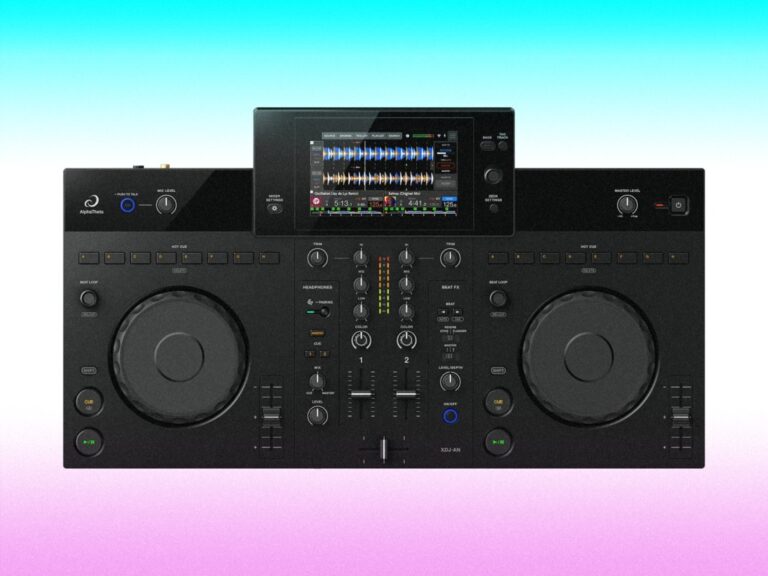
Stewart only had CDJs onstage, but the nature of the music clashed with the natural DJ instinct to focus on concrete elements such as BPM.
“Piecing it together was the most difficult part. In terms of BPM, ambient songs can be anything from like 60 to 110, but there’s no real beat to it,” Stewart says. Without tempo as a standard guideline, the set became about mood, texture, and timbre. “Moving through organic into more electronic stuff was a transition I felt throughout the set. Doing 15 to 20 minutes of more spaced-out strings and pianos into arpeggiated ambient.”
Reverb and echo effects took on a new importance, adding the spacious quality to more refined tracks while carrying different textures between transitions. He also did loop manipulations to sustain moments that he felt fit the environment.
“I listen to a lot of music, and sometimes I don’t necessarily like the drop. Sometimes, the melodic part of the song speaks more to me,” Stewart says. “There were certain songs that were really pretty at the beginning. I’d find something else in key, loop that, build the suspension, and then bring it back.”
Stewart did not get anyone jumping on stage as he was DJing, but at one point, he looked out to see what he described as a shaman helping members of the crowd with breathing exercises. While the music at the Moon Room was intended to be softer than the majority of the programming, for Perez-Carpenter, it was less about being strictly ambient than providing a safe space for people to do what they needed to do in the moment.
“The 2am to 4 am slot is going to be a little different each night. It’s less ambient and more downtempo, sexy, sensual, R&B, dub. It might get a little energetic in those hours,” Perez-Carpenter says. “I just made sure that people can move their bodies if they want, but this isn’t a dancefloor-oriented space. I hope people feel the music and want to move and do whatever they need to do.”
Personally, at a moment where I needed a break from Sara Landry’s gut-bursting hard techno, I went to the Moon Room, wrapped my pashmina around my face, and performed acupressure on my head. Even though the space wasn’t sonically isolated, and some raging beats still managed to sneak in, the music was perfect. After a few minutes, I was fully energised to do more festival-ing.
Now, in hindsight, Perez-Carpenter is considering how she can use production to create that extra layer of immersion away from the rest of the festival.
“It’s a creative challenge to create an ambient space amidst the noise of the rest of the festival but we are creative folks and we are excited to keep developing the concept.”
Feedback has grown from the enthusiasm she received leading up to the festival.
“Every time I stopped by, the Moon Room was full of people, pretty astounding if you consider that it operated mostly during headliner sets! I saw people enjoying the calmer space, cuddle puddles, rave naps, spontaneous group movement, and even a dancing crab made an appearance. It became a touchstone throughout the week as a place to drop in”
What it means
Artists using loops and effects pedals can find new audiences who prefer texture over tempo. Festival promoters can book niche acts without relying on streaming data. The space allows people to rest without leaving the event grounds.