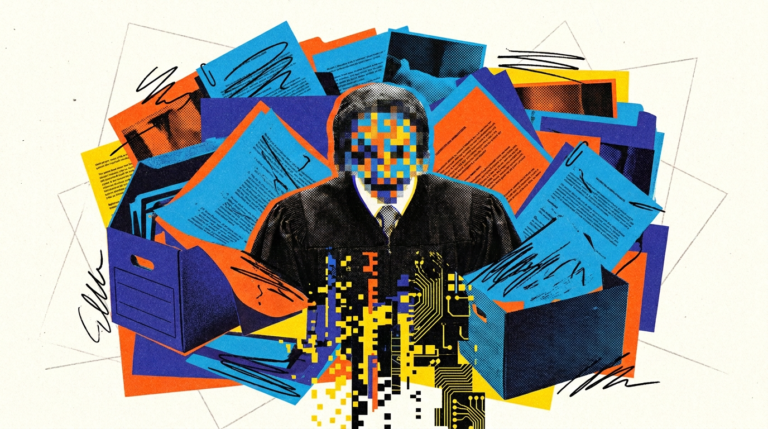
For creators and artists navigating the legal landscape, the rise of AI-assisted litigation means a paradoxical future: your ability to articulate a grievance has never been higher, yet your odds of actually winning remain stubbornly low. While large language models are supercharging the volume of pro se filings, they are not acting as magic wands for justice. Instead, they are creating a new frontier of legal uncertainty where chatbots draft pleadings that sound professional but may contain hallucinated facts, and where courts are scrambling to decide if a conversation with an algorithm deserves the same confidentiality protection as one with a human solicitor.
The flood of self-represented litigants
Across the United States, federal magistrate judges are witnessing a dramatic surge in cases filed by individuals without legal counsel. Judge Maritza Braswell, based in Colorado, has observed a significant uptick in these filings in her chambers. A recent study analysing 4.5 million federal civil cases from 2005 to 2026 reveals that the proportion of lawsuits initiated by self-represented parties rose from 11% in 2022 to 16.8% in 2025. Within that specific subset, the number of filings more than doubled compared to pre-2023 levels.
Braswell attributes this jump directly to artificial intelligence. As a technologically proficient judge who utilises AI tools to review documents, she has developed a keen eye for the distinctive prose of large language models. She can identify AI-generated text through its writing style, as well as through obvious errors like hallucinated case law and fabricated quotes. Paradoxically, she notes that these AI-assisted filings are often better drafted than those written by laypeople attempting to navigate the system alone.
AI supercharges lawsuits
To quantify this trend, researchers Anand Shah from MIT and Joshua Levy from the University of Southern California processed 1,600 randomly selected court documents through Pangram, a commercial AI-text detection tool. Their findings showed that the percentage of documents flagged as containing AI-generated writing skyrocketed from 1% in 2023 to 18% in 2026.
Despite the increased workload for the judiciary, Braswell views this development as largely beneficial for the clarity of the legal process. Traditional pro se documents are notoriously difficult to decipher, often arriving as illegible handwriting that forces judges to decode gibberish just to understand the core argument. With AI assistance, litigants can articulate their positions with greater precision. Braswell finds she can understand the substance of their arguments far more quickly when they have been refined by a model, even if she must remain vigilant against factual errors.
This accessibility has spawned a new ecosystem of online support. Communities are actively sharing guides on how to use AI to initiate legal action. In December 2024, a viral Reddit post detailed a strategy for immigration applicants to sue the United States Citizenship and Immigration Services over delayed reviews. The guide recommended drafting a writ of mandamus with Microsoft Copilot, paying a lawyer a modest fee to polish the document, and filing it in the District of Vermont. Following this guidance, cases filed by individuals without lawyers in Vermont leaped from approximately 45 per year prior to 2022 to over 1,100 in 2024.
However, the study by Shah and Levy confirms that while AI lowers the barrier to entry, it does not improve the outcome. Self-represented litigants remain significantly more likely to lose their cases than those with counsel, a statistic that has not shifted with the advent of AI. As Levy explains, mounting a lawsuit involves complex, multifaceted tasks that extend far beyond merely drafting text.
The privacy paradox of chatbot-client privilege
As AI models step into the shoes of legal advisors, courts are grappling with whether conversations with these tools should be privileged. Judge William Garfinkel, a federal magistrate judge in Connecticut with three decades of experience, is pondering whether interactions with large language models such as Claude, ChatGPT, or Grok should enjoy the same legal protection as client-attorney communications.
The judiciary has issued conflicting rulings on this matter. In February, a federal court in Michigan determined that a self-represented individual’s conversations with ChatGPT to prepare her case constituted work product, shielding them from the opposing side. Conversely, on the same day, a federal court in New York ruled that documents generated by a criminal defendant using Claude were not privileged. The New York court argued that because Claude is not an attorney, the user has no reasonable expectation of confidentiality, noting that AI companies could disclose user data to third parties.
Adding to the confusion, Judge Braswell ruled in March that a self-represented person’s use of a chatbot should remain off-limits regarding privilege. She acknowledged that systems like ChatGPT, Claude, and Gemini collect user data for training, but maintained that this does not eliminate all expectations of privacy. Consequently, the legal landscape remains deeply divided on whether algorithms deserve the same shield as human lawyers.
Malpractice without a pulse
Another critical issue emerging is the concept of liability. Judges are questioning whether a chatbot carries a duty to provide sound legal advice. Judge Allison Goddard, a federal magistrate judge in California, has noted that unrepresented litigants frequently receive detrimental advice from ChatGPT during settlement negotiations. In one instance, a plaintiff who slipped and fell in a store demanded $700,000 from the retailer-a figure vastly exceeding the case’s actual value. When questioned, the plaintiff admitted to consulting ChatGPT for the figure. Goddard corrected the error by explaining the relevant laws and suggesting a lower amount, likening the AI’s performance to “Dr. Google went to law school.”
Furthermore, the question of who bears responsibility when advice goes wrong is sparking litigation. In March, Nippon Life Insurance Company sued OpenAI, alleging that ChatGPT was practicing law without a licence and assisting a woman in reopening a settled lawsuit, thereby flooding the court with frivolous filings. The lawsuit asserted that ChatGPT is not an attorney. OpenAI responded in May by asking the court to dismiss the case, arguing that ChatGPT is not a person and possesses no legal knowledge or skill. The case remains pending.
Simultaneously, state legislatures and Congress are beginning to draft responses. New York introduced a bill in March prohibiting chatbots from impersonating lawyers, even if users are warned they are interacting with an AI. At the federal level, a series of bills have been proposed to ban chatbots from posing as lawyers, doctors, and other licensed professionals, though these measures have yet to gain significant traction.
For now, the trend of individuals turning to AI for legal representation is unlikely to reverse. For many, the empowerment to navigate a complex system outweighs the risks. As Braswell observed, litigants who once mumbled timidly when asked about evidence now answer with confidence, having rehearsed their arguments with a chatbot. While the system remains tough to navigate, AI has made it slightly less so.
Key takeaways
AI adoption among self-represented litigants has surged, with filings by individuals without lawyers more than doubling since 2023, yet these litigants remain far more likely to lose than those with counsel.
Courts are split on legal privilege, with some rulings protecting AI-assisted work product while others deny confidentiality to conversations with large language models due to data privacy concerns.