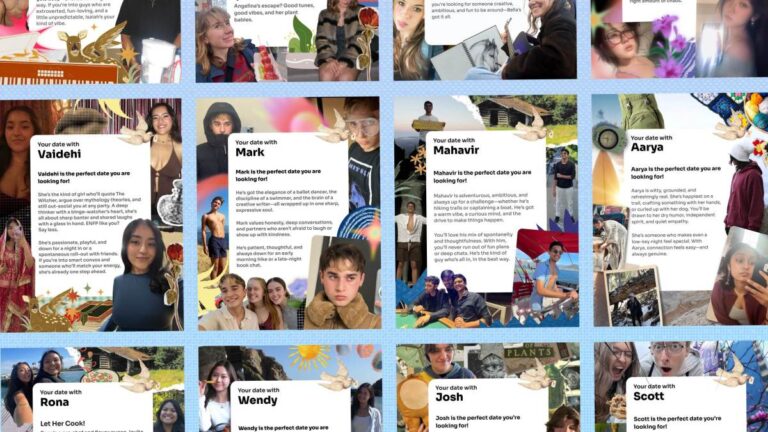
A new dating app for gay men called Goose has launched at number 4 in the App Store’s free lifestyle downloads category, a position it reached within days of release. The app now sits at rank 33 globally in lifestyle downloads.
The promotion relied heavily on a network of male influencers whose profiles appear to be entirely fabricated. Accounts such as @miles.sumrall and @danielmmulugeta posted invitations to a “members only community” on Instagram Close Friends Stories. These posts claimed the service was built specifically for the target audience. The website describes the tool as a place to “meet guys through the life you already have.”
Investigation reveals these accounts are not real people. Both profiles were created in May 2026 and contain fewer than 10 posts. Software analysis determined with greater than 90 percent confidence that their avatars are AI-generated. A separate check by Google Gemini found “most or all” of the profile pictures were created using Google AI.
The app was developed by Derek Chadwick and David Aliagas. It positions itself as a Grindr alternative focused on lasting relationships rather than casual encounters. Skeptics noted the irony immediately, with one user joking on X that “Goose is basically Pokémon Ho.”
Promotional content from these fake influencers likely drove the initial download surge. Screenshots shared on X by user @pspthe2nd showed that the app “use[s] AI models to promote fake interest #goose.” The accounts appear to be part of a larger network of handsome, seemingly artificial male figures promoting the service. They reached out to gay men via direct message or added them to exclusive story circles.
Ryan Cheam, an account executive in marketing and public relations, noticed a strange new Instagram account named @alistaircrombbie about a week ago. The bio claimed the user worked in PR at a well-known art gallery. Cheam initially thought he was just a normal gay guy. Suspicion grew after Alistair sent a direct message inviting him to join a “curated network of guys” at Goose. A SynthID check confirmed that “most or all” of Alistair’s profile photo was generated using Google AI.
WIRED identified more than two dozen similar accounts, all created in May or June 2026. They featured only a few posts, a typical sign of inauthentic profiles. Many of these accounts frequently commented on each other’s photos, often using the same heart and fire emojis.
The accounts often followed potential members to add them to Close Friends Stories. Sometimes they sent direct messages directly. Dalton Bauer, who works in marketing, received a message from a user named @lucalepkowski. The text began, “Hey! Okay this might feel random but felt you’d be interested :),” before inviting Bauer to the Goose community. The language matched exactly what Cheam received from Alistair.
Bauer noted this was the third such direct message he received that week, all using identical phrasing from brand-new accounts. “This is the first time I’ve seen this on Instagram, and at this scale,” he said. “I think someone needs to shed light on this as it’s shady and deceiving.”
The @lucalepkowski account was created in May 2026. Analysis using the AI Image Detector software found the profile image—an 80 percent likely artificial generation of a college-aged man in khaki shorts on a beach—was generated. Further analysis by Google Gemini determined at least part of the photo “was edited or generated with Google AI.”
Derek Chadwick did not respond to requests for comment. Neither did anyone else from Goose. However, co-founder David Aliagas advertised multiple job listings for “ambassadors” to manage unspecified social media accounts on his Instagram Stories.
An Instagram story Aliagas posted six weeks ago asked for help with his new app. He offered priority access to “OGs” for an “ambassador role.” The job required managing three Instagram accounts for four hours a day over two-plus months, with rates ranging from $1,800 to $2,100 a month. The post noted that “Familiarity with gay culture is a big +.” It ended with, “Time to monetize ur traumas :),” before adding, “And btw, still buying finstas [fake Instagram accounts] for $100 :).”
Aliagas posted another call for applicants three weeks ago, asking for a three-month commitment and stating, “We are going big :-).” Both Stories remain in his Instagram Story highlights under the title “AMBASSADORS.”
It is not unusual for brands and developers to use AI-generated influencers to promote products surreptitiously. A recent Guardian investigation quoted a former celebrity manager who estimated that “40 percent to 60 percent of the content out there from some of the big brands” is artificially generated, most of which is not publicly identified as such.
That does not make the practice aboveboard, says Rob Freund, an advertising and ecommerce attorney. The US Federal Trade Commission has guidelines prohibiting deceptive advertising, such as brands using AI to impersonate real individuals. New York recently enacted a law requiring advertisers to disclose if their content is AI-generated. Companies face an initial $1,000 fine if they fail to do so.
“If you are creating fake accounts for people who promote a product and explicitly creating a bunch of fake accounts that look like they are users of a product or a service to drive attention or sales to that product or service, that activity is very obviously unlawful under FTC guidelines,” Freund said. He stressed this remains the case regardless of whether the app is free. An FTC spokesperson declined to comment on specific company practices.
Meta, which owns Instagram and declined to comment, requires users to label content as artificially generated and will remove posts that are not correctly identified. The private nature of this marketing campaign in direct messages and Close Friends Stories may make regulation difficult. Incorrectly labeled AI-generated content often escapes detection, allowing users to believe accounts like @miles.sumrall’s and @lucalepkowski’s are the real deal.
Some people clearly saw through the ruse. “On one hand I’m flattered that I’m their target audience,” Cheam said. “But the need to essentially bait gay guys into signing up feels really sketchy.”
What it means
The campaign highlights a gap between platform rules and how marketing teams operate. While Meta demands public labeling of AI content, the strategy here relied on private direct messages and exclusive story circles to bypass detection. This makes enforcement harder and leaves users vulnerable to deceptive tactics that mimic genuine community recommendations.