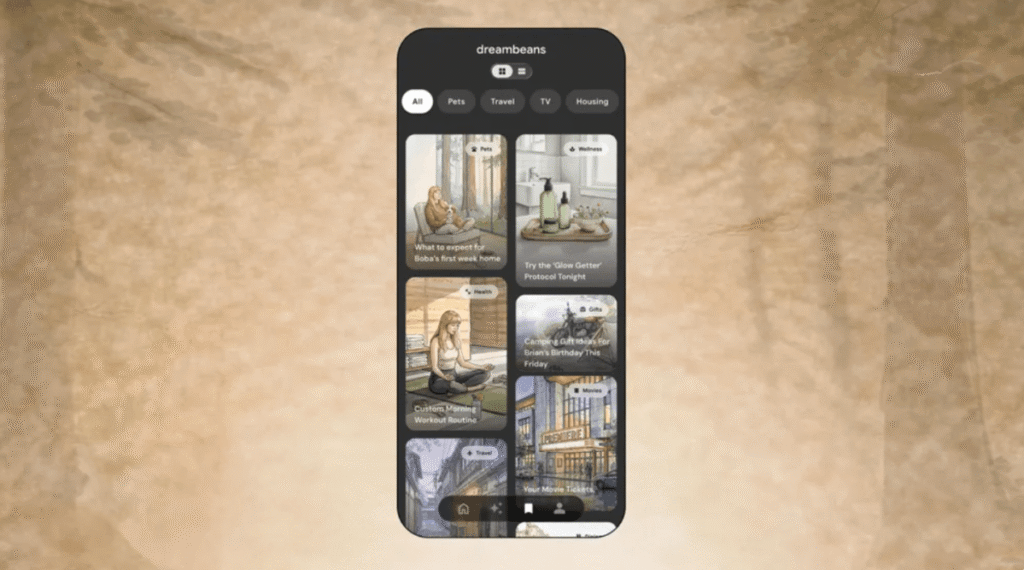
For the independent maker or artist tired of algorithmic noise, Google’s latest experimental tool offers a quiet alternative: it doesn’t just consume your attention, it attempts to curate your reality. Launched by Google Labs, the experimental product design team, this new iOS and Android application, dubbed Dreambeans, promises to literally animate your daily life by transforming raw data into illustrated narratives.
Why the peculiar moniker? The answer lies in the mechanics of its operation. Gozde Oznur, the product lead responsible for the project, explains that the name reflects a dual process of nocturnal processing and morning inspiration.
From Data to Illustrated Stories
The core function of Dreambeans is to synthesise information harvested from a user’s various Google services into a curated collection of AI-generated stories. These are not generic suggestions, but rather lifestyle recommendations tailored to the individual. Oznur describes them as “places to visit, topics to explore, things to try, upcoming trips, events that you should be aware of.”
With explicit permission, the tool leverages Personal Intelligence to link data points from Gmail, Calendar, Photos, YouTube, and Search History. The output is a finite set of daily stories designed to spark new ideas. Examples include geographical recommendations for a new local coffee shop or, as demonstrated in the marketing video, contextual advice for a new dog owner whose arrival was logged in the calendar. Other stories may simply be web-curated news articles aligned with past interests.
An Antidote to Doomscrolling
Crucially, the application is engineered as a countermeasure to excessive phone usage. To prevent the user from becoming another data point, Dreambeans serves only a limited number of stories per day, typically between 10 and 14. The philosophy is to provide a handful of inspirational prompts and then encourage the user to step away and live their life.
This approach mirrors a growing trend among companies seeking to court users weary of digital addiction. It stands in contrast to models that feed an endless stream of content, instead offering a concentrated “drop of inspiration” before the user returns to their day.
Privacy and Access
Regarding security, Oznur asserts that protections are robust. Access to the generated stories is restricted solely to the user. Furthermore, individuals retain full control over their data, able to delete it at any time and select which specific Google services are connected to the tool.
The nomenclature itself is rooted in this cycle of rest and creation. “The dream part is literal, because while you sleep, the app is working through everything across your connected apps, because, as you can imagine, it’s a lot of data that it is distilling,” Oznur noted. “The beans part is about how you kind of start your day with a freshly brewed cup of coffee. It has processed everything overnight and hands you a concentrated drop of inspiration in the morning.”
Currently, Dreambeans is accessible only to eligible subscribers of Google AI Ultra on Android and iOS within the United States. A waitlist remains open for users holding a standard personal Google account.
Key takeaways
- Dreambeans transforms personal Google data into a daily limit of 10 to 14 AI-illustrated lifestyle stories, acting as a deliberate antidote to doomscrolling.
- The tool operates on a “sleep and brew” model, processing data overnight to deliver concentrated inspiration in the morning rather than constant consumption.
- Privacy is central to the design, with users retaining full control over data deletion and the specific Google services connected to the app.