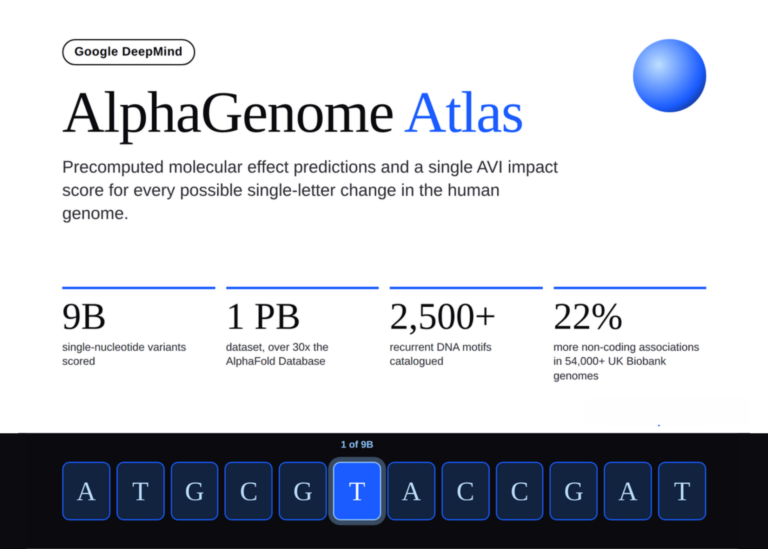
Google DeepMind has released AlphaGenome 2, a DNA analysis model that predicts how genetic variants affect function within specific cell types. The system takes a 1 Mb DNA window and a target cell state to generate outputs. Its predecessor averaged data across bulk tissues, whereas this version resolves closely related cell types and adapts to unseen single-cell datasets without fine-tuning. It is available through the AlphaGenome API for non-commercial research.
Technical specifications and performance
The input consists of a 1 Mb DNA window, covering human or mouse sequences. The model currently runs on a hosted API. Training consumed 2048 TPU v4 chips, and weights will be released upon final publication.
On single-cell eQTL and enhancer-gene benchmarks, the new model outperforms fine-tuned AlphaGenome 1, Borzoi and Scooby. At 90% sign accuracy on TenK10K sc-eQTLs, AlphaGenome 2 achieved 43% recall, compared to 23% for the fine-tuned version of AlphaGenome 1.
Performance drops outside accessible chromatin. In those regions, sign prediction AUROC reaches only 0.63.
Outputs cover RNA coverage, CAGE, splicing, chromatin accessibility, histone marks, TF binding and contact maps. CpG methylation is a new addition.
Model architecture and training
AlphaGenome 2 uses a U-Net style structure with a convolutional encoder, an 11-block transformer and a decoder. Unlike AlphaGenome 1, which predicted a fixed catalog of thousands of tracks in parallel, this model predicts outputs for one condition per call.
The condition is a 256-dimensional embedding. It modulates activations through FiLM layers in the encoder, transformer and decoder. Conditioning only the decoder or output layers gave minimal gains. Conditioning the encoder and transformer drove most of the improvement.
Training runs in four stages:
- Pre-training across bulk data plus 3,977 single-cell RNA and ATAC pseudobulk tracks from 36 studies.
- Condition refinement, which tunes only the embeddings and FiLM layers.
- Distillation of eight teacher models into one student, using mutated input sequences.
- Post-training that maps a single-cell expression encoder into the frozen model’s condition space.
That encoder was trained on over 100 million human scRNA-seq profiles, largely from CELLxGENE. Researchers can pass raw counts and get a condition embedding. The documentation allows up to 256 cells per call.
Benchmark results
On GTEx tissues, median Pearson r for cross-tissue expression changes rose from 0.61 to 0.71. Within tissues, explained cell-type variance rose from 23% to 34% for scRNA-seq.
The main result is on TenK10K single-cell eQTLs across 28 immune cell types. At 90% precision, AlphaGenome 2 recovered 30% of causal variants. AlphaGenome 1 fine-tuned on single-cell data recovered 16%. Direction-of-effect recall rose from 23% to 43%.
On held-out ENCODE-rE2G CRISPRi data, enhancer-gene AUPRC reached 0.78. AlphaGenome 1 scored 0.73, while a Borzoi ensemble scored 0.61. The gap was widest for enhancers 100 to 2,500 kb away: 0.62 versus 0.48.
For assay imputation, AlphaGenome 2 beat the Avocado baseline on 166 of 181 held-out tracks. On an unseen Parkinson’s cohort, it reached 41% recall versus 17% for cohort-tuned Scooby.
Comparison with other DNA sequence models
The table below compares features across AlphaGenome 2, AlphaGenome 1, Borzoi and Scooby.
AlphaGenome 2 vs others
| Feature | AlphaGenome 2 | AlphaGenome 1 | Borzoi | Scooby |
|---|---|---|---|---|
| Input DNA | 1 Mb | 1 Mb | 524 kb | 524 kb |
| Condition handling | Reference or scRNA-seq embedding | Fixed multitask tracks | Fixed multitask tracks | Cell-embedding decoder, per dataset |
| Single-cell outputs | scRNA, scATAC | No | No | scRNA, scATAC |
| Parameters | Not disclosed | Not disclosed | 235M | Not disclosed |
| Hardware | Hosted API | H100 recommended | Not disclosed | NVIDIA GPU (tested on A40) |
| Weights / license | API now, weights later, non-commercial | Kaggle and HF, non-commercial terms | Apache-2.0 | MIT |
| TenK10K sc-eQTL causality AUPRC* | 0.76 | 0.72 (fine-tuned) | Not evaluated | 0.69 |
| TenK10K sc-eQTL sign AUC* | 0.85 | 0.79 (fine-tuned) | Not evaluated | 0.77 |
| rE2G held-out CRISPRi AUPRC* | 0.78 | 0.73 | 0.61 (4-model ensemble) | Not evaluated |
*Benchmark rows come from the AlphaGenome 2 paper and are DeepMind’s own evaluation.
Developer access and resources
AlphaGenome 2 and Colab tutorials are live through the API. An API key is free for non-commercial use. Commercial research is in private preview. The alphagenome Python package exposes the model under alphagenome.models.v2.
DeepMind also released precomputed atlases. One covers enhancer-gene links across 640 primary cell conditions. Another scores about 7 million common and GWAS variants across 510 conditions. Both are on the downloads page.
What it means
Researchers can now define new cell states by passing raw scRNA-seq counts without retraining the model. The system handles up to 256 cells per call via the hosted API. Access remains non-commercial for the time being.