Z.ai has released GLM-5.4, its first model built on a loop transformer architecture.
The lab describes the change this way:
In a standard Transformer, each layer runs once per forward pass. In a Loop Transformer, a group of weight-shared layers runs for multiple iterations, refining the hidden states from the previous pass. This gives us a deeper network without increasing the parameter count.
This is the second instance of a looped transformer I have encountered in the last week. The first appeared on November 20th with Inkling 2 Mini from Thinking Machines Lab, which runs its middle layers three times for every token to improve reasoning quality on coding tasks.
GLM-5.4 is not yet available as open weights. I accessed it via the Z.ai API after signing up for their Coding Plan subscription, as the model is not available through the standard interface.
Both the coding plan and regular API use the same OpenAI-compatible Responses API endpoint. The API key from the coding plan worked for that endpoint and granted access to the new model.
I created an llm-glm plugin but discovered that llm-zai by Tommy Hughes already exists. I published mine because llm-zai did not yet support the new model, though I will likely retire it once the plugin is updated.
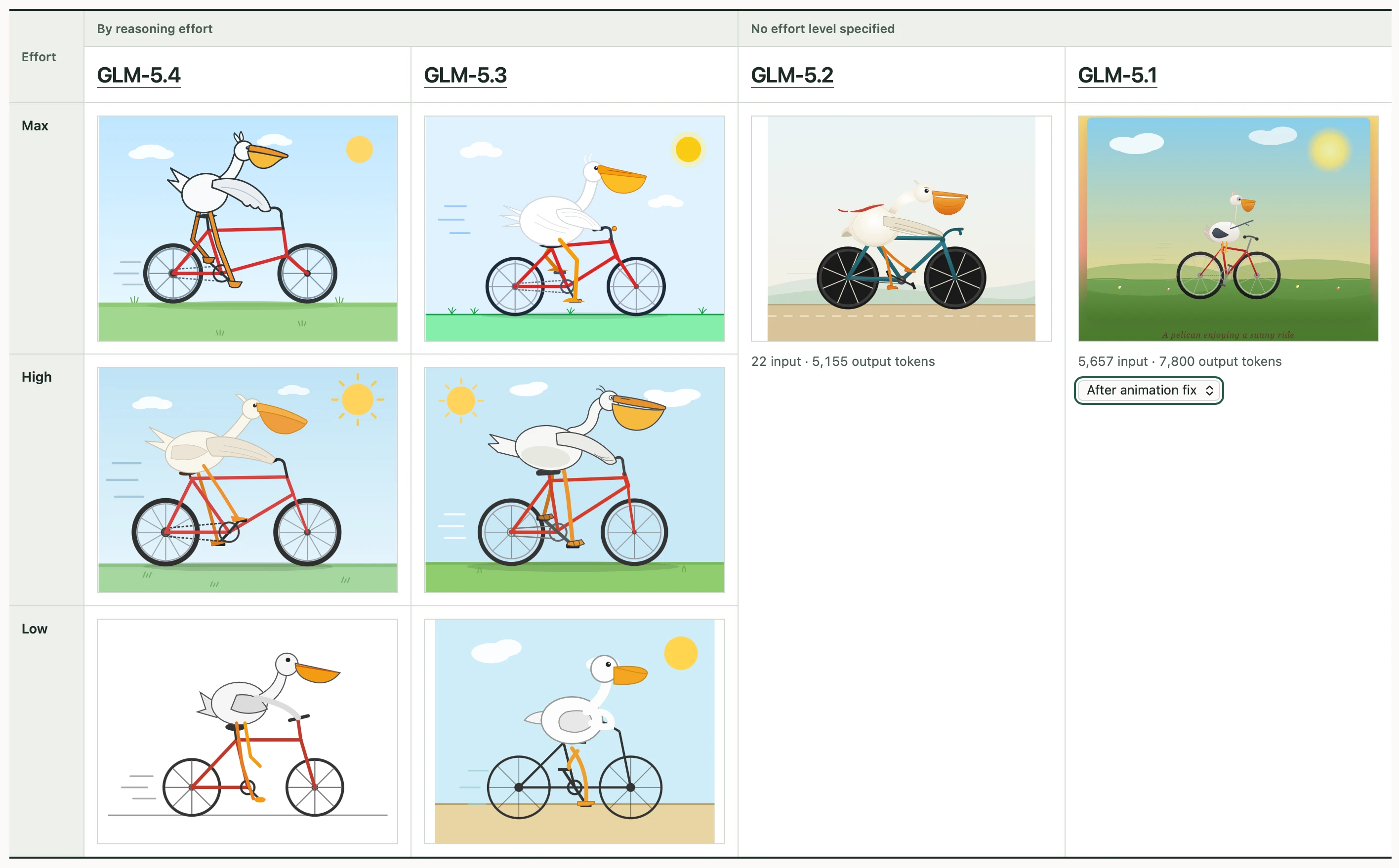
Here are pelicans for GLM-5.4 on low, high, and max settings. This is the max result:

I had not run pelicans for GLM-5.3 previously, so here are those results for the same effort levels. They look similar in quality to 5.4.
It is interesting how GLM 5.1 and GLM 5.2 produced radically different pelicans from other models. The pelicans for 5.3 and 5.4 are much more comparable to those I get from OpenAI or Anthropic models – the previous generations had their own distinctive look.
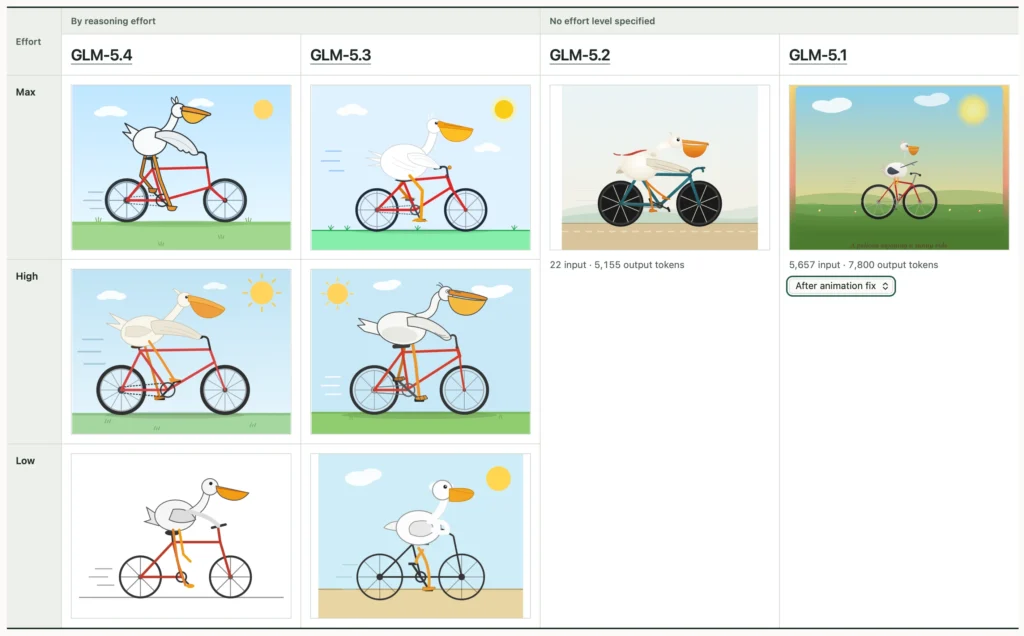
I made a comparison grid showing the four generations of GLM pelicans all in one place. The style transition between 5.2 and 5.3 is pretty stark.