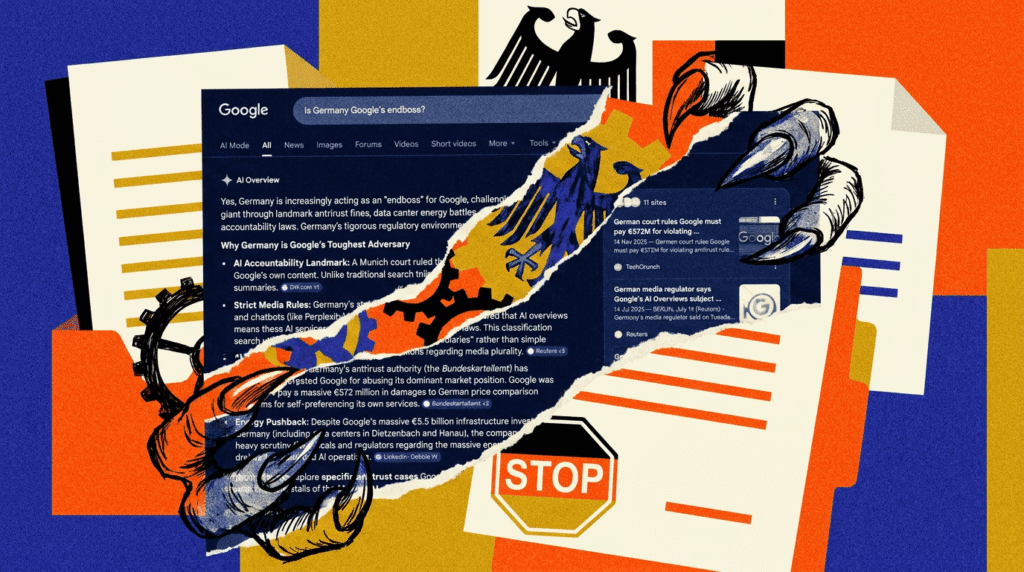
German media regulators have issued their first rulings against Google and Perplexity, classifying their AI search engines and chatbots as content providers under the State Media Treaty.
Why AI tools face new rules
The Commission for Licensing and Supervision (ZAK) argues that the liability exemption under the Digital Services Act does not apply to AI-generated outputs. These outputs are treated as independently created content rather than redistributed third-party material.
“AI search engines and chatbots are content providers, and we are now consistently applying German media law to them,” said ZAK Chairman Dr. Thorsten Schmiege.
A Munich court reached a similar conclusion earlier this year. It treated AI-generated text as independent content containing “independent, new, and substantive statements” produced by analyzing and combining material from various third-party sites. Google was held liable for false claims in that case and says it will appeal.
Google now faces action under media law on top of civil liability. The rulings formally find that the companies violated Section 109 of the State Media Treaty and are immediately enforceable. Both Google and Perplexity have one month to appeal.
Google’s AI answers allegedly bury traditional search links
Regulators accuse Google of failing to meet transparency rules and violating rules against discrimination. Google’s AI summaries get prime placement above search results, pushing down traditional links, especially those to journalistic sources.
Regulators say this amounts to prohibited discrimination because the AI responses are Google’s own content, not neutral search results.
But link visibility likely isn’t the only problem. Studies show that users rarely click source links once they feel their question has been answered. Moving those links higher is unlikely to change that. Google says the studies are flawed but hasn’t released data showing otherwise.
In Perplexity’s case, regulators have so far only flagged the company’s lack of a designated representative in Germany and missing transparency disclosures. The same concerns should apply in theory because the services work much the same way, though Google’s reach is far greater.
Source links put AI chatbots under the same rules as search engines
Regulators also see AI services acting as intermediaries. When a chatbot includes third-party content as sources or in link lists, it shapes whether users can find that content. That meets the bar for a media intermediary, regulators say, and triggers transparency rules meant to protect media diversity.
“Anyone who controls whether content gets found through the selection and placement of links must make that transparent. Otherwise, diversity among journalistic and editorial outlets will disappear,” Schmiege said.
A related legal opinion by Professors Jan Oster and Christoph Busch supports the regulators’ view. Adding AI to search engines changes how people find information. Instead of a list of linked results, users get a single prose answer. That cuts traffic to original sources and puts journalism’s funding at risk, the authors say. They recommend creating a separate category for AI search engines under state media law, with rules to protect media diversity.
Google has prepared for this in several ways, including rolling out its “Preferred Sources” feature. It is a fig leaf that lets the company argue in court that users can choose which sources appear. Few users are likely to maintain a custom source list, even as publishers line up to promote the feature. For Google, that amounts to a free pass to replace original sources in AI responses with providers that can’t or won’t fight back in court.
What it means
For people making content, the change is simple: AI summaries are no longer treated as neutral tools. They are now subject to the same transparency and diversity rules as traditional media. If an AI service hides or de-prioritises certain sources without clear justification, it risks legal action. Publishers can expect AI platforms to be held accountable for how they present links and information.