£1,900, focusrite.com
For creators and producers working in the studio, the new ISA C8X represents a significant leap forward in hybrid workflow capabilities. It merges the tactile control of classic hardware with the connectivity of modern digital interfaces, specifically designed to streamline the path from microphone to mix. While the price tag is steep, the unit offers a level of flexibility for multi-room setups and post-production environments that pure digital interfaces often struggle to match.
The story behind this lineage is well known: the original ISA 110 module was born from Sir George Martin’s search for superior preamplification and equalisation for AIR Studios. He selected the fledgling company founded by Rupert Neve, a decision that cemented Focusrite’s reputation. That legacy of transformer-coupled design is now the core of this new flagship interface.
Focusrite has now brought this heritage into the realm of comprehensive audio interfaces, combining its renowned preamp circuitry with the robust input/output counts found in its Scarlett and Clarett lines.

What inputs and outputs does the Focusrite ISA C8X provide?
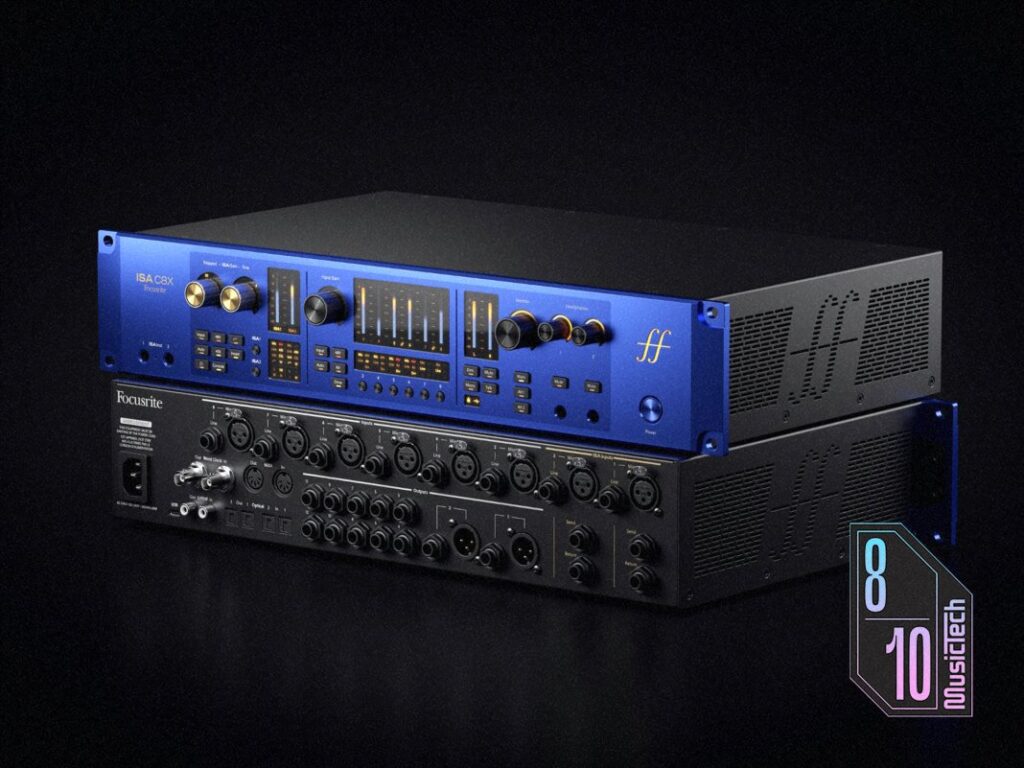
Visually, the unit departs from the familiar red aesthetics of the Scarlett range. The rackmount 2U chassis features a deep blue anodised front panel, richly detailed with physical controls, meters, and a soft amber backlighting that mimics the glow of vacuum tubes. This design choice creates a striking contrast between the sharp, modern lines of the fascia and the warm, retro-inspired illumination.

Internally, the connectivity is substantial. All eight analogue mic and line inputs accept both XLR and balanced jack connections on the rear panel, allowing users to switch between them via the front controls or the Focusrite Control 2 software. The first two channels additionally support high-impedance instruments via front-facing jacks, situated next to a hidden talkback microphone.
The extensive output section offers considerable routing flexibility. Six internal mixes can be assigned to any of the three monitor groups, which can be configured from two-channel stereo up to 7.1.4 surround sound. These groups are adjustable via the front panel or software. A standout feature is the ability to include output pairs in multiple groups simultaneously; for instance, the main stereo monitors can also serve as the front left and right channels within a surround configuration.
Digital expansion is handled through one pair of coaxial connectors and two pairs of optical inputs and outputs. Depending on the sample rate and port configuration, the unit supports up to 16 digital channels at 44.1 kHz and 48 kHz. Integration with other equipment is facilitated by word clock BNC connectors and a pair of traditional MIDI DIN ports located on the rear panel.

Come on, tell us about these illustrious preamps!
It is worth noting that only the first two channels utilise the legendary ISA preamps. The remaining six channels employ the same preamplifier found in the fourth-generation Scarlett interfaces. While this may disappoint some purists, it keeps the price accessible; equipping all eight channels with ISA circuitry would likely push the cost to the £5,000 mark. Furthermore, Focusrite sells digital output boards for standalone ISA units, allowing users to expand their ISA channel count by integrating separate hardware.
The non-ISA channels, which Focusrite terms ‘modern-style’ preamps, offer a clean and balanced sound with 69dB of gain. They include an Air mode presence peak and a variable Drive setting to emulate a console-like character.
However, the sonic difference between the ‘modern-style’ and ISA preamps is stark. The ISA channels use genuine Lundahl LL1538 transformers, delivering the warmth and character of the original designs. The low end is rich and balanced, the midrange is detailed and defined, and the high frequencies sparkle without becoming harsh. To ensure perfect tonal matching, four input impedance options are available (1.4kΩ, 800Ω, 2.4kΩ, and 7kΩ). The instrument inputs also switch between 400kΩ and 1.2MΩ to tailor the sound from warmer to brighter.
Two additional analogue circuits can be engaged on the ISA channels. The 430 Air option activates an inductor-based high shelf from the ISA 430 MkII, boosting presence and high-frequency detail. The Console mode introduces a soft clipping circuit to emulate the pleasing overdrive of the original ISA 110 output transformer. While the C8X’s implementation is effective, a genuine trim-controlled output transformer would have been a welcome addition.
Both channel types feature 75 Hz, 18dB/octave high-pass filters to remove rumble. Perhaps the most useful addition is the fully balanced insert points, allowing outboard processors to be patched in before the signal reaches the digital converters.

Is the ISA C8X easy to use?
Basic configuration for all input channels, monitor control, group switching, and headphone volume can be managed directly on the front panel. More advanced tasks, such as setting up the six internal monitor mixes, require the Focusrite Control 2 software, which can be operated remotely via the FC2 app on iOS or Android devices.
The unit includes an auto-gain system that analyses a few seconds of input to set channel levels automatically. However, this system tends to be conservative. For the best results, manual gain staging is recommended, though the auto-gain feature may prove useful for specific scenarios like recording a drummer alone. Note that this function currently applies only to mic and instrument inputs, not line inputs.

Do those ISA pres make C8X worth the money?
The ISA preamps are undoubtedly the primary draw, offering an exceptional sound that justifies their presence. However, the value proposition extends beyond those two channels. The remaining six inputs are competent, and the unit is packed with professional features suitable for its price point.
The ISA C8X is priced affordably enough for home studios while possessing the expandability and robust routing to serve as the central hub for larger facilities. Ultimately, its ability to blend classic sonic character with modern convenience, coupled with its distinctive design, makes it a compelling choice.
Key Features
- USB 2.0 audio interface
- 2 analogue mic/line/instrument inputs equipped with genuine ISA preamps, 430 Air circuit, soft clipping circuit, high pass filter and balanced insert points
- Switchable impedance for ISA preamp mic and instrument inputs
- 6 analogue mic/line inputs equipped with Scarlett-style preamps featuring Air and Drive
- 12 analogue balanced line outputs
- 2 independent headphone outputs
- 2 optical I/O pairs supporting ADAT/SMUX and S/PDIF
- 1 coaxial I/O pair for S/PDIF
- Up to 16 channels of digital I/O at 44.1 kHz/48 kHz (reducing to 8 channels at 88.4 kHz/96 kHz; no ADAT I/O above 96 kHz)
- Word clock in/out via BNC
- MIDI in/out via standard 5-pin DIN
- USB-C socket (USB-C to USB-C cable provided)Source Read original →